
The Used RS6 That Now Costs Less Than A 2014 Corolla
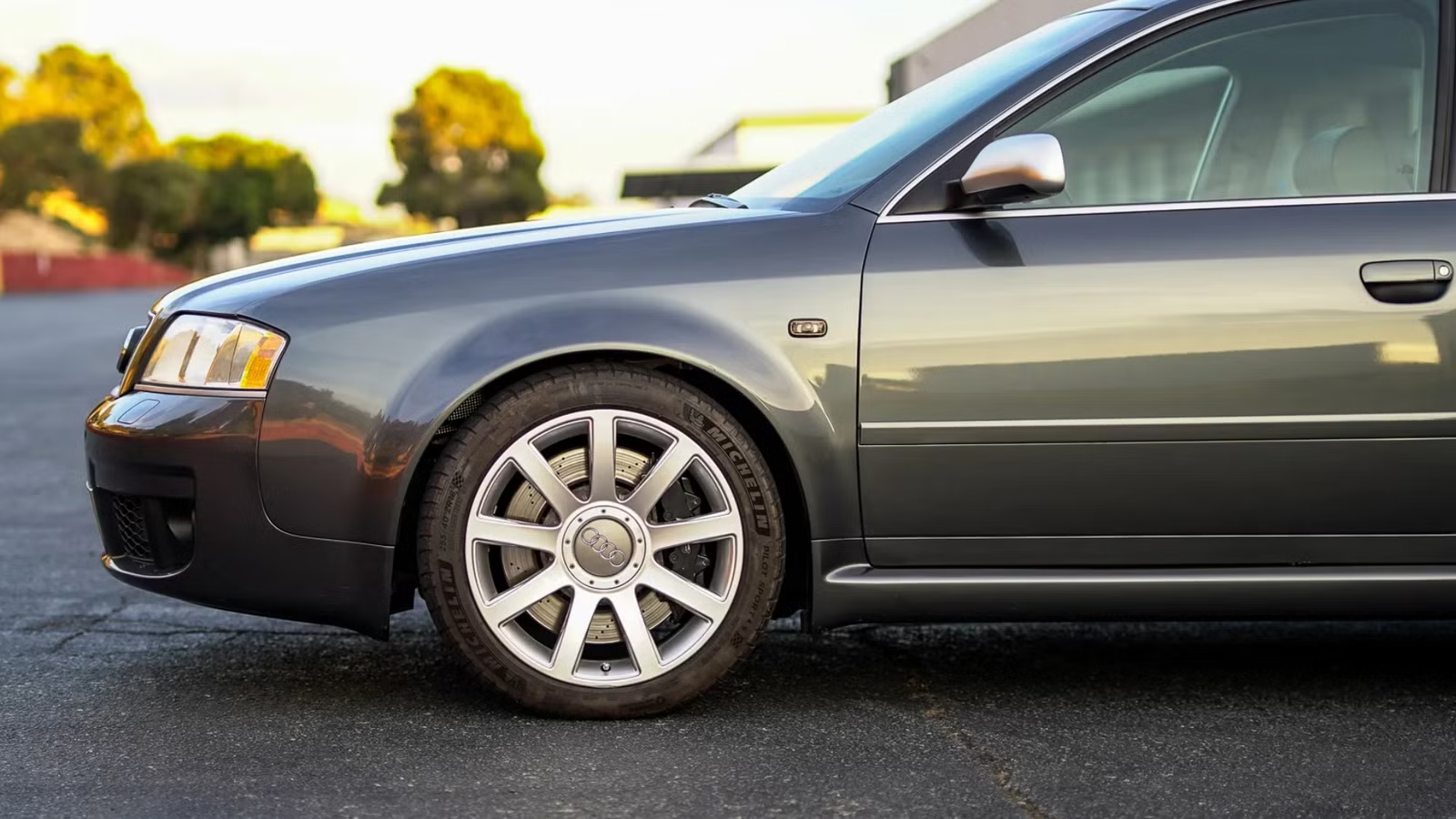
If you look at Kelley Blue Book right now, a 2014 Toyota Corolla has a Fair Purchase Price of roughly $9,750 to $11,800, depending on trim. That is a reasonable price for a sensible vehicle if you want basic transportation, modest operating costs, and inexpensive parts. However, there is a 2000s-era German sedan that you could also purchase for roughly the same money, and it has a twin-turbo V-8 producing 450 horsepower, was sold for a single model year, and has fewer than 1,500 examples in the U.S. So, if this sports sedan is such a good deal, why aren’t more people buying it? Well, there is a very good reason that this particular German four-door has become so cheap.
A $10,000 Used Car Doesn’t Usually Come With This Much Risk

Most people shopping for cars in the $10,000 price range are looking for inexpensive transportation, not a 450-horsepower performance sedan. Yet, this German sedan creates an unusual situation where its purchase price tells one story while its ownership reality is something completely different.
Why The $10,000 Toyota Corolla Is The Rational Choice — And This Article’s Baseline

The Toyota Corolla is the perfect benchmark car for a variety of reasons, and you can currently find the 2014 model year for roughly $9,750 to $11,800, depending on trim. With a simple four-cylinder powertrain and as conventional a drivetrain as possible, the 2014 Corolla is built for a seamless and carefree ownership experience. No matter where you take your 2014 Corolla, an independent mechanic will be able to work on it confidently, which is a huge plus in itself. For all intents and purposes, the Corolla is reasonable. It is simply a financial proposition that makes sense, and for about $10,000, you won’t find another car that offers the same level of value.
This Other Sedan Has A Very Different Reason For Being This Cheap

So, when we say you can get a 450-horsepower, twin-turbo V-8-powered German sedan with all-wheel drive, a five-speed automatic, low production volume, and only one model year ever produced for the U.S. market for the same price as that humble Corolla, you may be wondering why a car with that level of capability is priced that way. Consider the fact that a2027 BMW M340i Sedan only produces 386 horsepower and has a starting price of $62,300, while one of its spiritual predecessors produces more power despite being decades older. You would think that this extremely rare, high-performance sedan would cost considerably more given its rarity and performance, but it is still available for around the same money as the 2014 Corolla.

The 2003 Audi RS6 Is The Rare V-8 Sedan Hiding At The Bottom Of The Market

The mystery car in question is none other than Audi’s first RS6 model ever sold in America, and its extremely brief U.S. production run makes its current asking prices even more intriguing. The problem is that all the things that make this Audi performance sedan so good to drive are also the things that make it considerably more expensive to keep on the road than its market value would suggest.
Audi Sold The C5 RS6 In America For Just One Model Year

In 2003, Audi introduced the C5-generation RS6 stateside for a single model year. During that time, fewer than 1,500 examples were sold, and sadly, we never got the Avant variant, only the sedan. When it was new, the RS6 meant business with its 4.2-liter twin-turbocharged V-8 producing 450 horsepower, paired with a five-speed Tiptronic automatic transmission that drove all four wheels via Quattro all-wheel drive.

This powertrain gave the RS6 an approximately 4.6-second 0-to-60 mph time, making it Audi’s direct answer to sport sedans like the BMW E39 M5. However, unlike the E39 M5, there was no manual transmission option because, at the time, Audi didn’t have a viable transmission that could handle the power output of this twin-turbo engine. However, this detail would become one of the biggest complaints about the platform because, in the end, it would affect its enthusiast appeal and, therefore, its long-term value as a collector car.
Its Rarity Hasn’t Translated Into Collector-Car Money

That is why, despite only 1,500 or fewer units being produced, the Kelley Blue Book Fair Purchase Price on a 2003 Audi RS6 is only $9,500, with the Classic.com one-year average being $18,818 across 11 confirmed sales. As you can see, there is a considerable gap between the two valuation methodologies, demonstrating that its market value can vary significantly depending on the source and type of transaction being measured.

Even with the Classic.com average being about twice that of the Kelley Blue Book Fair Purchase Price, it is still remarkably low considering the fact that the RS6 was only produced for one year and has production numbers that would normally make it an obvious candidate for collector-car status, along with legitimate pedigree and performance capability.
Yet, if there is any lesson to be learned here, it is that rarity alone doesn’t automatically translate to collectible value. Compared directly with the E39 M5, the M5 has continued to climb in value over the years because of its manual transmission availability, a stronger enthusiast following, and a relatively simpler ownership proposition. The RS6 is not without collector potential; it is just that the cost and risk associated with ownership have not been enough to drive its value in line with its rarity.
Keeping A $10,000 RS6 Alive Can Cost As Much As The Car

The C5 RS6 is an exceptional driver’s car when everything is in order and it is in peak condition. The issues arise because many of its most important maintenance jobs are expensive, labor-intensive, specialized, and unavoidable.
A Timing Belt Service Can Cost Thousands Of Dollars

On a 2003 RS6, a simple timing belt service—there is no such thing as a simple timing belt service on a 2003 RS6. The recommended service interval for this maintenance item is about 35,000 miles, and because of the twin-turbo V-8’s massive size and the tight constraints of the engine bay, you will be lucky to leave an independent specialist with less than a $4,000 bill. Deferring this maintenance item is a significantly worse decision that, in the worst cases, can guarantee catastrophic engine failure.
One 2003 RS6 ownership account from the Audi subreddit paints a clear picture. This owner’s first C5 RS6 was purchased at 91,000 miles in 2017, and shortly after buying it, they spent about $6,000 immediately, much of it associated with engine-out work, the timing belt, and O2 sensor maintenance. While this is only one owner’s anecdote and not a guarantee of what may or may not happen to your RS6, it demonstrates that the financial commitment can begin almost immediately after you purchase the car.
The Suspension, Transmission, And Turbos Can Turn A Bargain Into A Money Pit

Another one of the C5 RS6’s most infamous ownership concerns is the Dynamic Ride Control suspension. This active suspension setup uses a hydraulic system known to leak over time, leading to expensive repairs that can cost around $1,000 per corner. Once replacement is necessary, many owners opt to simply get rid of the DRC system altogether and instead install a quality set of coilovers, which will still cost about $2,000 just for the hardware before installation. One owner specifically recommended opting for coilovers rather than dealing with the headache and expense of maintaining the stock system.

Then there is the issue of the five-speed Tiptronic automatic transmission, which has a reputation for failure around the 70,000- to 100,000-mile mark according to numerous ownership accounts. A failed transmission can result in a five-figure repair or replacement bill. This is particularly important because there is no manual alternative: You have one option, one choice, and that’s all you get. A custom manual swap sounds appealing, but that would mean venturing into largely uncharted territory with no guarantees and no established timeline for the project.

An OEM turbocharger replacement can also run around $7,500 because of the engine-out labor involved. There is simply no easy way to replace the turbos or the infamous manifold-mounted O2 sensors without removing the engine. Even if the turbos themselves are relatively inexpensive compared with the total repair, the labor is not, because accessibility changes the economics entirely. What might seem like a relatively routine sensor problem can become an extraordinarily difficult procedure on the RS6 because of the constraints of the engine bay.
The C5 RS6 Makes Sense Only If You Want The Challenge

Despite all the associated headaches, some owners are still willing to tolerate everything that comes with C5 RS6 ownership. Why? Because when everything is working properly, this sports sedan provides a complete performance package that would satisfy nearly any performance-oriented driver.
The Quattro Drivetrain Makes It A Sleeper — And That’s Exactly The Point

While the 2003 RS6 is a complete performance package, the 450-horsepower twin-turbo V-8 is clearly the star of the show, providing substantial torque, strong acceleration, a distinct character, and remarkable high-speed performance. This is not a rear-wheel-drive E39 M5. The Quattro drivetrain gives the RS6 a completely different personality, one that leans much more heavily into its sleeper-sedan character. Its styling is relatively understated, and it’s rare enough that most people, even enthusiasts, may not recognize it at first glance.

Compared with later RS models that are much more flashy, the C5 RS6 takes a much more restrained and subtle approach. The driving experience is the reason why the platform continues to be supported despite its well-known shortcomings. It isn’t the easiest performance sedan to own, nor is it the cheapest way to make 400-plus horsepower, but when everything is sorted, the experience it provides is difficult to replicate.
The Right RS6 Buyer Needs A Repair Fund, Not Just A Purchase Budget


That owner’s Reddit account perfectly sums up the modern C5 RS6 ownership experience. His first car was a $15,000 purchase, after which he spent another $6,000 immediately, then another $5,000 over the following four months. The car was eventually totaled in a rear-end accident after he had already spent roughly $11,000 on repairs and maintenance during those first few months.
This owner patiently sourced a replacement, eventually finding a 33,000-mile example for $26,500. Even then, this significantly more expensive, lower-mileage, and cleaner car still cost him approximately $15,000 in repairs over the next four years while he was driving it about 7,500 miles annually.

In the end, his conclusion was that lower-mileage examples can make more financial sense because neglected maintenance eventually catches up with the owner. Having a direct connection to a local specialist is also a significant factor because you will need a considerable amount of repair work done, and it is unlikely that you will be performing that work yourself, given the technical difficulty involved even in what seem like the most routine service items.
So, while the cheapest C5 RS6 might seem like a good idea, the best course of action is to find the best-documented example you can afford. Getting a pre-purchase inspection from a specialist who knows the platform is key, and a lengthy, clear service history can mean a lot more in the long run than a low asking price. If you do not have a serious contingency fund for this car ready to go before you buy it, don’t buy it. However, if you do have access to a local specialist and a substantial repair budget, this German sports sedan provides a stellar driving experience that even its modern counterparts cannot exactly match.
Sources: Audi, BMW, Audi subreddit, Kelley Blue Book, Classic.com

Related posts




Latest Post


No Comments