
Sport Bikes That Are More Fun Than Their Numbers Suggest
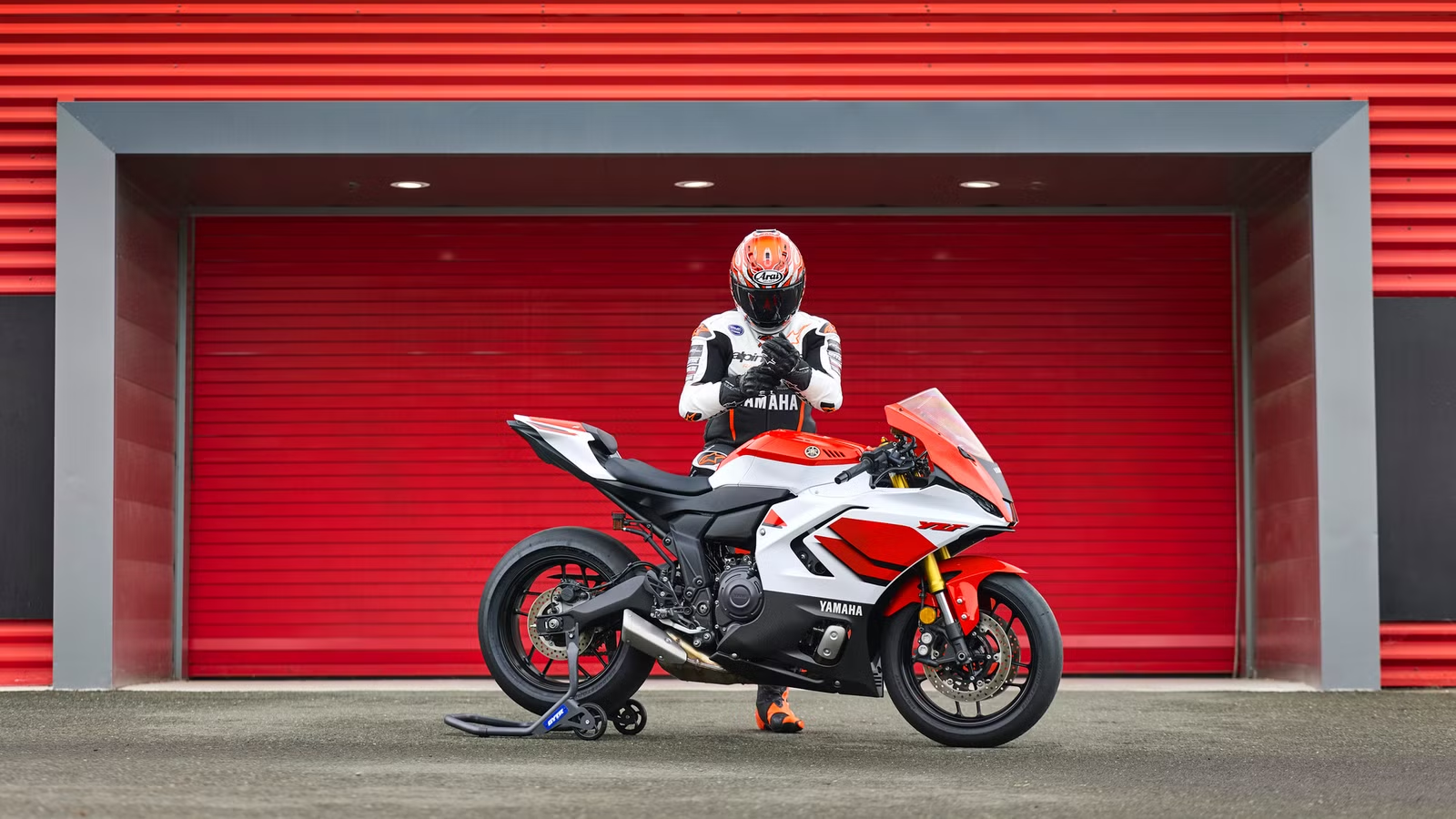
Horsepower works brilliantly for winning arguments on the internet, but it’s less reliable at predicting whether a motorcycle will leave you looking for the next corner before heading home. Once power reaches a certain point, public roads simply give riders fewer opportunities to use it properly anyway. That’s where the humble small-capacity sport bikes flip the script. Yes, they ask for more revs and generally more participation from you, but that’s precisely what makes for an engaging riding experience.

They don’t ask you to hold back, feather the throttle, and practice caution; they want you to have fun. If that sounds like your kind of fun, we’ve curated this list for just that. Even the stronger middleweights here lay emphasis on chassis and dynamics rather than horsepower. Ranked from lowest to highest peak output, these are ten reminders that a sport bike can be seriously entertaining without needing superbike horsepower.
10
Yamaha YZF-R3
Horsepower: 42 HP
42 horsepower sounds fairly meek until you realize the YZF-R3 expects you to use nearly all of it. Its 321cc parallel-twin makes peak power at 10,750 rpm, so short-shifting around the middle of the tach misses much of the point. The reward comes from holding gears, keeping the engine awake, and resisting the instinct to solve every corner with torque.


And the chassis is the enabler. The R3 weighs about 373 pounds wet, runs relatively narrow tires, and changes direction without requiring much muscle. There is enough performance to make a tight back road interesting, yet you still have to preserve momentum if you want to be properly quick. For riders who enjoy working with a motorcycle rather than merely hanging onto one, the R3 is a great choice.
9
Aprilia RS 457
Horsepower: 47.6 HP

Aprilia could have treated the RS 457 as its inexpensive learner bike. Instead, it gave the little parallel-twin an aluminum twin-spar frame that uses the engine as a stressed member, something rather more serious than its 47.6 horsepower output would suggest. The 457cc parallel-twin also produces its torque lower than the R3, so it does not need to be chased quite as relentlessly.

The chassis is where the RS shines too. There is a 41mm inverted fork, radial-mount front caliper, ride-by-wire throttle, three riding modes, and adjustable traction control. The result is not a mini-RSV4 impersonation, but a light sport bike that responds cleanly to what the rider asks of it. Beginners get usable performance and electronics, while experienced riders get a motorcycle light enough to place almost wherever they want.
8
CFMoto 450SS
Horsepower: 51 HP

The 450SS could easily disappear into the growing crowd of 400-something parallel-twins out there today. But its engine makes sure it doesn’t. CFMoto uses a 270-degree crank in the 449cc twin, giving the motor a lopsided firing rhythm and a bit of character that the class often lacks. For 2026, it produces 51 horsepower and 29.5 pound-feet of torque, where the former is class-leading.

CFMoto has also resisted stripping the chassis down to hit a price. The 450SS gets an inverted fork, Brembo M40 radial front caliper, traction control, and ABS, while wet weight sits around 375 pounds. It feels like a small sport bike expected to be ridden hard. There is no massive hit of acceleration, though, but there is plenty of speed to exploit the chassis repeatedly.
7
Kawasaki Ninja 500
Horsepower: 51 HP

Kawasaki’s 51-horsepower Ninja 500 is less interested in making the rider hunt for performance and more interested in putting useful drive everywhere. Its 451cc parallel-twin is essentially a longer-stroke development of the Ninja 400, producing 31.7 pound-feet at 7,500 rpm and a noticeably fuller midrange. So performance is linear and predictable.

The steel trellis frame is light, the ergonomics are relatively relaxed, and the engine pulls hard enough from mild revs with enough poke for easy overtakes. It is friendly without becoming sleepy. Throw it into a series of corners, and you can concentrate on braking, lines, and throttle inputs rather than managing a temperamental powerband.
6
Benelli Tornado 550
Horsepower: 56 HP

The Tornado 550 makes its modest horsepower with considerably more displacement. Its 554cc parallel-twin produces 56 horsepower at 8,250 rpm and 39.8 pound-feet at only 5,500 rpm. That tells you plenty about its personality: rather than saving everything for a frantic charge toward the redline, the Benelli has enough torque in reserve to pick itself up out of slower corners without constant gearbox work.

There is more ambition underneath the bodywork too. Benelli fits an adjustable 41mm Marzocchi inverted fork and twin 320mm front discs with Brembo radial calipers. At roughly 437 pounds ready to ride, the Tornado 550 is heavier than the smaller machines mentioned above, but it does make for a more substantial, planted motorcycle with a broad range of engine performance.
5
Kawasaki Ninja ZX-4RR
Horsepower: 56 HP

Here is where horsepower rankings start getting mischievous. Kawasaki officially rates the U.S-spec ZX-4R and the ZX-4RR at 56 horsepower, placing it alongside the Benelli. Despite that, the two motorcycles couldn’t be more different. This ZX uses a 399cc inline-four that wants revs by the bucketful, backed by riding modes, traction control, and a standard bidirectional quickshifter.

This is a serious track weapon that will make you learn to ride like a pro. Overseas versions make roughly 76 horsepower, with Kawasaki quoting close to 80 horsepower once ram-air effect is included, and the U.S.-spec ZX-4RR can be unrestricted to recover much of that missing performance. Few modern motorcycles let you regularly chase five-digit rpms while producing a genuine supersport soundtrack without reaching antisocial speeds quite so quickly.
4
Kawasaki Ninja 650
Horsepower: 67 HP

The Ninja 650 has been around long enough to become background furniture in Kawasaki’s lineup, but its numbers make more sense on the road even beside newer middleweights. The 649cc parallel twin produces 67 horsepower at 8,000 rpm and, more usefully, 48.5 pound-feet at 6,700 rpm. There is no dramatic second powerband near the redline because this is a workhorse of an engine that loves to ride the torque wave at mid-rpms.

Pair that with an upright riding position, steel trellis frame, and relatively slim profile, and the Ninja feels refreshingly uncomplicated. It tips into corners easily, pulls cleanly away from them, and does not demand racetrack levels of commitment for the chassis to be communicative. The 650 survives because 67 horsepower delivered at the right time can still make an ordinary road very interesting indeed.
3
Yamaha YZF-R7
Horsepower: 72.4 HP

Comparing the 2026 YZF-R7 with the old four-cylinder R6 solely by horsepower has never done the newer Yamaha justice. Ignore the family name for a moment, and the 689cc CP2 twin makes considerably more sense. Its roughly 72 horsepower is backed by strong midrange performance, and a 270-degree crank means you get great drive out of corners.

The 2026 update gives the engine a sharper chassis. Yamaha revised frame and swingarm rigidity, fitted lighter SpinForged wheels and Bridgestone Battlax S23 tires, and added a six-axis IMU with a more comprehensive electronics package. On technical roads or tighter circuits, the R7’s accurate braking, good corner speed, and instant midrange response make it better at carrying and using what it already has.
2
Suzuki GSX-8R
Horsepower: 82 HP

The GSX-8R sits in an awkward place, at least on paper. At 452 pounds wet, it is not especially light, and roughly 82 horsepower looks conservative beside the newer crop of middleweights. However, ride the 8R in the environment Suzuki designed it for, and those seeming limitations become harder to complain about. Its 776cc 270-degree parallel-twin produces 57.5 pound-feet, all of which is easily accessible low down.

Suzuki then adds a Showa SFF-BP fork, radial-mount Nissin front brakes, and a standard bidirectional quickshifter while keeping the riding position comfortable enough for the daily grind. The 8R therefore has a knack for carrying speed without turning every ride into an endurance exercise. It can commute without sulking and still attack a good road when one appears.
1
CFMoto 675SS
Horsepower: 95 HP

Ninety-five horsepower is what it took to top this list off, yet the 675SS still enters a class where crossing into triple digits is almost routine. CFMoto wisely did not force its new 675cc triple into a horsepower contest, albeit peak power coming in at a heady 11,000 rpm, accompanied by 51.6 pound-feet at 8,250 rpm. That does leave enough shove in the middle of the rev-range that riders do not need to choose between tractability and a proper top-end rush.

The three-cylinder layout is responsible for much of the appeal. It has a broader spread than older 600cc inline-fours while still gaining enthusiasm as the revs rise in a way many modern parallel twins can’t compare. KYB suspension, an adjustable steering damper, J.Juan brakes, and an up-only quickshifter give the rest of the motorcycle enough substance to follow the engine’s lead. The usually overlooked 675SS reminds you that noise, revs, and a chassis willing to play count for quite a lot too.
Source: Various Manufacturers

Related posts
Latest Post


No Comments