
The Pontiac Engine Option Rarer Than A Hemi That Nobody Remembers
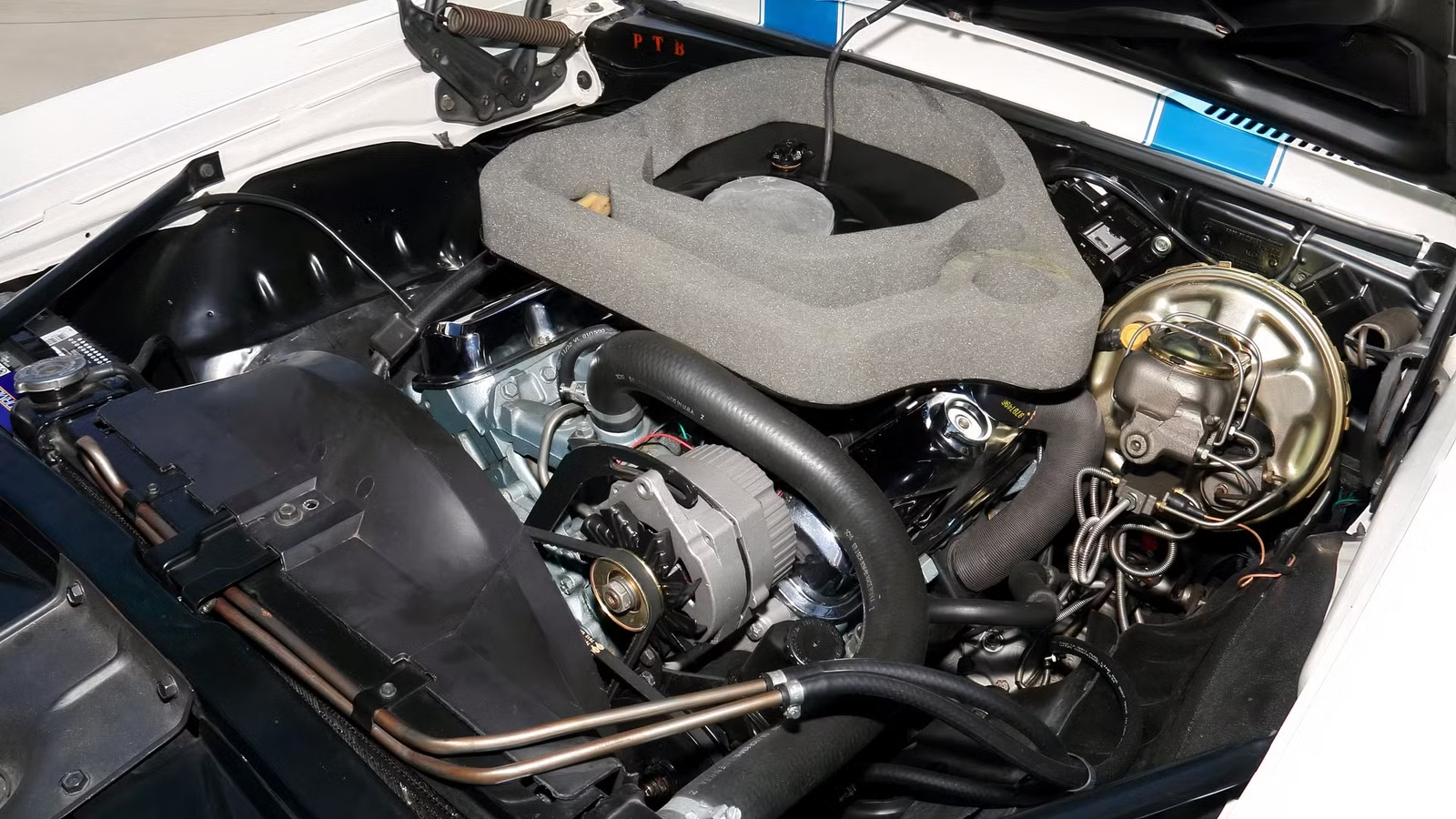
Detroit’s muscle car arms race left behind some awesomely ridiculous production figures. One factory V8 found its way into just 55 examples of a famous 1969 model, while only five convertibles wearing another badge got the same engine. Ordinarily, numbers that small would buy an express ticket into American automotive folklore.

Instead, the headlines went elsewhere. Pontiac had an extraordinary answer to Detroit’s horsepower obsession, but its most interesting engine somehow slipped between the cracks.
The Hemi Grabbed The Headlines While Pontiac Built Unicorns
Ask an American muscle car enthusiast about legendary engines and Chrysler’s 426 Hemi will enter the conversation before the coffee gets cold. Dodge and Plymouth built an entire identity around that elephant-sized V8. The 440 Six Pack earned its own following, while Chevrolet’s 454 LS6 gave General Motors fans a formidable response.

Pontiac had every reason to be part of that conversation. The original GTO helped establish the formula for Detroit’s midsize performance cars, and the division spent the 1960s turning its 400 V8 into increasingly serious hardware. Pontiac’s most ambitious factory 400 was better known to specialists than to the wider muscle car crowd.
Consider the 1969 GTO Judge. Introduced as Pontiac’s answer to Plymouth’s Road Runner, it cost around $332 more than a regular GTO and arrived wearing stripes and a rear spoiler. Its standard Ram Air 400, commonly called the Ram Air III, carried a 366 hp rating. Pontiac offered something considerably more aggressive above it.
These Ultra-Rare GTOs And Firebirds Had Something In Common

The first clue sits with the 1969 Pontiac Trans Am. Pontiac built only 697 of its new performance flagship, including eight convertibles. The white-and-blue Firebird already attracted attention with its functional hood scoops, but just 55 examples received the most potent engine option. For perspective, that works out to fewer than eight in every 100 first-year Trans Ams, even before considering how many survive today.
The 1970 Pontiac Trans Am had a completely new body, a prominent shaker hood scoop and a longer list of admirers. Its production climbed to 3,196 cars, yet only 88 were fitted with the same exceptional V8. Things got downright absurd on the GTO side. Pontiac built 108 Judge convertibles in 1969, and just five came with the top engine. Even an ordinary 1969 GTO equipped with that V8 was uncommon: only 759 were built across hardtop and convertible body styles.
Pontiac’s 400 Ram Air IV Was A 1,808-Car Secret

The connecting piece was Pontiac’s 400 Ram Air IV V8, a factory engine option offered only for 1969 and 1970. The commonly cited production total is 1,808 cars across those two model years. Of those, 1,563 were Pontiac GTOs and Judges, while another 245 belonged to the Firebird family.
Breaking down the GTO figures, 759 cars received the Ram Air IV in 1969, leaving 804 for 1970 within the two-year tally. The Firebird numbers are trickier. Only 55 Ram Air IV Trans Ams were built in 1969 and 88 followed in 1970, giving the famous badge a combined total of 143. Subtract those from the stated 245 Firebirds, however, and 102 additional cars are left outside the Trans Am count.
The Trans Am might’ve grabbed most of the attention, but it accounted for only 143 of the 245 Firebirds reportedly equipped with the Ram Air IV. That leaves another 102 cars, likely spread across other Firebird configurations, making this rare Pontiac V8’s history even more intriguing.
Pontiac Claimed 370 HP, But The Quarter-Mile Told Another Story

The Ram Air IV earned its reputation through real engineering rather than another splash of paint. Its 400 V8 used round-port 722 cylinder heads, an aggressive 041 camshaft, and 1.65:1 rocker arms for greater valve lift. Pontiac also installed a high-rise aluminum intake manifold with a separate cast-iron heat crossover. The combination helped the engine breathe at higher speeds, where ordinary street-oriented V8 hardware could start running out of enthusiasm.
The price of that engineering barely registered on the official horsepower chart. In the 1969 GTO, the Ram Air III was rated at 366 hp and the Ram Air IV at 370 hp. A four-horsepower difference sounds like the kind of gain an optimistic salesman could promise from a fresh air filter. In the 1969 Trans Am, the advertised gap was similarly modest: 335 hp for the standard engine versus 345 hp for the upgrade. The 1970 Ram Air IV Trans Am carried a 370 hp rating.
Hidden Away

Performance figures from tests at the time made those numbers look suspiciously shy. A 1969 Ram Air IV Judge recorded a 13.7-second quarter-mile at 103 mph in one test, while another managed 14.45 seconds at 97.8 mph with less aggressive gearing. Assessments at the time suggested the engine could be producing closer to 400 hp than Pontiac’s published claim.
Pontiac also fitted four-bolt main bearings and free-flowing exhaust manifolds, while the functional hood scoops helped feed cooler outside air into the engine. Available 3.90:1 and 4.33:1 rear axle ratios made acceleration a priority, with the predictable trade-off of busier highway driving.
Why This Rare Pontiac V8 Never Became Another Hemi

At a reported 1,808 installations, the Ram Air IV has been described as rarer than the better-known 426 Street Hemi, 440 Six Pack and Chevrolet 454 LS6. That comparison is intriguing, although it needs consistent boundaries: total engine installations across their respective runs are different from the number of cars built in a particular year or body style.
Pontiac also made its own fame harder to consolidate. The GTO had its followers, the Judge had its theatrical personality, and the Trans Am gradually built a separate reputation. All could carry this special V8, but each nameplate collected its own anecdotes and auction headlines. Add in the understated factory horsepower ratings, and the engine itself became the shared secret enthusiasts had to investigate instead of the household name painted on everybody’s lips.
Sources: Silodrome, TopSpeed, Barn Finds.

Related posts





Latest Post


No Comments