
5 Sleeper Sedans America Built When Nobody Was Watching
They say it’s the quiet ones you need to watch out for, the unassuming. In this case, it’s the four-door sedan parked in the corner space. Plain as the day is long, with sensibly sized wheels, and a plush, soft interior. A good sleeper can fool the average passerby, but the great ones can pull the wool over a trained eye. Spotting one in the wild is like being part of an inside joke that only a few people know.

Hiding high performance in plain sight was the goal when these five sleeper sedans rolled off the assembly line and onto public roads. They arrived unexpectedly and often unannounced, flying under the radar, camouflaged in modesty or wearing a city-mandated livery.
These four-door sedans may look like Clark Kent, but they hide a great source of power behind thick-framed glasses. Whether it’s heavy-duty suspension, a detuned Corvette V8, an extra set of turbochargers, or a complimentary leather jacket, these are five sleeper sedans that Detroit built when nobody was watching.
5
1991-1992 Dodge Spirit R/T
Power Output: 224 HP

For a brief moment in the early 1990s, one of the quickest four-door sedans in America was a manual, front-wheel drive, Chrysler K-Car with a Lotus turbocharged four-cylinder engine. Debuting in 1991, the Dodge Spirit R/T featured a turbocharged 2.2L, 16-valve DOHC four-cylinder engine developed by Lotus. That’s right, this Mopar was powered by British engineering.
Dubbed the Turbo III, this Lotus-Mopar engine developed an impressive 224 horsepower and was fitted with a heavy-duty five-speed manual transmission. At the time, Car and Driver recorded the Dodge Spirit R/T sprinting from zero to 60 in 5.8 seconds, making it quicker than other super sedans like the BMW M5 (6.3 seconds) and Ford Taurus SHO (6.8 seconds). Better yet, the Spirit R/T retailed for a lot less than the M5 and Taurus SHO, making the Lotus-powered Dodge a high-performance bargain for drivers looking to humble unsuspecting motorists at stoplights.
What makes the Dodge Spirit R/T stand out on this list of super sleepers is its modesty. This car looks like it belongs to a school vice principal with only a tiny rear spoiler and 15-inch snowflake wheels providing a subtle hint at the intercooled power under the hood. While the Dodge Spirit was in production from 1989 to 1995, the 224-hp Spirit R/T was sold only in the United States in 1991 and 1992, with fewer than 1,500 examples, making it the rarest sleeper sedan on this list.
10 Ridiculously Fast American Sedans On The Used Market
Who says four-doors are boring? These sedans prove that going fast doesn’t mean compromising on space.
4
1994-1996 Chevrolet Caprice 9C1 LT1
Power Output: 260 HP

Halfway through the fourth generation of the Chevrolet Caprice production, General Motors decided to give the Caprice’s 9C1 police package some extra force. The 9C1 is the code General Motors uses to designate Police Pursuit Vehicle (PPV) models and has been used on several GM models, from the Chevy Nova to the Tahoe. However, in 1994, the 9C1 gained a detuned version of the Corvette C4’s LT1 5.7L V8 to give the Caprice more muscle to fight crime.
Unlike the Corvette, the Caprice 9C1 version of the LT1 V8 used an iron block with iron heads, and a camshaft tuned specifically for idling during long hours on patrol. Sequential port fuel injection and a reverse-flow cooling system helped generate 260 hp, paired with a four-speed automatic transmission.

In addition to a high-output alternator, dual exhaust, heavy-duty (cop) brakes, (cop) shocks, and (cop) suspension featuring larger sway bars and reinforced engine mounts. All this equipment helped to push the over 4,000-pound Caprice sedan from zero to 60 in an estimated seven seconds while on the job. Side note, the Caprice 9C1 LT1 served as the DNA platform for a well-known sleeper sedan, the 1994-1996 Chevrolet Impala SS.
By 1996, Chevrolet had stopped production of the Caprice 9C1, making the LT1 variant a short-lived model. If you want to buy a real Caprice 9C1 LT1, look for the signs. The most obvious being the 9C1 code or a certified 140-mph speedometer on the dash, along with a fleet interior featuring vinyl seats, a column shifter, and, more than likely, a spotlight mounted on the A-pillar.
3
2003-2004 Mercury Marauder
Power Output: 302 HP

In 1969, Mercury introduced a high-performance personal-luxury coupe called the Marauder X-100. This car featured a monstrous 429 V8 laying down 360 hpto move its nearly 20-foot-long steel body off the line. The Marauder X-100 only lasted one year before being discontinued in 1970. We wouldn’t hear or see the Marauder nameplate again until the new century.
The 2003-2004 Mercury Marauder is a Grand Marquis you won’t find parked in front of a church on Sunday. More than just an appearance package, the Marauder shared the same 302 hp DOHC 4.6L V8 engine as the 2003 Ford Mustang Mach 1, the Lincoln Mark VII, and the Lincoln Aviator. To handle the increased power, the Mercury Marauder used an aluminum driveshaft and the same limited-slip differential as the Ford Crown Victoria Police Interceptor with 3.55 rear axle gearing.
Spotting a real Marauder requires checking the interior for a floor-mounted shifter instead of the standard column shifter you’d find in a Grand Marquis. Tires are also a giveaway, as the Marauder has a staggered wheel setup with wider rear tires. You can also ask the driver if they have the official Mercury Marauder black leather jacket that came with each car as a gift.
10 Factory Sleepers That Came With Engines From Supercars
These carmakers shoehorned their very powerful supercar engines into average family haulers.
2
2005-2008 Pontiac Grand Prix GXP
Power Output: 303 HP

During its final years, Pontiac seemed determined to give us as much performance as possible before closing its doors forever. Before General Motors gave Pontiac the axe, we got to enjoy the 6.0L V8 GTO, the sleek Solstice, and the G8, a muscle car with too many doors. Yet there’s one Pontiac built during this final season that most people overlook: the Grand Prix GXP.
Built from 2005 to 2008 before being replaced by the Pontiac G8, the Grand Prix GXP is a high-performance variant of the standard front-wheel-drive Grand Prix. The GXP replaced the standard 3.8L V6 with a 5.3L LS4 V8 producing 303 hp. This created a V8-powered, front-wheel-drive sleeper sedan with Brembo brakes, Bilstein shocks, a rear spoiler, and a quad-tip exhaust system.
The Grand Prix GXP even had staggered wheels to improve handling, so the tires are wider at the front than at the rear. One look at this Pontiac, and you’d never assume it was packing heat. Like a grandmother hiding a Clint Eastwood-style magnum in her purse.
1
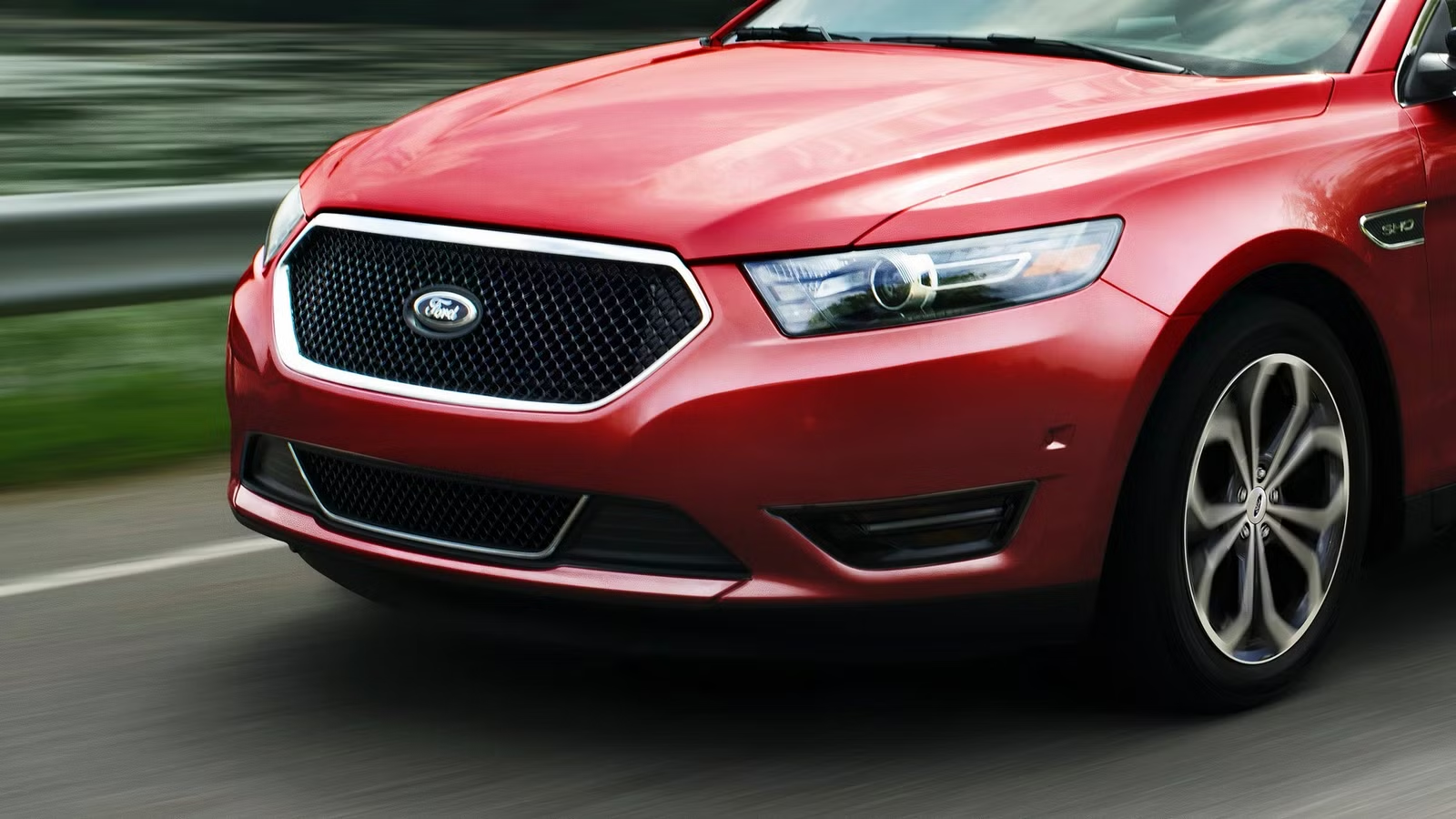
2010-2019 Ford Taurus SHO
Power Output: 365 HP

The 2010-2019 Ford Taurus would be the last true sedan to wear a blue oval. This four-door sedan offered the trunk space to satisfy a crime boss and the subtle styling of a concealed weapon. Its full-size utility made it an ideal vehicle for police work in 2013, replacing the iconic Crown Victoria Police Interceptor, which ended production in 2011.
The Taurus SHO features a twin-turbocharged 3.5L EcoBoost V6 generating 365 hp, a six-speed automatic transmission, and standard all-wheel drive. It uses MacPherson struts and a multi-link rear suspension with SHO-specific upgraded shocks, springs, front and rear stabilizer bars, and strut mount bushings. The optional Performance Package added upgraded brake pads, engine and transmission oil coolers, recalibrated power steering settings, and a “Sport” mode.

When the SHO wasn’t being offered as a subtle performance sedan, it was a viable option for law enforcement agencies seeking more power to fight crime. A Police Interceptor could be optioned with the same 3.5L twin-turbo EcoBoost V6 as the Taurus SHO. These models could sprint from 0 to 60 in under 6 seconds, even while loaded down with police gear.
However, if you’re shopping for a decommissioned Taurus Police Interceptor, don’t assume they are all undercover SHOs. Ford offered two other engines in the Taurus Police Interceptor models. The standard engine is a 3.7L V6 making 305 hp, engineered for the heavy demands of fleet service. The second engine, meant as a fuel-efficient alternative, was a naturally aspirated variant of the 3.5L V6 EcoBoost.
Sources: Hemmings, Ford, Chevrolet, Mercury, Pontiac, Dodge

Related posts

Latest Post


No Comments