The Subaru Trailseeker’s Biggest Upgrade Is Here Sooner Than Anyone Expected
8 minutes reading
Friday, 10 Jul 2026 18:00 0 68 autotech
Electric vehicles (EVs) are evolving more rapidly than internal combustion engine (ICE) vehicles, since these vehicles are still relatively new—or at least not as old as century-old ICE tech. This is a major contributor to an EV’s faster depreciation. Unlike an ICE car, whose century-old tech is pretty much near its peak today, EVs have only become mainstream in recent decades.
This brings us to the new 2027 Subaru Trailseeker, a wagon-like electric crossover with rugged intentions without compromising on grippy on-road handling through its standard all-wheel drive (AWD). For its recent update, nothing much has changed externally, but it comes with a mechanical improvement that promises real-world handling improvements. Stick around to find out what it is, as we also explain how EVs are evolving rapidly due to this drivetrain technology having so much room for innovation.
EVs’ Innovative Rise Versus ICE’s Technological Peak
Rear 3/4 view of a 2025 Kia EV3Kia
It seems that over the past decade, any improvement to the ICE has yielded only incremental gains. Take away the turbocharging and electrification from an ICE, and the recipe is still pretty much the same.
And what better way to determine how innovative an ICE is than by measuring it in terms of its thermal efficiency? You see, when an ICE combusts fuel, most of it becomes heat, and that’s exactly what you feel when you touch your car’s hood. Thermal efficiency is a measurement of how much fuel is actually converted into energy to propel the car forward. On average, an ICE has 30 percent thermal efficiency. The Mazda 6’s Skyactiv-G gasoline engine has a relatively high 40 percent thermal efficiency. Geely’s newest ICE, despite numerous measures, already has one of the highest thermal efficiencies at 48.41 percent.
And yet after all these innovations, an ICE’s thermal efficiency is still far away from an electric motor’s average thermal efficiency of around 80 percent. These are your signs that the ICE is already nearing its peak. Increased horsepower isn’t necessarily innovation, because there are so many ways to achieve it these days. Horsepower isn’t a measure of innovation, because an electric motor can easily outmuscle an ICE with far fewer parts in a more compact and thermally efficient package.
EV Technology Continues To Leap Forward
The new Denza Z9 GT and BYD’s Flash ChargingBYD
This brings us to the rapid innovations that EVs are still currently experiencing. One of those is in terms of battery and charging technology—particularly with what BYD has achieved recently with its Flash Charging technology. Making its debut outside the Chinese market through the facelifted 2027 Denza Z9 GT, BYD has begun rolling out its Flash Charging infrastructure across Europe. Developed with the principle of ‘Ready in 5, Full in 9, Cold Add 3’, the 1,500 kW ultra-rapid charger allows for a 10 to 70 percent charge in just five minutes, and a 10 to nearly full (97 percent) charge in just nine minutes. In freezing conditions—one of a battery’s worst enemies—you’ll only have to add three minutes to the total charging times (hence the Cold Add 3).
We’ve done a deep dive into how BYD has achieved its Flash Charging technology. One question that may arise is how the grid can support such a large power output. BYD has thought about this, and so the Flash Chargers actually come with their own external second-generation Blade lithium-iron-phosphate (LFP) batteries. Those batteries are filled at an output that the grid can support. Once filled with enough power, those batteries can deliver up to 1,500 kW in DC charging output. BYD’s Flash Charging technology is a clear demonstration of how much innovation there is left with EV drivetrains, and yet we haven’t even fully tackled how batteries can still be shrunk through increased energy density, such as with upcoming solid-state batteries.
The Subaru Trailseeker’s Enhancements For 2027
2026 Subaru Trailseeker First DriveSubaru
This leads us to the 2027 Subaru Trailseeker, which, while it doesn’t feature the kind of leap that Chinese EV makers can achieve these days, still comes with a meaningful update to its AWD system.
Upgraded Symmetrical AWD
2026 Subaru Trailseeker front shotSubaru
Subaru brands its AWD technology as Symmetrical AWD. Symmetrical AWD is called as such because of how symmetrical its layout is, from the central positioning of the boxer engine relative to the vehicle’s spine to its equal-length half axles. This changes somewhat in the Trailseeker EV, because it no longer has a boxer engine, and the electric motors are mounted at the front and rear axles to provide all-wheel traction. The dual electric motors have a combined output of 375 horsepower, which is split 50/50 to the front and rear wheels. This allows for a 0–60 mph time of just 4.3 seconds—the fastest for any Subaru to date.
Base Trim Engine
Electric
Base Trim Transmission
single-speed Automatic
Base Trim Drivetrain
All-Wheel Drive
Base Trim Horsepower
375 hp
Make
Subaru
Model
Trailseeker
Segment
Midsize SUV
But an electronic AWD system can be more than just about rapid acceleration and reassuring grip. If you want more nuanced handling control, this is where the 2027 update comes in. Subaru engineers have tweaked the Symmetrical AWD for 2027 by adding acceleration sensors at the front and rear. These sensors allow the Symmetrical AWD to adjust its power split, not just between the front and rear wheels, but also to the left or right wheels, based on dynamic loads during acceleration, braking, and cornering. This variability also applies to the regenerative braking, which has all been done in the pursuit of improving the Trailseeker’s stability and agility in various road and handling conditions.
All This Without A Price Increase
2026 Subaru Trailseeker rear shotSubaru
For a fresh change of pace, the 2027 Subaru Trailseeker isn’t getting a price increase despite this mechanical update. The Trailseeker still starts at $39,995, which undercuts its Toyota sibling, the bZ Woodland, by more than $5,000. Perhaps the difference is dictated by the bZ Woodland’s two-year complimentary maintenance, but there are probably other factors contributing to the price difference. Take note, however, that while the MSRP remains unchanged, the destination fee is now $1,475, $25 higher than before. Still, that’s pretty much negligible by today’s standards. But the price story only makes sense once you understand everything else the Trailseeker brings to the table — and some of it directly undercuts its Toyota sibling in ways that matter.
What Else A 2027 Subaru Trailseeker Offers
2026 Subaru TrailseekerSubaru
Apart from the improved Symmetrical AWD and unchanged pricing, here’s what you can expect from the 2027 Subaru Trailseeker.
Rugged Looks, Modern Interior
2026 Subaru TrailseekerSubaru
2026 Subaru Trailseeker front seatsSubaru
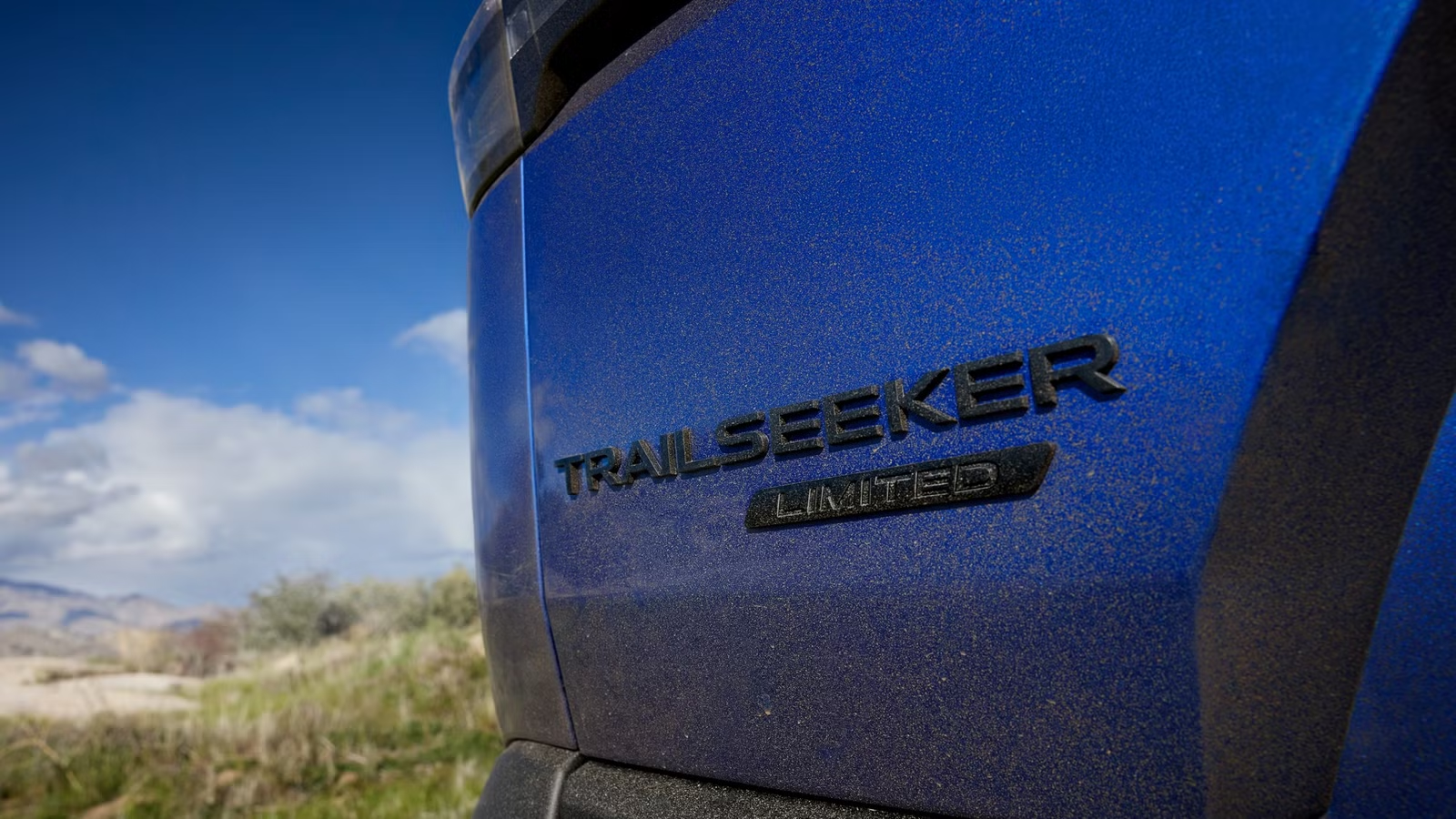
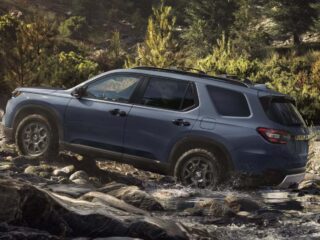
The Subaru Trailseeker is essentially a lengthened Solterra, which in turn is an EV co-developed with Toyota. The Trailseeker sets itself apart from its Toyota sibling through its boxier, more upright front end, along with the availability of 20-inch wheels in the Limited and higher trims. It also has a minuscule ground clearance advantage of 0.1 inches over the bZ Woodland’s 8.4 inches, assuming that is enough of a selling point for some buyers.
Inside, the Trailseeker goes for a modern and architectural aesthetic. The horizontal dash motif with a large 14-inch touchscreen is shared across the Subaru and Toyota siblings, with differences mostly focused on certain trim and color choices. The Trailseeker offers synthetic leather upholstery, but Subaru offers genuine leather upholstery on the range-topping Touring variant with an available blue hue. The Toyota only offers synthetic leather on all variants. The Trailseeker already offers a Harman Kardon sound system in the $43,995 Premium variant, while a JBL premium sound system in the bZ Woodland is only available in the $47,400 Premium variant. Lastly, a fixed glass roof is offered in the range-topping versions of both the Trailseeker and bZ Woodland.
Up To 281 Miles Of Range, NACS Port Is Standard
2026 Subaru TrailseekerSubaru
Whichever variant you choose, the 2027 Subaru Trailseeker comes with a 74.7 kWh lithium-ion NMC battery that’s good for 281 miles of range in the Premium and 274 miles for the Limited and Touring. The range advantage of the Premium is attributed to its smaller 18-inch wheels. Unsurprisingly, this is also the same range as the bZ Woodland. Making charging convenient is its standard NACS port, allowing you access to Tesla Superchargers. The battery can receive up to 150 kW of DC fast charging output, which is good for a 10 to 80 percent charge in 28 minutes.
Drivetrain
Dual motor, AWD
Horsepower
375 horsepower
Torque
396 lb-ft
EPA Combined Energy Efficiency
117 MPGe (Premium)
114 MPGe (Limited, Touring)
Max AC Charging
22 kW
Max DC Charging
150 kW
Battery size
74.7 kWh
Range
281 miles (Premium)
274 miles (Limited, Touring)
Base MSRP
$39,995
Subaru takes pride in its battery preconditioning, which, through the onboard navigation system or a setting in the infotainment, allows the Trailseeker to arrive at a DC fast charging station with the battery already primed to accept the full 150 kW output. This also works in climates that are as cold as 14 degrees Fahrenheit.








No Comments