
The JDM Coupe With Skyline GT-R Tuning Headroom For FD RX-7 Money
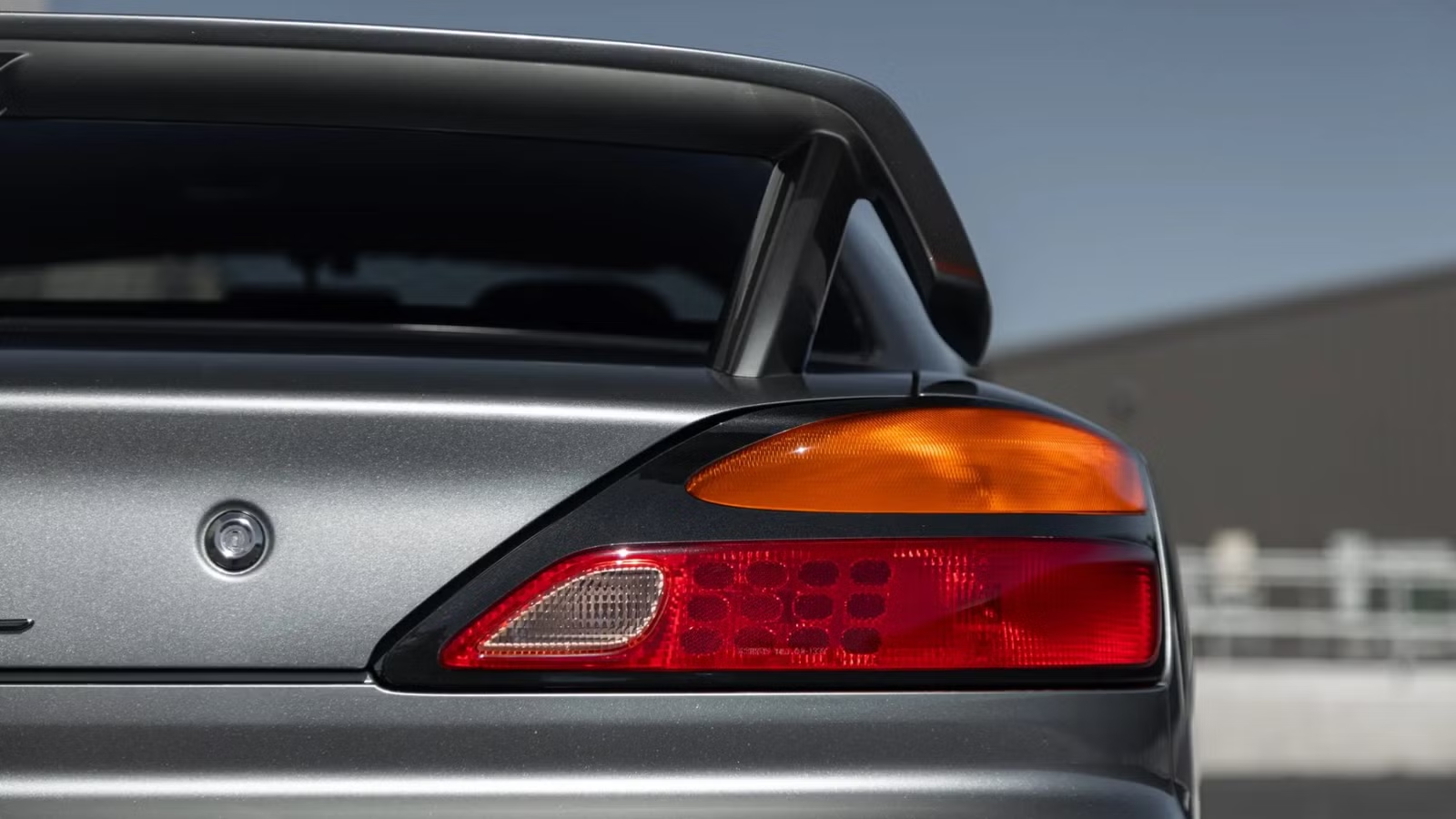
The average Mazda RX-7 FD3S listing sits at $34,995 today. Another Japanese turbo coupe from the same era averages roughly $27,000, and it does not carry a rebuild clock.
Cheaper usually means slower or flimsier, but this JDM coupe gives you a cast-iron block, consumables you can buy at any parts counter, and a list of weak points where every item has a published price attached. The rotary does not work that way.
A change to U.S. import duties in 2026 widened that gap further, and most buyers pricing these cars have not noticed.
Every Clean FD RX-7 Hides The Same $12,000 Question

Live FD3S listings currently run from $14,710 to $63,995. That spread is not a market struggling to price a car. It is the gap between a healthy rotary and one that is a few thousand miles from needing $6,000 to $12,000 of engine work.
Telling the two apart requires a differential-pressure tester built for Wankel engines, because a standard cylinder-bore compression gauge does not read a rotary correctly. Both rotors should show even numbers across all three faces, and a long crank on a warm restart points to the same weak compression.
Apex seals wear on condition rather than mileage, so there is no service interval to budget against and no paperwork showing where an engine sits in its cycle. Two FDs with matching odometers can be $28,000 apart in real value.

Clean original cars are scarce because cheap rotary power turned the FD into a permanent modification target. An unknown tune combined with aging vacuum lines is the standard route to a dead apex seal.
Every dollar of that risk sits at the front of the transaction, buried in a component you cannot fully inspect before you pay. So what else from the same era gives you a turbocharged, rear-drive coupe without that specific bet?
Nissan Saved Its Sharpest Silvia For Last

Nissan’s answer arrived in January 1999 as the Silvia S15 Spec-R, and the launch press materials spelled out what it was built to do. The 2.0-liter SR20DET made 247 horsepower at 6,400 rpm feeding a new six-speed manual with close-ratio gearing. Torque was 203 lb-ft at 4,800 rpm.
That 247 hp figure was a regulatory ceiling, not an engineering one. Japanese manufacturers had agreed among themselves to cap published output, and the S15 ran the highest-output SR20DET variant right up against that agreed limit.
Nissan quoted a power-to-weight ratio better than 5 kg per PS (11.18 lbs per hp), achieved on a 2,733-pound curb weight. A Garrett T28R ball-bearing turbocharger cut friction and sped up spool, working alongside larger 480cc injectors and variable intake cam timing — the most developed version of the engine Nissan built.

Aichi Machine Industry developed the six-speed, and it remains the only six-speed manual ever fitted to any Silvia. Every five-speed S15 is a Spec-S, not a Spec-R.
Spec-R buyers also got a helical limited-slip differential as standard on manual cars fitted with 16-inch tires, plus a strengthened shell, larger anti-roll bars, and four-piston front brake calipers shared with the Z32 300ZX.
Production records put the total at 43,097 cars — 41,954 coupes and 1,143 convertibles — with 38,741 staying in Japan. The chassis went on to take close to 70% of D1 Grand Prix championship wins.
What A Spec-R Really Costs Once It Clears Customs

Eligibility runs on the month and year of manufacture shown on the door-jamb compliance plate, not the model year. The earliest 1999 builds cleared in January 2024, and the final 2002 cars phase in through the end of 2027. A car advertised as a 2002 model may still be months from legal entry, so check the plate before wiring money.
The tariff position is where buyers are leaving money behind. Customs and Border Protection exempts autos at least 25 years old from the 25% Section 232 duty on passenger vehicles, while autos from Japan otherwise carry a combined 15% rate. A qualifying import is assessed the 2.5% base duty instead. On a $27,000 car, that exemption is worth roughly $3,400.
Landing a $30,000 car on the West Coast runs $2,500 to $4,500 in ocean freight, about $750 in duty, $400 to $700 in port handling and brokerage, and $800 to $2,200 to move it inland. Add state title and registration and the all-in figure is $35,000 to $40,000. Yokohama to New York takes around 45 days at roughly $3,050.
Driver-grade cars — modified, drift history, high mileage, thin records — start near $10,300 from Japanese exporters and run to about $30,500 before shipping.

Clean unmodified examples with verified mileage and low rust average close to $27,000 across global listings, and the strongest of them trade between roughly $35,000 and $52,000 in Europe.
Show-ready collector cars top out near $44,500 on live listings, though one documented car sold for $90,000 at auction in January 2026 according to Classic.com.
The currency tailwind is narrowing. The yen sat near 159 to the dollar on August 12, and it strengthened 1.90% over the previous month after a joint intervention by Tokyo and Washington. Prices also tend to swing 30% to 50% in the month a build date clears.
What It Costs To Take A Stock Spec-R Past 300 HP

Considered one of the greatest Japanese engines ever made, the SR20DET uses a closed-deck cast-iron block with an aluminum head, despite a number of parts vendors describing the block as aluminum. The closed-deck design is what gives the block its rigidity under boost, and it underpins everything below.
The stock T28 turbocharger is the first ceiling, running out of efficiency around 280 to 300 whp. That is a bottleneck rather than a failure point. A Garrett GT2871R bolts directly into the S14 and S15 T28 position and supports 375 whp with the right supporting modifications, for roughly $1,200 plus fueling.
The connecting rods are the second ceiling and the first genuine failure point. Around 280 to 300 wheel horsepower (whp) is the commonly cited practical street limit on stock internals, with rod failure risk rising noticeably above 350 whp. Sustained power above 300 whp warrants upgraded race bearings, and clearing this ceiling means pulling the engine for forged rods and pistons.

The six-speed gearbox is the third ceiling and the one that ends cars. A locating circlip on the layshaft works loose, letting gears move as you try to select them, and the damage that follows usually scraps the gearbox.
Specialists including Garage-D and Quaife fit an uprated locking kit for roughly $460 to $930. After a failure, a rebuild runs $2,300 to $3,500, and a good used gearbox now costs $3,500 to $4,600. Garage-D calls the modification preventive rather than a strength upgrade, and points out that torque and clutch choice near 400 hp is what actually kills these boxes.
None of that makes the S15 an RB26 on stock internals. What it does is attach a published number to every failure point — exactly what a compression test on an FD cannot give you.
A Finished Car Beats The Project Every Time

Building the same car from a 240SX is the obvious alternative, and the math no longer favors it. A clean S14 averages $18,081 at auction, and average-condition cars reach $20,000 while even rough examples rarely trade below $5,000, based on Hagerty estimates.
Add a used SR20DET with its transmission, then mounts, intercooler piping, a fuel system, a wiring harness, a clutch, and a flywheel. The stack lands close to what a running Spec-R costs, and that is before anyone pays for labor.
What the money does not buy is a factory helical differential, a six-speed, the strengthened Spec-R shell, Z32 calipers, or a title reading anything other than 240SX.

Buying the finished car instead means four checks on a cold start: VCT rattle, the exhaust manifold and turbo gasket, the oil spray bars in the head, and clean six-speed engagement. Look hardest at the rear wheel arches and sill sections for rust. Budget the first year for coil packs, a spray bar service, and gearbox verification before adding any power at all.
Set that against an FD averaging $35,000 with an engine you cannot read, or an R34 GT-R that has moved to six figures today from $30,000 to $40,000 in 2015. The Spec-R is the only one of the three where the worst-case bill is a four-figure number you can pay in advance.
Sources: cbp.gov, Nissan, Hagerty, Classic, Garage D

Related posts




Latest Post


No Comments