
The Forgotten Kawasaki Cruiser That Hid A Ninja Engine For $2,800
Kawasaki has always taken performance very seriously — an attitude that gave us legends such as the Z1, H2 Mach IV and, more recently, the supercharged Ninja H2. The Concours 14 sport-tourer is yet another great example, equipped with a massive inline-four engine similar to that of the ZX-14 and boasting 156 horsepower on tap. What we’re trying to illustrate here is the company’s willingness to take things to the absolute extreme, something that’s basically turned into an integral part of its brand image long ago. And the bike we’ll be examining today was built in that exact same spirit, so it’s worth remembering even if it hasn’t attained the same level of fame as its rivals.
The GPZ900R’s Release In The 1980s Was A Watershed Moment

When the very first Kawasaki Ninja debuted at the Paris Motor Show in the fall of 1983, it brought about a new standard for all superbikes to aspire to from that moment on. It came with a liquid-cooled 908cc inline-four engine housing 115 ponies in its stable, which translated into speeds exceeding 150 mph. The GPZ900R was, in fact, the first production motorcycle to surpass the 150-mph mark, and it is nowadays cherished by aficionados as a cult classic treasure. But Kawasaki didn’t just call it a day after putting that stout four-banger inside a single model, instead seeking to see how it could be tuned for a different purpose. Around the same time, a little thing called the power cruiser was just starting to carve out its place on the motorcycling landscape.
When Power Cruisers Became A Thing

Yamaha’s brutal V-Max is widely regarded as the world’s first true muscle cruiser, but some might argue that title actually belongs to the earlier Honda V65 Magna. Both of them followed a similar recipe, one introduced by the Magna and thoroughly refined by the Yammie soon after. Riders were particularly fond of the V-Max, so much so that Yamaha changed very little about it for more than two decades and right up until the first generation kicked the bucket in 2007. What you may not know is that Kawasaki also had some skin in the power cruiser game, though, and this unfamiliarity likely stems from its attempt being nowhere near as successful as Yamaha’s from a commercial standpoint. That being said, let’s jump straight into the deep end and see how everything unfolded.

Kawasaki ZL900 Eliminator: A Ninja Cosplaying As A Cruiser

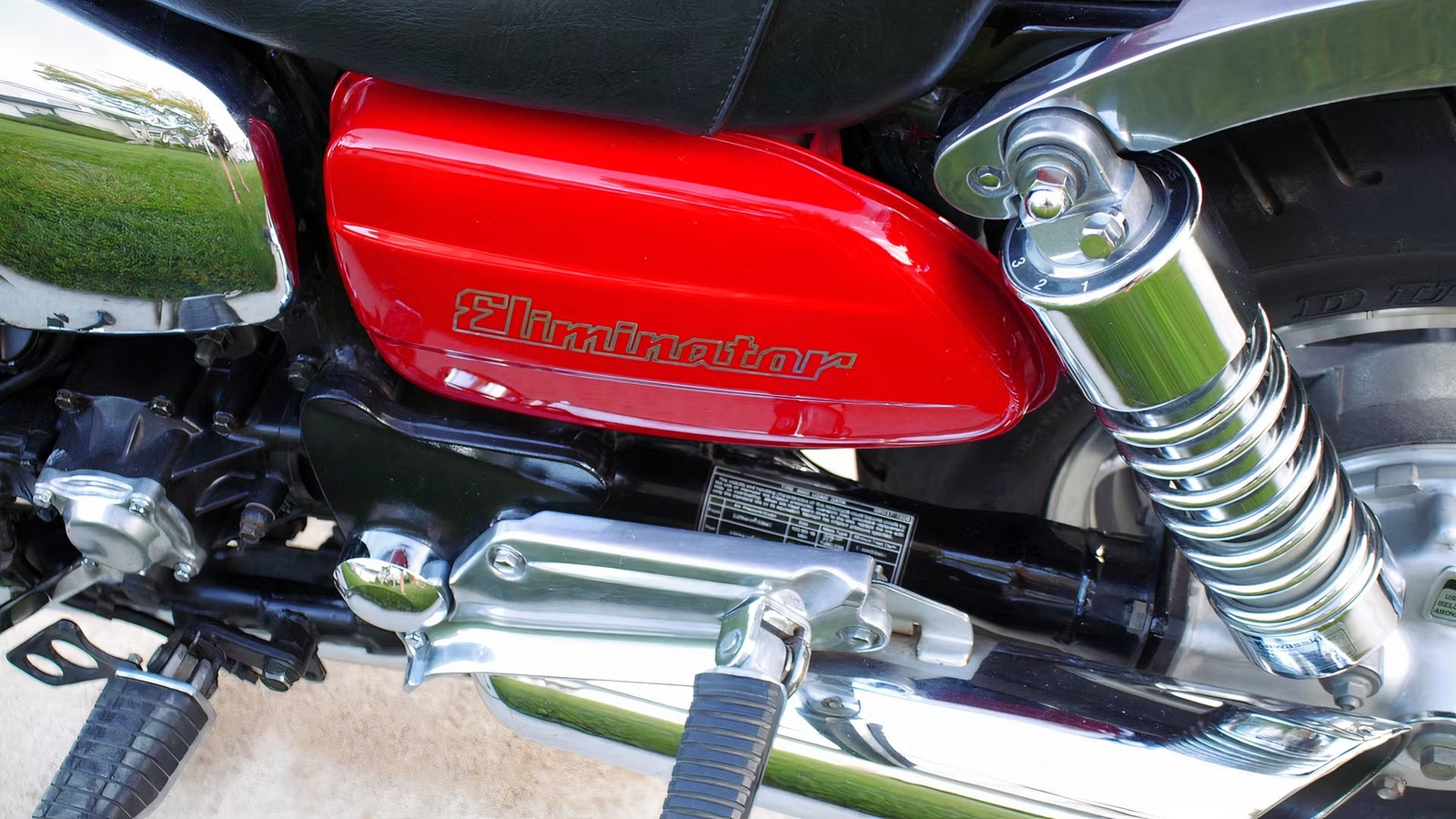
The Eliminator debuted as a 1985 model and was only produced for two years before getting the axe, differentiating itself from the competition with that inline-four Ninja powerhouse. Whereas motorcycles like the V-Max and Magna used V4s, Kawasaki stuck with the tried-and-true layout used on the GPZ and had it tuned for better low- and mid-range torque. The Keihin carbs dropped from 34 to 32 millimeters (from 1.34 to 1.26 inches), and the cam profiles were revised for reduced duration and lift. This resulted in a bit less top-end power — 105 ponies compared to the Ninja’s 115 — while getting the engine’s 63 lb-ft of torque to kick in much earlier on. Besides that, the four-banger remained largely unchanged, with 11:1 compression and a total of 16 valves operated by dual overhead camshafts.

Kawasaki beefed up the clutch so it could handle the additional low-end twisting force, while converting the final drive from a chain to a shaft mechanism. In terms of performance, the ZL900 only needed about three seconds to go from zero to 60 mph, and it completed the quarter-mile run somewhere in the upper 11-second range. Although this made it slower than its rivals at the drag strip, the Eliminator was faster off the start line and could easily outrun them in a 50-yard dash. Just like the GPZ, it used a six-speed transmission to send the engine’s power to that shaft-driven rear wheel and then the ground. But if the two bikes were similar when it came to the powertrain componentry, the chassis department is where they diverged significantly.
The Ninja’s frame used the engine as a stressed member, while the ZL900’s was a more conventional double cradle design with rubber mounts for that four-cylinder mill. Its wheelbase measured a huge 62.8 inches to keep things nice and stable at high speeds, while the ergonomic package was more aggressive than that of other contemporary muscle cruisers with a drag-style handlebar and foot pegs mounted further back. Furthermore, the bike had a slammed, low-slung posture and an exceptionally buff rear wheel at 6.3 inches in width. Disc brakes together with air-assisted suspension finished off the running gear, and the Eliminator tipped the scales at 567 pounds with all the necessary fluids. At launch, it had an MSRP of $4,499 in America.
Why The ZL900 Faded Into Obscurity

The original Eliminator was killed off in 1986, making room for the bigger and better ZL1000 to take its place. But its successor was also short-lived since it still hasn’t quite managed to captivate the public as thoroughly as the Yamaha V-Max, and these old-school ZLs are largely forgotten today. Even though Kawasaki revived the nameplate in recent years, the current model with its 451cc parallel-twin is a far cry from the Eliminator’s buff muscle bike roots. And as cool as it may have been, the classic ZL doesn’t come up in conversations anywhere near as much as the V-Max or V65, doomed to live in their shadow and remain underappreciated at least for the foreseeable future.
However, that has nothing to do with the Kawi being a bad bike in any way, because it was actually a pretty solid machine that simply failed to get people’s attention in what was then a brand-new niche. At just 908cc, it was smaller, less powerful, and slightly slower than the Magna, V-Max, or Suzuki’s GV1200 Madura, so folks often dismissed it without considering that it might’ve just been the most well-rounded of the bunch. But despite the ZL900 being a commercial flop, it does occupy a very interesting place on today’s second-hand market, and this somewhat hopeful note is what we’d like to end on today. What exactly do we mean by that, though?
The Sleeper Cruiser With A Ninja Soul

The ZL900’s charm can be attributed to a couple of different factors, the main one being all that sweet Ninja DNA repackaged into something you could hardly liken to the GPZ. Its character may be distinct, but the liquid-cooled inline-four mill at the base of it all will still have you smiling from ear to ear as you take off from a traffic light. The Ninja genetics are still very much there, even if they’ve been repurposed for straight-line acceleration rather than all-round performance or canyon-carving ability. What’s more, you also get to own a quirky piece of lesser-known muscle cruiser history and one that’ll surely be a great conversation starter at bike meets — perhaps more so than a V-Max or V65.
Pricing on used models tends to fall somewhere between $2,800 and $3,000, but a pristine example with just 12,000 miles on the clock was once sold via Mecum for just $1,925. By contrast, an early GPZ900R can easily fetch north of five grand at auction, and perhaps much more if it’s in tip-top shape, so what you’re essentially getting with the Eliminator is vintage Ninja heritage at a steep discount. There’s just one important caveat to keep in mind, though. Given the model’s short production run and relatively low sales volume, it is by no means easy to find a ZL900 on the used bike market today. But if you do come across one at any point, be sure to give it some thought and consider snatching it while you can, because the opportunity won’t be presenting itself very often.
Sources: Kawasaki, Honda, Yamaha, Hagerty, Mecum

Related posts

Latest Post


No Comments