
The Performance Car That Would Never Be Approved Today
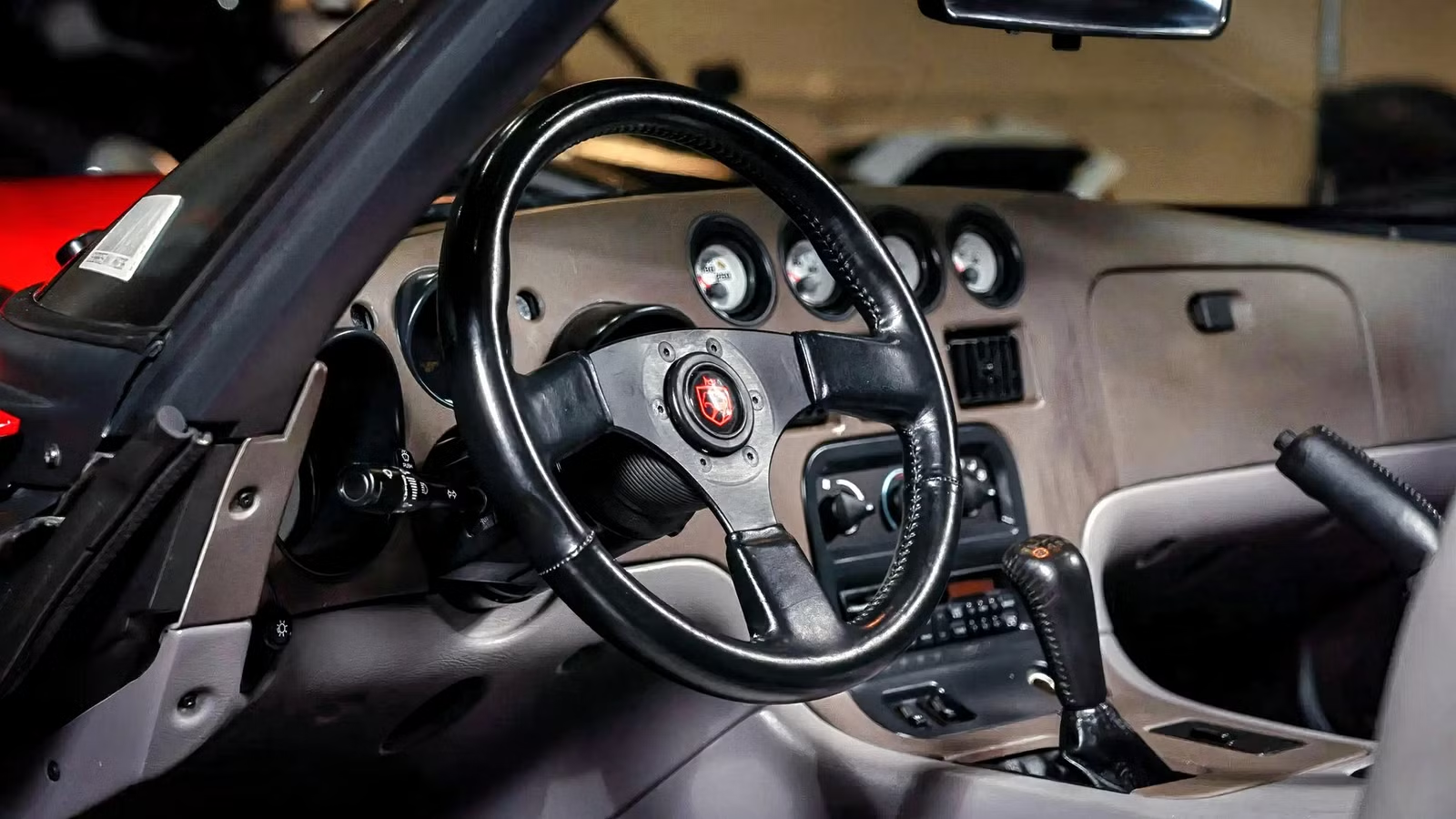
Safety standards in the automotive industry have come a long way, and today’s cars offer better protection than ever for their occupants. It’s easy to take safety features like airbags, crumple zones or electronic assists for granted nowadays, but let’s not forget that things haven’t always been this way. There was a time when a crash could turn your steering column into a spear more lethal than the initial impact itself, windows shattered into large shards that could slice you up, and there was no electrical safety net to forgive your mistakes. On top of that, things became particularly treacherous when you added a healthy dose of blistering performance into the mix.
Performance Used To Be Much More Intimidating Than It Is Today

Looking back through the pages of automotive history, you’ll note that so many iconic sports cars we all love would have absolutely zero chance of meeting safety regulations today. The revered Shelby Cobra from the sixties is one of the best examples that come to mind, and then you’ve also got the 930-gen Porsche 911 Turbo aptly dubbed “The Widowmaker.” Both were built during a time when passenger safety was far from what it is today, but they didn’t exactly make a deliberate attempt at dodging what was already mainstream. By contrast, the model we’re about to look at was a very conscious deviation from the norm, aiming to be as raw as possible rather than somewhat approachable.
Chrysler Hatched A Crazy Plan In The Late Eighties

With CEO Lee Iacocca and president Bob Lutz at the helm during the 1980s, Chrysler began to wonder what it would be like to build something in the Shelby Cobra’s spirit just as American automakers were still recovering after the infamous Malaise Era. That meant bare-bones simplicity taken to the absolute extreme, along with visceral performance demanding plenty of respect and skill. Comfort would be minimal, the only safety features to be added were those mandatory to make the car road-legal, and drivers would get no electronic interferences to save them if things went south. This philosophy sounds borderline extreme in our day and age, but it’s what gave Dodge one of its most remarkable models ever. With that said, let’s get straight into the details.

The Original Dodge Viper Was Like A Car Nut’s Fever Dream

At launch, the Dodge Viper RT/10 was unlike anything else out there on the road. Tom Gale led the design team, and none other than the great Carroll Shelby himself had served as an advisor during development. The Viper concept was first presented to the public at the Detroit Auto Show in 1989, generating a ton of hype before it went into production as a 1992 model. Remarkably, the differences between the concept and actual car were fairly minimal, showcasing Chrysler’s intention to make no compromises whatsoever with its new sports car. A huge part of the Viper’s charm had to do with what was under the hood: a gargantuan eight-liter V10 developed with the help of Lamborghini back when it was owned by Chrysler.
This naturally aspirated monstrosity had an all-aluminum construction and was paired with a six-speed BorgWarner manual transmission. It could produce up to 400 horspower and 465 lb-ft of torque — considerably more than a contemporary Corvette LT1, Ferrari 348, or Porsche 964 Turbo. In the real world, all that power could translate into a dash from zero to 60 mph in just 4.5 seconds, as well as a quarter-mile time below 13 ticks of the stopwatch. Ultimately, the venomous American sports car would reach a top speed of 165 mph, doing so without the aid of forced induction. Its performance was utterly insane by early nineties standards, but that’s only part of the reason why the Dodge Viper became so famous and universally respected.

To be fair, the model’s reputation leans as much on its fearsome, uncompromising nature as it does on horsepower and torque numbers, perhaps even more so. The first-gen Viper RT/10 (codenamed SR I, by the way) was notoriously punishing and difficult to drive, partly due to the complete lack of electronic driver aids. There was no traction control, stability control, or launch control, no ABS, and no electronic intervention to keep you on the road if you made a mistake. As if that weren’t enough, the car didn’t even come with airbags, so things could turn very dangerous in the (seemingly probable) event of a crash. At the very least, they did include seat belts. The madness didn’t quite end there, though, because these early Vipers were just as stripped-down when it came to comfort.
Noise insulation was virtually non-existent, the cabin was said to get extremely hot due to engine heat, and there weren’t even any exterior door handles to speak of. Instead, one had to use the interior handle to enter the cabin, which wasn’t too much of an issue since the Viper had only detachable plastic covers in place of windows. By now, you probably won’t be surprised to learn that air conditioning was also absent. Any other car this rudimentary would’ve been laughable in the 1990s, but no one dared to laugh at the Dodge Viper knowing what it was capable of. Although the nameplate became considerably more civilized over subsequent generations, the notoriety of its first iteration was there to stay.
Why Something Like The First-Gen Viper Could Never Exist Today

In an age when safety regulations are more stringent than ever, there would be no way for a car like the Viper to exist in street-legal form. The sheer lack of even the most basic features like airbags would immediately disqualify it with any regulatory bodies in the developed world, and fewer buyers today would be willing to sacrifice comfort in favor of performance to that extent. And given how used we are to things like ABS and traction control nowadays, jumping in a car without the tiniest bit of electronic assistance would surely be more than a lot of us could handle. But for those who had the skill to tame the fierce Viper, its analog character was incredibly rewarding and pretty much impossible to forget.
Collectibility And Cult Classic Status

As you would expect from a sports car with the early Viper’s reputation, collectors and hardcore aficionados will happily pay a premium to get their hands on one such specimen. Well-kept examples with low mileage can easily command north of $50,000 at auction, like a 1992 model with around 6,000 miles sold on Bring a Trailer for $62,500 not long ago. Prices can climb considerably higher in exceptional cases, such as yet another first-year Viper showing just 27 miles on the odometer, auctioned off last year for $100,000. Market values have also been trending upward over recent years, so the first-gen Viper RT/10 might serve as an excellent investment, as well.
Either way, we certainly won’t be seeing anything like it again, which only enhances its cult classic allure. Yet another factor making these things so precious is their rarity, as fewer than 7,000 copies are said to have been produced during the Viper’s first generation. And we must give credit to Chrysler, whose willingness to do things differently from the crowd gave us one of the best American sports cars ever made. However, it wasn’t just a fantastic sports car for a U.S. manufacturer, but truly a force to be reckoned with on the global stage. And next time you get rescued by your ABS or traction control, be thankful you weren’t in an SR I Viper.
Sources: JD Power, Hagerty, Bring a Trailer, Dodge

Related posts





Latest Post


No Comments