
The Flat-Six GT You Can Still Buy For Camry Money
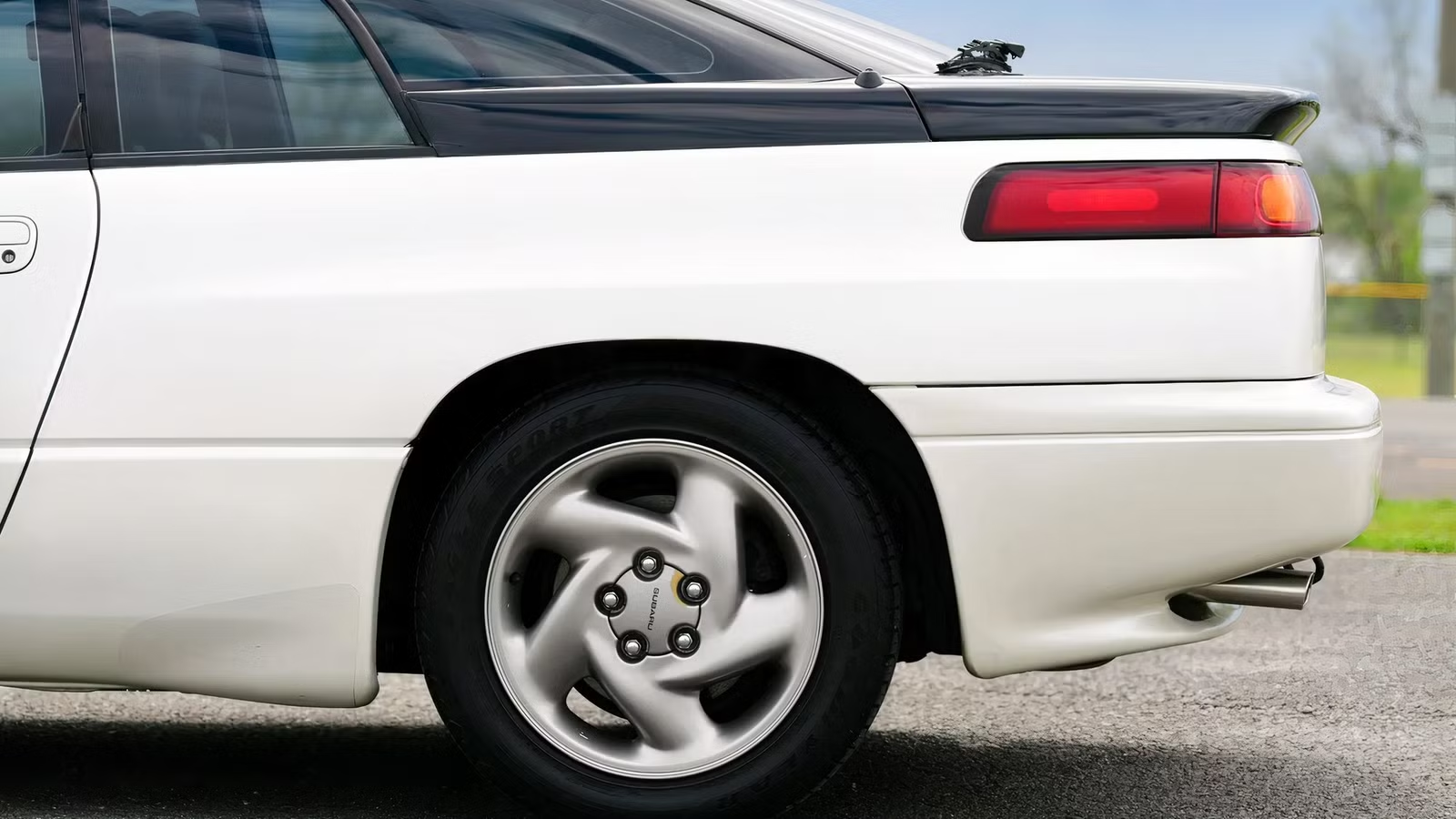
Some designer names can light up a collector car market faster than a turbo warning light in an old classifieds listing. Attach the right Italian signature to the right shape, and suddenly the conversation moves from ‘used old coupe’ to ‘investment-grade sculpture’, usually while somebody in loafers explains why the door-shut line matters more than your mortgage.
That makes one early-’90s grand tourer look like a clerical error in the used car world. It has a famous Italian designer, a flat-six engine, all-weather hardware, concept-car glass, and a production story expensive enough to make accountants reach for a chair. Somehow, this Japanese GT still lives in the price band where normal people shop for reliable commuters and lightly bruised Camrys.
Italian Design Pedigree’s Become Expensive Almost Everywhere Else
Giorgetto Giugiaro didn’t exactly spend his career sketching forgettable rental-counter appliances. His portfolio includes the DeLorean DMC-12, Lotus Cars Esprit, BMW M1, Maserati Bora, and plenty of shapes that still make auction catalogs sound like wine menus. Wedge, proportion, restraint, drama. The man knew how to make a car look like it had arrived from a better-dressed future.
That future has become expensive. The BMW M1 has long since left normal human territory. Early Lotus Esprits have collector pull far beyond their old used car lives. The DeLorean, helped by stainless-steel skin, gullwing doors, and Hollywood immortality, has its own cultural orbit. These cars aren’t casually cross-shopped by people wondering whether they should also look at a clean Accord.
Yet there’s one Giugiaro-designed Japanese grand tourer that still hasn’t been pulled into the same gravitational field. The shape is there, as are the oddball glass shapes. The late-century design confidence is there, too. Park it mentally beside an M1 or Esprit, squint a little, and the family resemblance starts to show. Then check the market value, and the whole thing gets weird.
The Rare Subaru Sports Car With An Italian Design
Despite its gorgeous looks, this sports car wasn’t as successful as Subaru had hoped, and one attempt to save it came too little too late.
Subaru Built One Halo Coupe Without The Badge To Explain It

Subaru in the early ’90s had a clear identity, and ‘Italian-drawn luxury GT’ wasn’t the first phrase that came to mind. The brand was known for practical, slightly eccentric, all-weather cars that appealed to people who owned dogs, skis, hiking boots, or some combination of the three. Subaru was trustworthy, capable, and pleasingly weird.
That, however, didn’t stop Subaru from trying. The company aimed high with a plush, expensive, two-door grand tourer intended to sit far above the regular Subaru range. The pricing at the time kind of tells the story. Early base examples were listed at $24,445, while a later top LSi reached $36,740. For a brand whose showroom neighbors were far more sensible, that was a sizable ask. It was like walking into a hardware store and finding a tuxedo section.
Unfortunately for Subaru, the timing wasn’t exactly fortuitous. Japanese performance and luxury coupes were everywhere, and many had easier elevator pitches. A Toyota Supra was a Supra. A Nissan 300ZX knew exactly what poster it wanted to be, and a Lexus SC had the new luxury-channel shine that buyers understood. This Subaru, on the other hand, had the right ingredients, but its badge asked buyers to recalibrate too quickly.
It also carried the wrong kind of ambition for a mass-market showroom. Subaru reportedly lost roughly $3,000 on every car, which makes the whole project feel like a very expensive experiment. The Subaru halo car was too costly to build, too expensive to sell easily, and too unusual to explain in one sentence. Great cars often survive that kind of confusion later, but new car buyers tend to be less forgiving when the monthly payment is due.
The Subaru SVX Was The Giugiaro Flat-Six GT You Probably Missed

|
Engine |
Power |
Torque |
Transmission |
|
3.3-liter flat-6 |
230 hp |
228 lb-ft |
4-speed automatic |
The Subaru SVX, known in Japan as the Alcyone SVX, was far more serious than its current market reputation suggests. Giugiaro’s concept appeared at the 1989 Tokyo Motor Show, and the production Subaru SVX that followed for the 1992 model year stayed remarkably close to the show car idea. But instead of paying attention to it, most of the world seems to have looked at it, blinked twice, and returned to arguing about Supras.
Under the hood sat a 3.3-liter DOHC flat-six, rated at 230 hp and 228 lb-ft of torque. That wasn’t supercar output, but it was smooth, distinctive, and entirely in keeping with a Subaru grand tourer brief. A flat-six in a low, long-distance coupe naturally invites Porsche comparisons, though the Subaru SVX had its own personality. Think more all-weather express than apex-hunting track rat.
It may not look like much now, but the styling was the real conversation starter then. Its ‘window-within-a-window’ canopy looked like aircraft thinking had leaked into the door frames. The lower section of the side glass could open while the larger upper pane stayed fixed, helping to reduce wind buffeting at speed. It also gave the Subaru SVX a cabin profile unlike almost anything else on the road. Admittedly, drive-through windows probably involved some mild yoga, but at least the car gave you a story with the fries.
Production stayed limited. Global volume reached 24,379 units, including 14,257 sold in the U.S. That’s rare enough to matter, but not rare in the unobtainable, museum-basement sense. It’s the sweet spot where a Subaru enthusiast can still find one, buy one, and use one without requiring a finance committee or a security guard named Anton.
The Automatic Gearbox Hurt It Then But Defines It Now

The Subaru SVX’s biggest problem was also one of the reasons it makes more sense today. Every example used a four-speed automatic transmission because Subaru didn’t have a manual gearbox capable of handling the torque of the 3.3-liter flat-six. For buyers who wanted a traditional enthusiast coupe, that was a hard sell. In the early ’90s, a mandatory automatic could make a performance-minded shopper walk away before the brochure was even folded shut.
The car’s weight didn’t help its case. At roughly 3,500 to 3,580 pounds, depending on spec and trim, the Subaru SVX was carrying grand-touring mass in a segment full of sharper, lighter, louder alternatives. The 0-60 mph time sits around 7.3 seconds, with the quarter-mile in the mid-15s. That was respectable then, but it didn’t have the fireworks to bully turbocharged Japanese icons or V8 luxury coupes.
The Drive Dilemma

Judged as a sports car, the Subaru SVX gets stuck in an argument it was never built to win. Judged as a grand tourer, though, that’s when it suddenly clicks. The automatic suits the relaxed character, while the flat-six makes smooth, steady power. The cabin is comfortable, the glasshouse gives it a panoramic feel, and the all-weather personality makes it a Subaru built for covering distance without treating every highway ramp like a qualifying lap.
The AWD story is slightly more layered than the simple legend, too. Most Subaru SVX models had all-wheel drive, while a few front-drive versions were offered in North America in 1994 and 1995 as a cost-saving move. Those didn’t catch on, which is hardly surprising. If you’re buying Subaru’s expensive futuristic flagship, you probably want the full Subaru party trick, not the budget remix.
The Last AWD Sports Sedan Available With A Manual Transmission In 2025
The manual transmission is on its way out, and this extremely capable AWD sports sedan is now the last of its kind.
Camry Money Should Not Still Buy This Much Car

Here’s where the Subaru SVX becomes sit-up-and-take-notice interesting. The average sale price for one sits at around $5,000, with the highest recorded sale sitting at $7,200. Even allowing for condition, mileage, and the usual old-car weirdness, that keeps the Subaru SVX in a market band where plenty of buyers are also looking at used commuter cars.
That little money, for that much car? A Giugiaro-designed Subaru with a 3.3-liter flat-six, available AWD, concept-car styling, limited production, and a development story that reportedly cost Subaru money on every unit? Sounds absurd. There are reasons the Subaru SVX stayed cheap, of course. The automatic transmission needs attention, parts availability can be awkward, and buyers should avoid neglected examples that have been treated like disposable winter beaters. Early transmission issues, wheel bearings, brake rotors, and deferred maintenance all matter. The smart move is to spend more on a sorted Subaru SVX rather than rescue the cheapest one while telling yourself it’ll be fine. That sentence has funded many mechanics’ vacations.
Hard To Ignore

Still, the collector argument is hard to ignore. The Subaru SVX has the designer, the rarity, the mechanical distinctiveness, and the visual signature. It also has the charming misfit energy that tends to age well once everyone stops judging a car by what it failed to sell against when new. Back then, buyers didn’t know what box to put it in. Today, that’s the whole Giugiaro-designed appeal.
Sources: Subaru, Automobile Fandom, Tire Kickers, Hagerty, RepairPal.

Related posts



Latest Post


No Comments