
5 Sub-$25K Touring Bikes Quietly Delivering 90% Of A Gold Wing
Think luxury touring motorcycles and bagger/full-dresser models from Harley-Davidson and Indian, and they pop right up. But among metric offerings, there is only one luxury tourer that can hold up to the American V-twin charm in luxury, comfort, and convenience—the Gold Wing. It further helps that Honda has honed the Gold Wing for so long that it has been a near-perfect luxury tourer for several years. A unique flat-six engine, with surprisingly dynamic underpinnings, and top-spec technology all add to the package. But what do you do if you want to break the norm and pick something like the Gold Wing but not a Gold Wing? Well, then you need to look at one of its alternatives listed below.

This list organizes alternatives to the Honda Gold Wing from most to least expensive.
Harley-Davidson Street Glide
Price: $24,999
Thanks to the revised pricing of the new Harley-Davidson Grand Touring range, we now have a Street Glide priced cheaper than the Honda Gold Wing. The Street Glide is currently the smartest purchase in the Harley lineup, since now we can get a gorgeous-looking Batwing’d mile muncher with a commendable list of comfort, convenience, and entertainment features for the price of last year’s Road King Special.

Powering the Street Glide is a chunky Milwaukee-Eight 117 V-twin. The 1,917 cc mill with liquid-cooled cylinder heads produces 105 horsepower at 4,600 RPM and 130 pound-feet of torque at 3,250 RPM. Power is sent to the rear wheel via a six-speed manual gearbox with a final-drive belt. Housing the mill is a double-cradle frame suspended on Showa dual-bending valve forks and twin outboard shocks with remote hydraulic preload adjustability.
It offers many luxurious features, too. Notable features include a huge 12.3-inch TFT touchscreen with Skyline OS. This is the window to features like ride modes, cornering traction control, cornering ABS, linked braking, and cornering drag-torque slip control, among others. Overall, the Street Glide offers a fusion of old-school American charm and comfortable, luxurious long-distance touring, all for less than the price of a Honda Gold Wing bagger.
BMW K 1600 B
Price: $23,395 (MY25)

This bagger is the closest Honda Gold Wing rival when it comes to offering comparable levels of engine and chassis technology and a modern suite of features. In certain respects, it outguns the Gold Wing, too. Just like Honda, the BMW K 1600 B is also powered by a unique engine, an inline-6 that delivers sports bike-like power. It is a transversely placed 1,649 cc mill that produces 160 horsepower at 6,750 RPM and 132.7 pound-feet of torque at 5,250 RPM.
The chassis and suspension setup are also unique. A bridge-type aluminum frame that uses the engine as a stressed member pairs up with BMW’s patented Duolever wishbone suspension at the front and the Paralever rear setup attached to the single-sided swingarm. It comes with electronic damping, and the setup offers 4.5 inches of travel up front and 5.3 inches of travel at the rear. Grip duties are courtesy of 17-inch alloy wheels wrapped with chunky 120/70 front and 190/55 rear tubeless radial tires.

The technology integration is also top-spec, akin to that of the Honda Gold Wing. The K 1600 B gets a huge 10.25-inch TFT screen with a clean skin, Bluetooth connectivity, and integrated map navigation. It is loaded with enhanced ride-enhancing, assistive, and safety technology features. Notable ones include three ride modes (Rain, Road, and Dynamic), Dynamic Traction Control, Engine Brake Control, and Hill Start Control, among others. It also gets a neatly integrated four-button cluster on the fairing for favorite functions.
BMW R 1300 RT
Price: $22,645

While the BMW R 1300 RT might not offer the same low-slung riding stance as the Honda Gold Wing, it surprises by packing a healthy dose of touring comfort, convenience, and luxury. This is a BMW touring bike that makes luxury feel practical. Powering the R 1300 RT is an R 1300 GS-shared boxer twin. The 1,300 cc mill produces 145 horsepower at 7,750 RPM and 110 pound-feet of torque at 6,500 RPM. Like the Gold Wing, you can equip the RT with an optional automatic gearbox to truly transform the riding experience.
Underpinning the R 1300 RT is a twin-spar frame that uses the engine as a stressed member. This chassis is much lighter than the preceding steel trellis frame on the R 1250 RT. This chassis plays a vital role in the R 1300 RT’s sporty dynamics. The sub-frame is also a bolt-on aluminum lattice tube frame to uphold its nimble riding character. Suspension duties are handled by dedicated hardware. It gets BMW’s patented Telelever front wishbone setup and the Paralever layout coupled to an aluminum single-sided swingarm. It offers 5.8 inches and 6.2 inches of travel at the front and rear, respectively.

Despite the visual compactness, the R 1300 RT is quite a large and comfortable touring bike. It is 87.7 inches long, 38.2 inches wide, and has a wheelbase of 59 inches. BMW offers standard seat adjustability ranging from 32.2 to 33.0 inches. Speaking of comfort, let’s talk about technology, and you’ll be happy to know BMW has left no stone unturned. A huge 10.25-inch TFT, which has Bluetooth connectivity and navigation as standard, takes center stage.
This is replete with ride modes, keyless ignition, tire pressure monitoring system, heated grips, cruise control, electronic suspension, and linked brakes. Safety features include cornering ABS, traction control, and engine brake control are also present. The optional technology list is even more feature-packed, with radar-assisted front collision warning, lane change warning, adaptive headlamps, and cruise control. This Beamer makes up for the loss of outright luxury when compared to a Honda Gold Wing with its superior suite of standard and optional features.
Kawasaki Versys 1100 SE LT
Price: $19,499

The Kawasaki Versys 1100 SE LT clearly cannot match the low-slung, laid-back lux appeal of the Honda Gold Wing. But what it loses in outright luxury is compensated for by added sporty performance and dynamic appeal. It is much more compact and lighter than the Gold Wing while still comfortably accommodating an adult pillion and a luggage system comprising side cases and a top box.
A lot of that is down to the 1.1-liter inline-four engine that powers the Versys 1100 SE LT. It produces 133 horsepower at 9,000 RPM and 82.5 pound-feet of torque at 7,600 RPM. Power is sent to the rear wheel via a six-speed gearbox and a final chain drive. The fifth and sixth gears are longer on this Kawa to help with a more relaxed engine character on the highway.

As for underpinnings, there’s an aluminum twin-spar frame, with the engine used as a stressed member. It utilizes Showa’s Skyhook EERA (Electronically Equipped Ride Adjustment) technology, comprising 43 mm inverted front forks and a BFRC rear monoshock. These work in tandem with Kawasaki’s Electronically Controlled Suspension (KECS) technology. A six-axis IMU, three traction-control modes, ABS, a two-way quickshifter, and two power modes bring further ease of mind during varied conditions.
Creature comforts are aplenty, too. Heated grips, cruise control, smartphone connectivity via the sleek TFT, and cornering lights are all standard bits. The Versys 1100 SE LT clearly offers a drastically different package compared to the Honda Gold Wing. But with its aggressive price tag under $20,000 and a solid bundle of touring comfort, performance, convenience, and even a fair amount of luxury, it’s hard to dismiss this sport-tourer as the Gold Wing’s alternative.
Yamaha Tracer 9
Price: $12,599

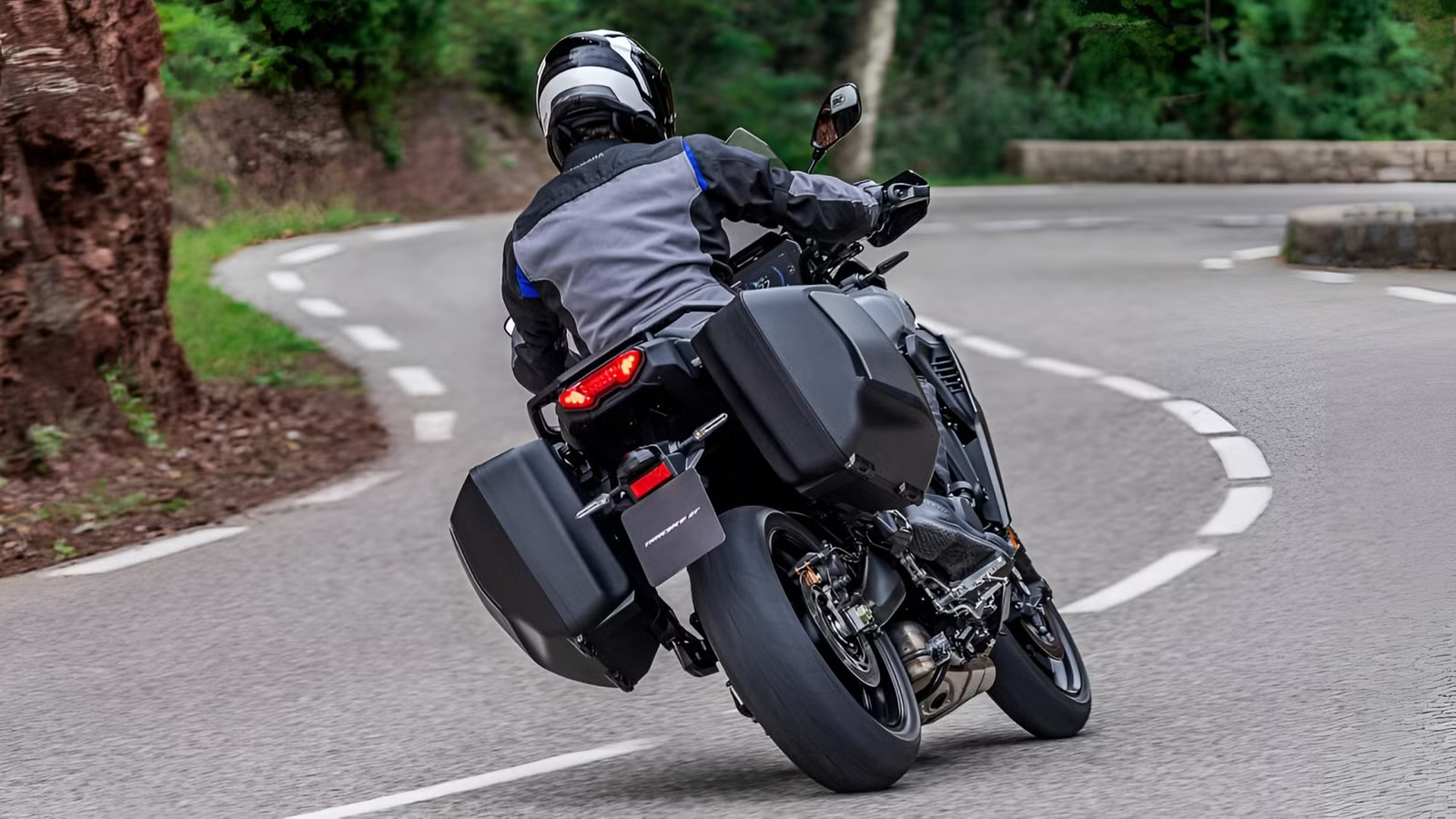
The Yamaha Tracer 9 is a wildcard entry here, priced at half the Honda Wing’s price. Yet, the Tracer 9 surprises by offering an experience that is quite impressive in terms of touring comfort, convenience, and even a certain degree of luxury. It is a crossover tourer that strikes a balance between comfort and performance, thanks to the versatile CP3 engine. The 890 cc inline-3 mill is also shared with the Yamaha MT-09 streetfighter and the new Yamaha R9 sports bike. The numbers lie at 117 horsepower at 10,000 RPM and 68.6 pound-feet of torque at 7,000 RPM.
At the same time, the dimensions are slim, and the underpinnings uphold a sporty character. It sits on a lightweight aluminum diamond main frame with a bolt-on sub-frame designed for greater load-bearing capacity. This is to help take the weight of an adult pillion and the standard side cases. Suspension duties are taken care of by 41 mm inverted KYB front forks with 5.1 inches of travel. The rear gets a monoshock with 5.2 inches of travel. Both ends offer preload and rebound-damping adjustability.

Electronics are quite top-notch, as well. These include five ride modes, ride-by-wire, a six-axis IMU, lean-angle-sensitive brake control, and even adjustable lift-and-slide control. While the Tracer 9 is a solid alternative to the Gold Wing for half the price, we are gravely missing out on the Tracer 9 GT. It is superior to the base Tracer 9, with features such as electronic semi-active suspension, heated grips, an electronically adjustable windscreen, and an advanced matrix lighting system.
Sources: BMW Motorrad, Kawasaki, and Yamaha Motorsports

Related posts

Latest Post


No Comments