
Dodge’s Charger That Cheated The Wind Before Daytona Even Existed
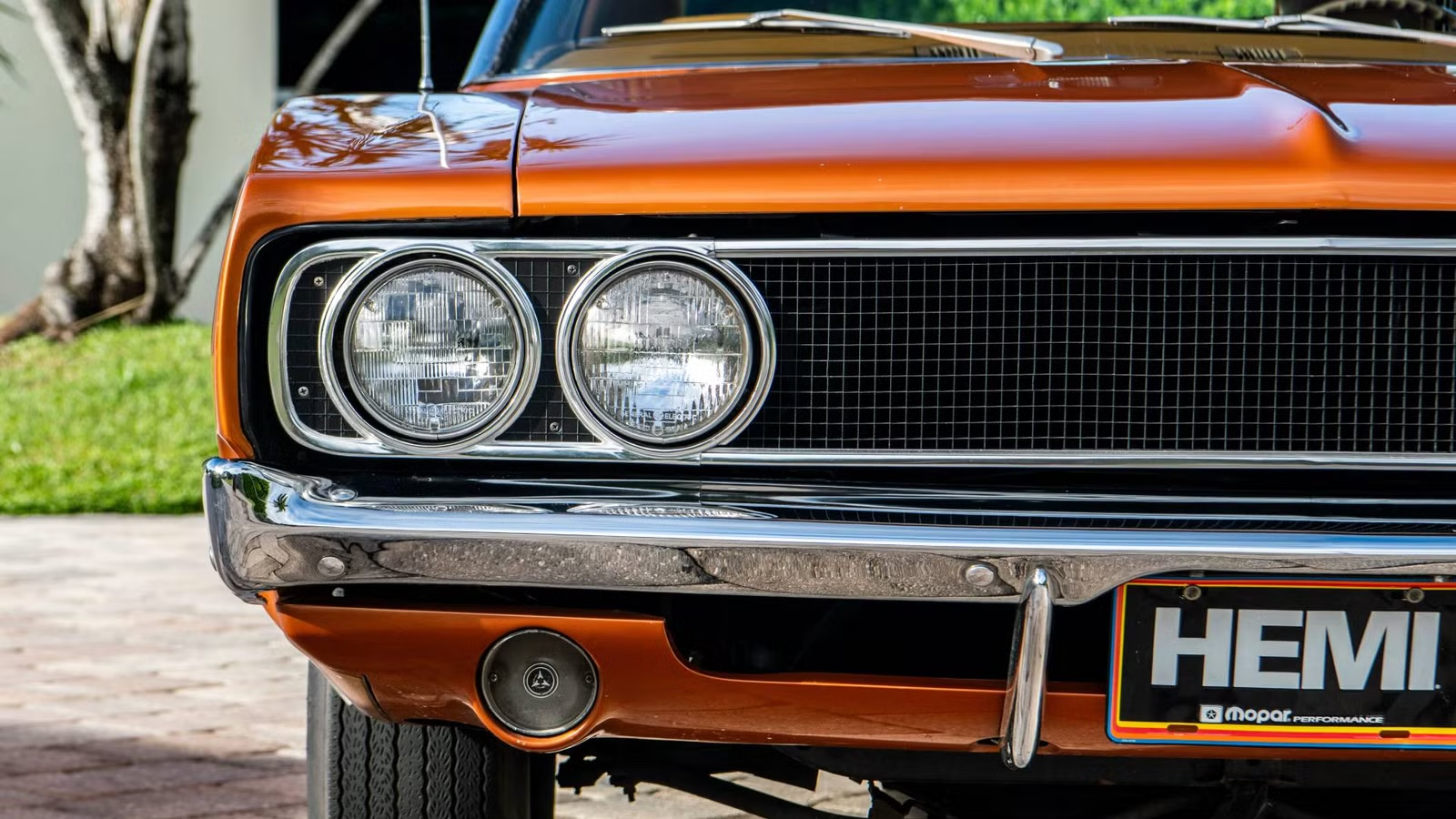
The Dodge Charger was the defining ride of the Golden Age of American Muscle, but its original intent was to redefine stock car racing. Unfortunately, through the first two generations, the Charger’s design, which was sizzling on the streets, was absolutely tepid on the track, suffering from horrendous airflow. Dodge eventually ironed out the wrinkles with the wild-winged Daytona aerocar, but most people don’t know that another Charger model was the first car to address the aerodynamic issues. The Daytona obviously went on to NASCAR dominance, but it would never have happened if not for the 500 and its wind-splitting concepts.
Win On Sunday, Sell On Monday

Back in the day, NASCAR was still stock car racing, meaning the cars roaring around the track were the same basic rides available at your local dealership. Automakers invested heavily in race teams because when fans saw their favorite driver capture a checkered flag on Sunday, by Monday they were on the lot for a test drive. In 1964, Plymouth was doing some volume business with the Belvedere, thanks to Richard Petty piloting a Hemi-power one for his first Cup Series Championship campaign. Dodge was reasonably successful in 1964 with the 330, taking fourth and fifth place, and while they had a great stable of drivers including David Pearson, Bobby Isaac, and A.J. Foyt, they didn’t have a track killer yet, which is where the Charger would come in.
First-Gen Dodge Charger Zamboni

1966 was a huge year for Dodge and the classic muscle car era, as it’s when the 426 cubic-inch Hemi V8 and the Charger both first hit the streets. The Hemi was made available because Dodge needed to homologate it for NASCAR after Ford cried that it was too fast and got it banned. The Charger was designed specifically to be their stock race car, but this was before wind-tunnel testing, and it was just assumed that its long, sloping roofline and rear end would act like a foil, cutting through the wind like a lightsaber through Darth Vader’s limbs. No, seriously, starting with his Anakin days, Lord Vader has had his arms and legs chopped off approximately six times. In any case, it turned out that the roof diverted air down the sides of the Charger instead of pushing it down onto the rear end, resulting in lift over the rear axle. Drivers described driving the first-gen Charger at high speeds as being like driving on ice, which is clearly the exact opposite of what you would want in a race car.
Second-Gen Charger Needs Charging

In 1968, Dodge unleashed the second-gen Charger, which was the baddest design of the entire Golden Age, but what they were hoping for with its design was a NASCAR superstar that could stick to the track. To address the lift issues with the first-gens, Dodge designed a “flying buttress” roof with a recessed rear window that they thought would channel the air straight down the back. Instead, air became turbulent, which created a low-pressure wake, leading to both drag and lift. That wasn’t the only problem with the second-gen design, as the recessed front grille acted like an air scoop that not only created drag but also reduced steering response. When the car would enter a turn, it wanted to keep going straight, which is a terrifying thing at 180 MPH. The second-gen Charger may have looked dynamite, but with top speeds out of reach, it was another dud.

’69 Charger 500 Takes A Third Stab At It

With mounting frustrations over the Charger’s inability to kick some NASCAR ass, Dodge attempted to salvage the second-gen with a couple of design changes they thought would put this matter to bed. First, they replaced the recessed front grille with a Coronet flush grille, and then they smoothed out the rear window, ditching the stylish channels on either side of it. To the untrained eye, a Charger 500 looks like a second-gen car, but this was more than a trim package and had actual sheet metal differences. The 500s were modified right there on the assembly line alongside the regular second-gens, so no extensive retooling was necessary. Many people assume that car was named after the Daytona 500, NASCAR’s premier race, but actually it was dubbed the 500 because that’s how many cars they had to sell to qualify it for competition.
Issues Addressed, But Still Unimpressed

With the new flush grille and rear window, the ’69 Charger 500 created much less lift and drag, but was it the closed-circuit crusher Dodge was hoping for? The answer is kind of yes but mostly no. Bobby Isaac did win 17 NASCAR races in 1969 behind the wheel of a 500, with two other drivers taking checkered flags in one, so it was a decent race car. The problem was, it wasn’t a dominant race car, and Ford upped the stakes with their aerodynamic Torino Talladega, which the 500 had trouble keeping up with. There was also the Mercury Spoiler II, which was cutting through the wind, so Dodge recognized that decent wasn’t going to be good enough in the coming aerocar wars. What the 500 actually achieved was to point Dodge in the right direction, serving as a stepping stone for what would become the ultimate NASCAR race car.
Homologation Halted

It was called the Charger 500 to reflect the number of cars they needed to meet NASCAR homologation requirements, but Dodge should have named it the 392, because that’s how many they actually produced. With Dodge shifting focus to the radical Daytona aerocar, the 500 project was abandoned, and the homologation numbers were never met. The question is, if they were supposed to make 500 to qualify, but they only came up with 392, why were they allowed to race? The answer is probably that the 500-car homologation rule is a total crock that people, this editor included, continue to write about. The truth is, there is no official NASCAR 500 car rule for 1969 or any other hard numbers. They just wanted to make sure that the car racing had a production passenger vehicle counterpart and actually wanted as many different manufacturers and models competing as possible.
’69 Charger Daytona Dominator

After so many disappointing years with the Charger, Dodge finally went outside the box, or realistically blew the damn box up with the 1969 Charger Daytona. An air-scoop grille was no longer a problem because they fitted an 18-inch pointed fiberglass nose cone that allowed smooth airflow over the front of the car and reduced aerodynamic drag. Both lift and drag were also completely eliminated with an outlandish 23-inch-tall rear wing that created downforce but, more importantly, also stabilized the car at high speeds. This was the first car to break the 200 MPH barrier on a closed course when Buddy Baker logged a 200.447 MPH lap at Talladega Superspeedway in 1970. It was a late entry for the 1969 NASCAR season, but it did manage to win two races. In 1970, it was utterly dominant, with Bobby Isaac winning 11 races and the championship, though it’s possible some of those victories were not in a Daytona.
Superior ’70 Superbird

Richard Petty left Plymouth in 1968 to drive for Ford, so the 1970 Plymouth Superbird was used as bait to lure him back. Based on the Road Runner, it too had a nose cone and rear wing like the Daytona, but was contoured slightly differently. Those subtle changes proved to be beneficial as Petty alone won 18 races in 1970, all or most driving a Superbird. The reason why we can’t say for sure is that Petty’s racing team only listed his car that season as a “1970 Plymouth.” There are 12 wins that are documented for sure as a Superbird, but six others where he might have been driving a normal Road Runner. It doesn’t seem likely, considering how much ass he was kicking in the Superbird, but without confirmation, we can’t state it as fact. The real kicker here is that Petty won 18 races and finished 6th in the points standings, so he had a real feast-or-famine kind of a year.
The Great Aerocar Ban of 1970

Between the Dodge Daytona, Plymouth Superbird, Ford Torino Talledega, and Mercury Cyclone II, the 1970 NASCAR season was totally wild, in which aerocars took nearly every checkered flag. Despite giving fans the most thrilling season in its history, NASCAR decided aerocars were too dominant and banned them after 1970. Well, technically they didn’t prohibit them — they just changed the rules stating that aero-bodied cars were limited to 305ci engines, so it was effectively a ban. Dodge still could have fielded a Daytona in ’71, but with a 305 it would have had a last-place campaign for sure. Ironically, Richard Petty started driving third-gen Chargers, and performing very well in them — cars that had a “fuselage” body style that was notably aero-bodied in appearance.
1969 Charger 500’s Quiet Collectibility

Considering its rarity and historical significance, the ’69 Charger 500 should be a marquee Mopar collectible, but the fact is, most people aren’t even aware of it. The 500 became a mid-level trim for the 1970 second-gen Charger as well as the 1971–1974 third-gen, so maybe a lot of people dismiss it, thinking it’s an okay appearance package instead of the raucous homologation special it is. The ’69 500 came standard with a 375 horsepower 440 big-block and was upgradable to the 425 hp 426 Hemi V8. Of the 392 units, 325 of them were 440 cars, while there were just 67 unicorns. The 440s have a Hagerty value of between $45,900 and $146,000, which is not bad, and the Hemis go from $109,000 for a project car to $276,000 for a Concours condition showpiece.
Charger 500: From Chopping Block To Auction Block Captain

Because this is something of an overlooked Mopar, the auction results are all over the place. Mecum has sold a numbers-matching 440 in great condition for as low as $53,900, which is an exceptional value for such a rare classic Mopar. There have also been some 440 cars that have flirted with or exceeded the six-figure threshold, but none that met or beat its Concours condition value of $146,000. For the Hemi cars, which are again quite rare, one in excellent shape sold for $115,000, which is about its base condition value, and several more for under $200,000. There was a pair that sold for exactly $231,000 with that Green Machine above in 2025 and that Hemi Orange Honey two clicks up in 2023. There was another Hemi Orange Hemi 500 that was bid up to $270,000 but didn’t hit the reserve and failed to sell in 2025. It should be noted that none of these prices actually hit the 500’s top condition value, so this is a worthy investment with nothing but upside.
Sources: Hagerty, Mecum

Related posts





Latest Post


No Comments