
The 1970 Pontiac Luxury Cruiser Hiding 500 LB-FT And GTO-Grade Firepower
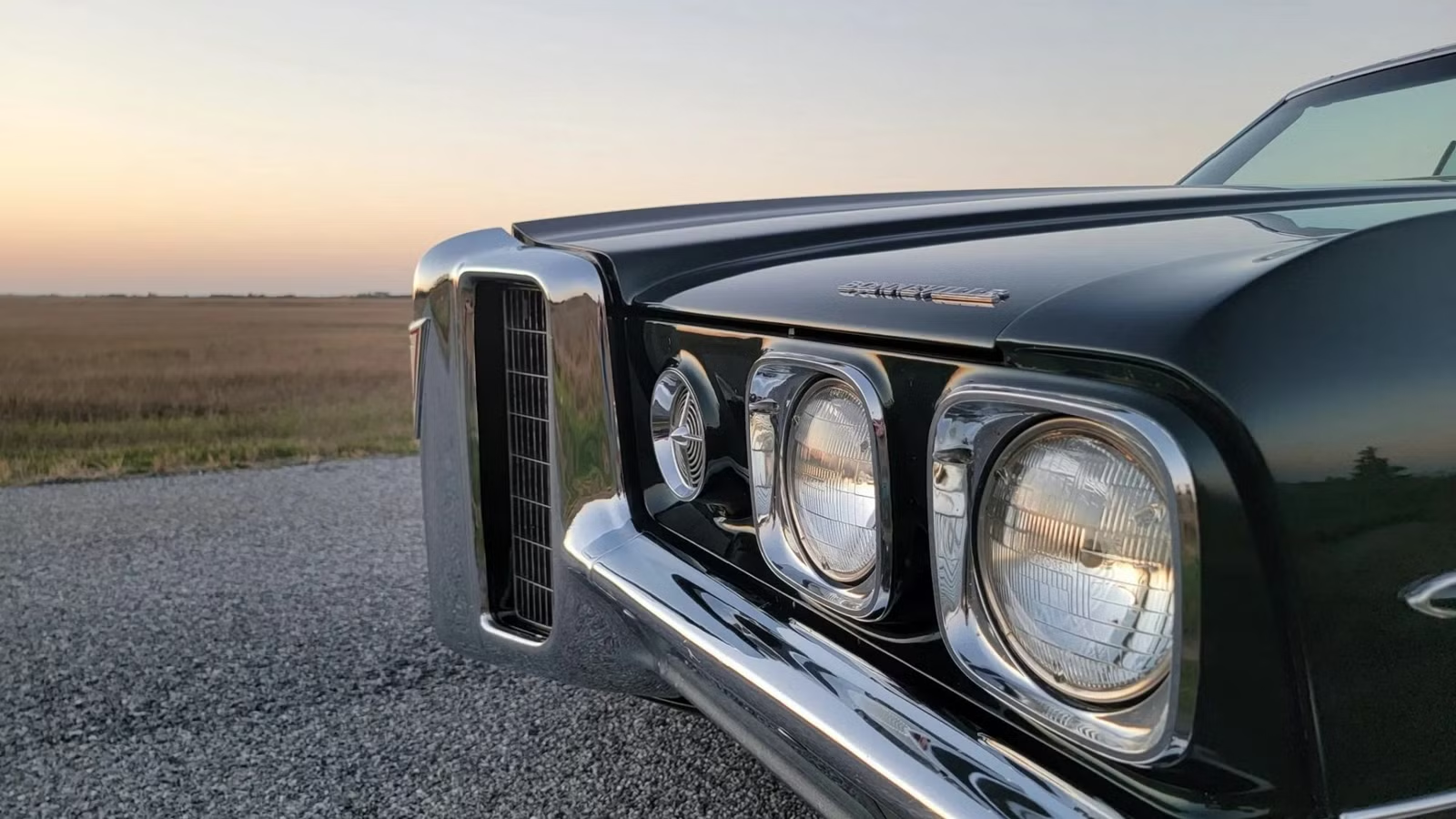
Detroit built plenty of obvious muscle in 1970. Hood scoops, stripes, spoilers, loud exhausts, and bright paint made sure nobody missed the point. One of Pontiac’s biggest full-size luxury cars at the time packed 455 cubic inches, around 500 lb-ft of torque, and the same big-displacement thinking found in the GTO and Grand Prix. Yet it wrapped that hardware in deep seats, acres of sheet metal, chrome, and power accessories.
1970 Was The Last Year Detroit Could Still Get Away With This

The 1970 model year landed at the perfect moment for American engine excess. Pontiac introduced its 455-cubic-inch V8 and spread it far beyond one halo model. A 455 appeared in full-size cars, the personal-luxury Grand Prix, and even the GTO after GM relaxed its old 400-cu-in displacement ceiling for intermediate cars. Pontiac rated different versions at roughly 360 to 370 gross horsepower. But the 455’s real party trick was torque, not power—its 4.21-inch stroke helped it produce as much as 500 lb-ft in 1970 applications, and that shove arrived low enough in the rev range to matter in normal driving.
That kind of engine made particular sense in a large car. Big Pontiacs carried far more mass than an intermediate GTO, so they needed a hard push as soon as the throttle opened, and a long-stroke 455 delivered exactly that. Passing another car could become a squeeze-and-go event instead of a downshift-and-pray exercise. Around 500 lb-ft also gave a big Pontiac something luxury-car buyers valued almost as much as silence: effortlessness.
The timing made the whole thing even more remarkable. Insurance companies had started hammering conspicuous high-performance cars with steep premiums, hurting models aimed at young buyers. At the same time, Detroit already knew high-compression engines faced a short future. GM president Ed Cole announced in January 1970 that the company would lower compression ratios for the 1971 model year, so its engines could tolerate lower-octane unleaded fuel. Federal emissions requirements were also tightening fast, and the Clean Air Act amendments signed at the end of 1970 demanded huge cuts in future tailpipe pollution. Pontiac launched the 455 just as the rulebook started closing around engines like it. The clock was ticking louder than a loose hydraulic lifter.

Pontiac Hid Its Biggest Advantage Behind Brocade And Power Accessories

The car in question gave almost no visual warning. It sat on GM’s full-size B-body architecture and stretched roughly 224.6 inches from bumper to bumper, with a 125-inch wheelbase. A four-door example with the 455 could weigh well over 4,300 pounds at the curb. That meant a long hood, a huge passenger compartment, formal rooflines, and enough bodywork to make today’s three-row crossovers look like they skipped breakfast. Pontiac dressed that mass for polite company with rich patterned fabrics, Morrokide upholstery, padded seats, armrests, burled-elm-style trim, and thick carpeting.
That fit Pontiac’s showroom strategy. The GTO existed for buyers who wanted everybody at the burger stand to know what they had bought. Firebirds served the sporty pony-car crowd. Pontiac’s big cars had another job, though – they sold room, comfort, road manners, and prestige, with performance acting more like a reserve of strength than the whole sales pitch. The factory options list drove the point home. Buyers could add air conditioning, cruise control, power windows, four- or six-way power seats, power door locks, a power trunk release, upgraded radios, and automatic level control. Pontiac would even sell performance hardware such as Safe-T-Track and firmer suspension pieces, but the cabin still looked ready for a business lunch rather than a burnout contest.
That created a wonderfully strange sleeper. A buyer could surround the big V8 with a vinyl roof, wheel covers, soft upholstery, and power conveniences, then drive away looking like the sort of person who carried a briefcase and knew what a municipal bond was. Pontiac had effectively hidden one of its strongest mechanical advantages behind an interior designed to make passengers ask whether the air conditioning could get a little colder.
The 1970 Pontiac Bonneville Put 455 Muscle In An Executive Suit

That car was the 1970 Pontiac Bonneville, then Pontiac’s senior full-size luxury model. It lived at the opposite end of the showroom from the youth-market GTO. The automaker presented the Bonneville as a car for buyers who had money, passengers, luggage, and no interest in explaining themselves at every stoplight. Its factory brochure went so far as to call the 1970 edition the most luxurious Bonneville Pontiac had built. The Brougham option could pile on contoured seats, cut-pile carpet, center armrests, power windows, and a power-operated front seat.
Under the hood, however, Pontiac got wonderfully unreasonable. The 455 was not merely some obscure extra buried in fine print. Pontiac’s 1970 brochure described a 455-cu-in, 360-horsepower V8 as the Bonneville’s normal power plant, with a 370-hp version available for buyers who wanted still more. A regular-fuel 400 could also be specified. Period specifications put the 360-hp four-barrel 455 at roughly 500 lb-ft of torque, while references list the Bonneville’s 1970 455 at a lofty 10.75:1 compression ratio.
There is an important detail here for anyone who enjoys turning Pontiac engine codes into a competitive sport. Some modern databases label a 370-hp Bonneville engine as a “ 455 HO,” but Pontiac’s own 1970 consumer brochure simply tells Bonneville buyers that they could order a 370-hp version of the 455. It does not present a special Bonneville “455 HO” trim level or a separate muscle-car package.
The Bonneville therefore did not become a four-door GTO simply because somebody checked the right engine box. Physics still collected its bill—the big Pontiac stretched more than 18 feet long and carried several hundred extra pounds compared with Pontiac’s intermediate muscle car. Its suspension, gearing, seating position, and overall mission favored relaxed speed over drag-strip drama. Yet that is exactly what makes the car interesting—the GTO turned 455 cubic inches into theater, and the Bonneville used the same big-cube philosophy to make speed feel casual.
One Model Year Later, Pontiac’s 455 Was Already Being Tamed

The window started closing almost immediately. For 1971, GM imposed much lower compression ratios across its divisions, so engines could operate on lower-octane, low-lead, and unleaded gasoline. Pontiac’s performance engineers had to work around that new reality instead of simply raising compression and feeding an engine premium leaded fuel. The change was not some distant response to the 1973 oil crisis, which had not happened yet. GM had announced its low-compression direction during 1970, and the engines arrived for 1971. That makes the 1970 Bonneville’s high-compression 455 feel less like a random old V8 and more like a mechanical artifact from the final months of an outgoing design philosophy.
Pontiac’s 1971 455 H.O. shows the shift clearly, although that engine should not be confused with a special Bonneville specification. In GTO and Trans Am applications, the 455 H.O. used an approximately 8.4:1 compression ratio and carried a 335-hp gross rating. It still made about 480 lb-ft of torque. It gained desirable hardware including round-port cylinder heads, a freer-flowing aluminum intake, and high-flow exhaust manifolds. It remained a formidable street engine because 455 cubic inches can cover a lot of regulatory bruises.

The historical trap involves the horsepower numbers themselves. Detroit also began moving from SAE gross ratings toward SAE net figures around this period. Gross numbers came from engines tested under favorable laboratory conditions, while net ratings better reflected the installed engine running accessories and production exhaust equipment. That change makes the early-1970s horsepower collapse look even steeper on paper. But the 1971 compression cut was not bookkeeping – it represented a real mechanical change. Pontiac had to engineer around lower-octane fuel while emissions became a central development target.
For the Bonneville, the transition carried another bit of symbolism. Pontiac introduced the Grand Ville for 1971 and placed it above the Bonneville in the full-size hierarchy. The Bonneville had spent years as Pontiac’s big-car flagship; now its place in the pecking order changed at almost the same moment that Pontiac’s engines changed philosophy. A buyer who drove home in a 1970 Bonneville was therefore catching two endings at once – the car came from the last model year before GM’s sweeping compression reduction, and from the final year before another nameplate took over Pontiac’s top full-size luxury slot.
The Bonneville’s Real Trick Was Making The End Of The Muscle Era Look Luxurious

Put the pieces together and the Bonneville becomes much more interesting than its old “land yacht” stereotype suggests. Here was a full-size B-body stretching nearly 225 inches, wrapped around 455 cubic inches and roughly 500 lb-ft of torque in its 360-hp configuration. Pontiac even advertised an available 370-hp 455 version. Yet the same brochure talked about patterned upholstery, padded seats, burled-elm-look trim, power windows, and Brougham luxury.
Calling it a secret GTO would sell the Bonneville short. The GTO was lighter, sharper, louder in both appearance and intent, and better suited to the traditional muscle-car job description. The Bonneville did something stranger – Pontiac took the same enthusiasm for displacement that powered its performance cars and gave it to a customer who might care more about an automatic transmission, air conditioning, a soft seat, and quiet highway speed.

Then 1971 arrived with lower compression, changing fuel requirements, tightening emissions demands, rising insurance pain, and a new full-size flagship above the Bonneville. Later 455s still had plenty to offer, and Pontiac would prove remarkably good at extracting useful performance from big displacement under tougher rules. But 1970 remains the cleaner snapshot of the old formula: high compression, huge cubic inches, gross horsepower figures, and very little embarrassment about fuel consumption. The end of Detroit’s first muscle era was already visible, but one of its last great expressions was sitting quietly in Pontiac’s full-size catalog, wearing luxury trim and waiting for somebody to press the accelerator.
Source: Pontiac, Hemmings, Hagerty

Related posts





Latest Post


No Comments