
The McMurtry Spéirling Pure Just Became The First Production Car That Can Physically Drive Upside Down
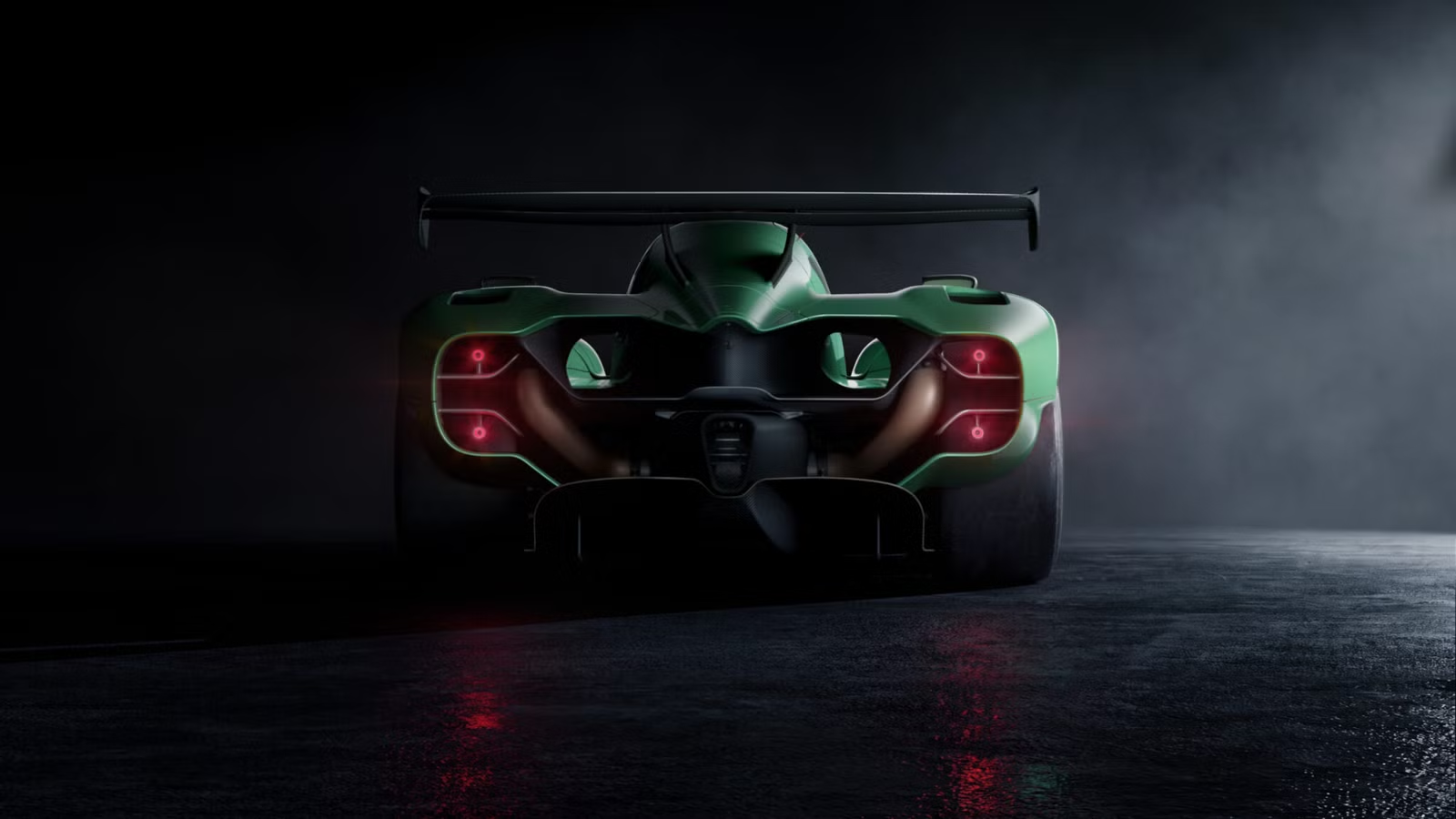
McMurtry Automotive confirmed production specifications for the Spéirling PURE this week, and the headline number isn’t horsepower or lap time — it’s a gravitational claim no road-legal Supercars has ever made before. The Pure generates enough fan-driven downforce to adhere to an inverted surface at speed, making it the first production car physically capable of driving upside down. That’s not a marketing metaphor. It’s a measurable engineering threshold, and McMurtry has cleared it.

The announcement lands with a price tag to match the ambition: $1.3–1.4 million, limited to 100 units. Performance figures are equally staggering — 0–60 mph in 1.55 seconds, 1,000 horsepower from an all-electric drivetrain, and a 100 kWh battery backing the whole system.
 84 autotech
The Quickest British Car You’ve Never Heard Of
This monster will launch to 60 in a mind-numbing 1.4 seconds and destroy lap times while looking like a Batmobile.
How the Fan System Actually Works — and Why It Changes Everything

Traditional hypercar aero relies on shaped bodywork — splitters, diffusers, rear wings — to redirect airflow and push the car into the pavement. The physics work, but they’re speed-dependent: at low speeds, there’s not enough airflow to generate meaningful downforce. A Bugatti Tourbillon or Koenigsegg Gemera can produce enormous grip at 150 mph, but at 30 mph they’re essentially aerodynamically inert.
McMurtry’s approach flips that logic entirely. The Spéirling Pure uses a high-powered electric fan system mounted beneath the car to actively evacuate air from a sealed skirt surrounding the underbody, creating a persistent low-pressure zone regardless of road speed. Downforce is present from a standstill. The moment the car is moving — even crawling through a pit lane — the suction effect is already working. That’s why the upside-down claim is credible: the system doesn’t need velocity to function, it needs the fan spinning. At sufficient fan speed, the generated downforce exceeds the car’s own weight, which is the precise definition of being able to stick to a ceiling.
This is the same principle that got Brabham’s BT46B fan car banned from Formula 1 after a single race in 1978. McMurtry has spent years refining it into a road-legal, production-viable package — and the Pure is the result.
The Production Numbers: 100 Units, Seven Figures, Bigger in Every Direction

The production Spéirling Pure is physically larger than the prototype that set records at Goodwood. McMurtry expanded the exterior dimensions and increased battery capacity to the 100 kWh unit, changes that bring real-world usability closer to what a buyer paying $1.3–1.4 million would expect. The car remains a single-seater — the narrow, centreline-cockpit layout is fundamental to the aerodynamic architecture — but the production shell has been engineered to meet road-legal requirements across key markets.
With 100 units planned, the Pure sits in rare company by production volume. For comparison, the Koenigsegg Jesko Absolut was capped at 125 cars; the Gordon Murray T.50 — another fan-car concept, though a passive one — was limited to 100. McMurtry’s production run matches that benchmark while making a performance claim neither of those cars can match.
Quicker Than an F1 Car — and What That Benchmark Actually Means

The 1.55-second 0–60 figure is the one that stops the conversation. Fan-generated suction loads the tyres from the moment of launch — there’s no waiting for aero to build, no wheelspin window to manage. The car is mechanically planted at zero mph, which means the electric motors can apply full torque almost immediately without overwhelming grip.
That’s the deeper engineering story here. The upside-down headline grabs attention, but the performance implication is what reshapes the hypercar conversation. Passive-aero machines like the Bugatti Tourbillon — with its naturally aspirated 8.3-litre V16 hybrid producing around 1,800 hp — generate extraordinary power figures, but they’re still fighting the same low-speed aero limitations that have defined the segment for decades. The Spéirling Pure sidesteps that constraint entirely. More power doesn’t automatically mean faster acceleration if the tyres can’t put it down. Fan downforce solves the traction problem at the source.
One hundred gearheads are about to take delivery of a car that does something no production machine has done before. The engineering case for fan-based aero has been theoretical for nearly 50 years — McMurtry just made it real, road-legal, and buyable. Enthusiasts who’ve followed the Goodwood record runs and the prototype development deserve to see what this thing does on a proper circuit. The benchmark has been set.

Related posts




Latest Post


No Comments