Refreshed Audi Q7 Trim Steals Attention From X7 xDrive40i Buyers
9 minutes reading
Monday, 5 Oct 2026 11:30 0 6 autotech
Three-row luxury SUV shoppers with roughly $70,000 to spend have long defaulted to the BMW X7. It’s spacious, capable, and carries the badge cachet that justifies the price. But Audi’s redesigned third-generation Q7 changes the math in a way a simple refresh never could. A new twin-turbo V6 now sends 429 horsepower to all four wheels, a reworked cabin closes the tech gap entirely, and the starting price still lands nearly $16,000 under the X7 xDrive40i. This isn’t about accepting less for a discount. It’s about whether the X7’s extra size still justifies its price once the Q7’s new case is laid out in full.
Three-row luxury SUVs occupy an odd corner of the market. Buyers spending $65,000 to $100,000 expect a vehicle that does everything. It should be comfortable for a family of seven, composed on a highway run, quiet enough to justify the badge on the trunk lid, and still reasonably efficient. Few nameplates manage all of it without asking the owner to give something up.
The 2026 BMW X7 has spent years as the default answer. It’s the biggest, most powerful vehicle in this comparison, and its 2024 chassis refresh already sorted out the air suspension and steering feel that once felt disconnected from the rest of the lineup. But the X7 xDrive40i starts at $86,700, and options can push a well-equipped example past $100,000 before anyone touches the flagship M60i.
Rear 3/4 shot of 2025 BMW X7 xDrive40i in blue parkedBMW
That price ceiling is exactly where the compromise conversation begins. At six figures, buyers start asking harder questions. Does the third row actually seat adults, is the fuel economy defensible for a daily driver, and does the cabin feel special enough to justify skipping a loaded midsize sedan or a smaller, sportier SUV instead? The Mercedes-Benz GLS circles this same territory, but neither it nor the X7 has faced the kind of direct challenge that Audi’s redesigned Q7 now presents.
The outgoing Q7 has been criticized for showing its age, riding on a platform that dates to 2015 with two prior facelifts. Audi didn’t answer that with another facelift. The 2027 Q7 is a ground-up third generation, built to compete on power and technology rather than price alone. Whether it succeeds changes who the default recommendation should be.
Audi’s Refreshed Q7 Brings Premium Design And Six-Cylinder Muscle Into Sharper Focus
2027 Audi Q7 front shotAudi
The 2027 Audi Q7 drops the old two-engine, four-cylinder-and-V6 lineup entirely in favor of a single, more potent powertrain: a twin-turbocharged 2.9-liter V6 producing 429 horsepower and 442 pound-feet of torque, paired with an eight-speed Tiptronic automatic and standard quattro all-wheel drive, now with a new limited-slip center differential. Audi claims a 0-60 mph time of 4.8 seconds, nearly a full second quicker than the outgoing 3.0 single turbo V6 model managed.
That’s a significant jump. The old 55 TFSI V6 made 335 horsepower. The new standard engine makes nearly 100 more, which means every 2027 Q7 leaving the factory now out-powers the BMW X7 xDrive40i by 54 horsepower, a gap that didn’t exist in the previous generation. Pricing starts at $70,900 for the Premium trim before destination, still comfortably under the X7’s $86,700 starting point despite the power increase.
2027 Audi Q7 rear 3/4 shotAudi
For buyers who want more, Audi is also launching a redesigned SQ7 alongside the standard car, powered by a twin-turbo 4.0-liter V8 making 591 horsepower and 590 pound-feet of torque, good for a 3.7-second 0-60 run. It starts at $98,700 and makes the standard air suspension available on the Q7 a standard fitment on the SQ7 specifically. Both models are built in Bratislava and begin arriving at US dealers in the fourth quarter of 2026 as 2027 models.
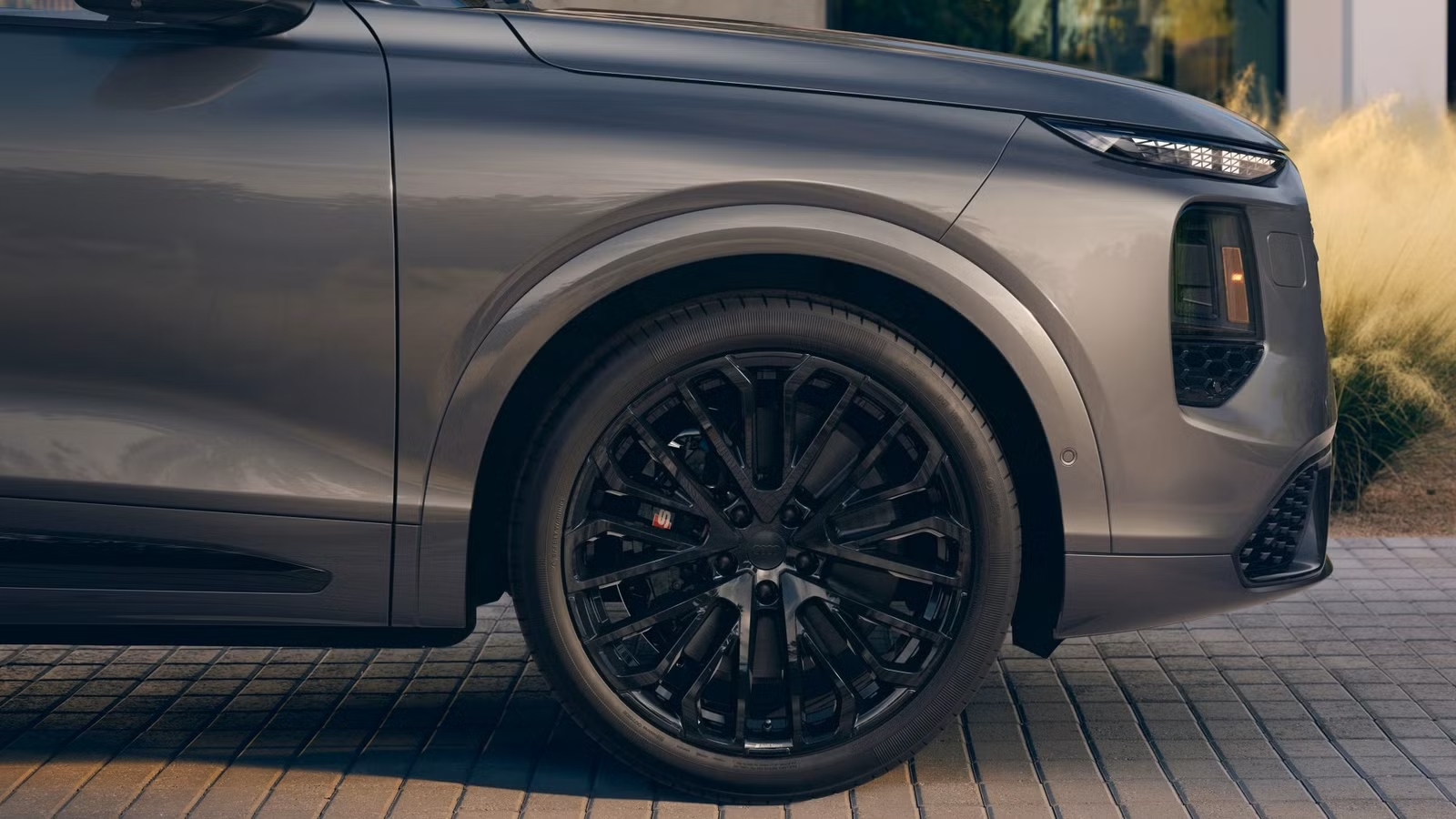
Visually, the redesign borrows cues from the upcoming Q9 flagship, with a more dramatic front end and lighting graphics that move the Q7 decisively away from the design language it wore for over a decade. It’s a generational shift rather than an incremental one, and it removes the “dated” criticism that had followed the previous Q7 for years.
The Q7 Costs $19,000 Less To Own Over Five Years — And That Changes The Math Entirely
The case for the Audi Q7 isn’t about accepting less. For the first time in this rivalry, it’s about getting more power and more standard technology for meaningfully less money, and recognizing that a portion of X7 xDrive40i shoppers never needed the BMW’s extra size to begin with.
Consider the ownership picture. Kelley Blue Book estimates a five-year cost to own of roughly $88,900 for a Q7, against approximately $108,200 for the X7 xDrive40i, a gap driven by both the higher purchase price and steeper depreciation on the larger BMW. For a buyer financing the difference, that’s real money that could go toward a longer loan term, a lower monthly payment, or simply staying under a self-imposed budget ceiling without dropping down to a non-luxury nameplate.
2027 Audi Q7 rear seatingAudi
The Q7 also suits a specific kind of household better than the marketing suggests. Audi now offers a six-seat configuration with second-row captain’s chairs alongside the standard seven-seat layout, something the X7 also offers but without the Q7’s newly expanded 78.1 cubic feet of cargo space with the rear seats folded, up notably from the outgoing model’s 69.6 cubic feet. If the third row is reserved for occasional carpool duty rather than full-time adult seating, the Q7’s slightly smaller footprint matters less than the price and power advantage now working in its favor.
Warranty coverage remains comparable between the two brands, which removes one traditional disadvantage from the equation. What’s left is a buyer decision less about accepting a smaller, less powerful alternative and more about whether the X7’s added size is worth paying nearly $16,000 more for, when the Q7 now matches or beats it on the numbers that used to favor BMW outright.
Three Screens, Bang & Olufsen Audio, And 7,700-Pound Tow Rating: The Q7’s Cabin Stops Playing Catch-Up
2027 Audi Q7 front cabinAudi
Where the Audi Q7’s refresh earns the most credit is inside the cabin, where the tech gap to the X7 has effectively closed. The new Q7 runs a 14.5-inch central touchscreen, an 11.9-inch digital instrument cluster, and a 12.3-inch passenger display—a three-screen layout that outscopes the X7’s setup on paper. Wireless Apple CarPlay and Android Auto come standard, along with a 22-speaker Bang & Olufsen audio system, an AI voice assistant, a head-up display, a built-in dashcam, and dual Qi 2.2 wireless charging pads in the center console. An illuminated panoramic sunroof with adjustable transparency rounds out a cabin that no longer reads as the older design in this comparison.
The X7’s most recent update brought iDrive 8.5 as standard equipment, along with standard wireless charging, heated front seats, and adaptive matrix LED headlights. BMW’s curved display remains a strong, dramatic execution, and its voice control and gesture functions are proven and mature. But the Q7’s new three-screen layout and expanded feature set mean Audi is no longer playing catch-up on technology the way the previous generation was.
2027 Audi Q7 screenAudi
Ride comfort tells a similar story. The X7 benefits from the air suspension and steering refinements introduced in its 2024 chassis update, and it remains the more composed vehicle over broken pavement, thanks to its size and standard air springs. The Q7’s optional adaptive air suspension (standard only on the SQ7) doesn’t automatically match. Buyers who want that setup on the standard Q7 will need to option it, whereas BMW includes it from the base trim. It’s a real point in the X7’s favor, but it no longer stands alone the way it once did against an aging Q7 platform.
Practically, the Q7 holds its own on utility too. Its 429-horsepower V6 delivers stronger real-world acceleration than the class average suggests, and it can tow up to 7,700 pounds when properly equipped, matching the X7’s capability and covering the needs of most families cross-shopping this segment.
The Q7 Now Wins On Power, Tech, And Price — Here’s The One Reason To Still Choose The X7
2027 Audi Q7 front 3/4 shotAudi
2027 Audi Q7 rear 3/4 shotAudi
The X7 xDrive40i hasn’t lost its position at the top of this segment. Its respectable power, more sophisticated air suspension, and genuinely larger interior still justify the price for buyers who need maximum capability and can afford to pay for it. Nothing about the Q7’s refresh changes that fundamental comparison.
What has changed is the size of the compromise required to choose the Audi Q7. A buyer who wants more power, a newer and more comprehensive technology suite, and a nearly $16,000 lower starting price no longer has to accept a smaller engine or an outdated cabin to get there. The redesigned Q7 asks for less money and delivers more horsepower, which flips a dynamic that has favored BMW in this segment for years.
2027 Audi Q7 rear seatingAudi
The decision still comes down to priorities. Buyers who want the most settled, isolated ride quality available and consider standard air suspension non-negotiable should stay with the BMW X7, which remains the more composed vehicle over rough roads. But buyers who want stronger acceleration, newer cabin technology, and lower ownership costs now have a genuinely competitive reason to choose the Q7—not as a fallback, but as the more complete package on paper.
Base Trim Engine
2.9L Twin-Turbo V6
Base Trim Transmission
8-Speed Automatic
Base Trim Drivetrain
All-Wheel Drive
Base Trim Horsepower
429 hp @ 5,500-6,800 rpm
Base Trim Torque
442 lb-ft @ 2,000-4,500 rpm
Make
Audi
Model
Q7
Segment
Midsize Luxury SUV
Sources: Audi U.S., Edmunds, Kelley Blue Book, MotorTrend











No Comments