
The Kawasaki You Should Buy Instead Of A Honda
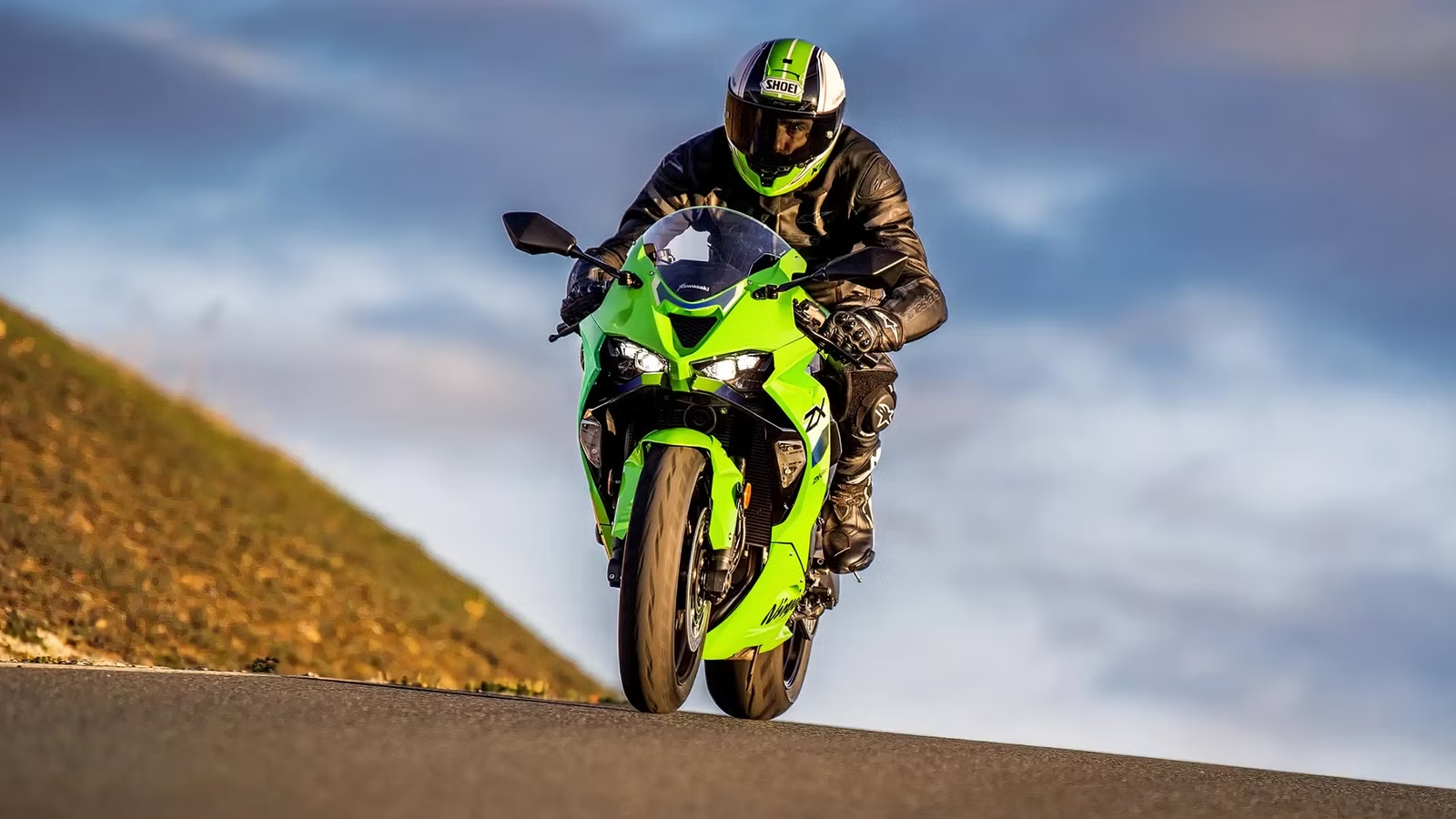
For decades, the global motorcycle industry has been shaped by the Japanese Big Four. Out of them, Honda has traditionally focused on refinement, reliability, and accessible performance, while Kawasaki has built its reputation on aggressive styling and exhilarating performance. Both manufacturers offer compelling supersport motorcycles, but when outright performance and everyday usability matter equally, one particular Kawasaki makes a convincing case against its Honda rival.
Honda’s Two-Wheeler Lineup Is Hard To Beat Today

Honda’s motorcycle lineup is among the most diverse in the industry. From entry-level commuters and rugged dual-sports to globe-trotting ADVs like the Africa Twin and luxurious Gold Wing tourer, Honda covers virtually every corner of the market. In the sportbike arena, the Japanese maker’s pedigree remains legendary. Riders can step onto the forgiving CBR500R, graduate to the balanced CBR650R, or chase lap records aboard the razor-sharp CBR600RR and MotoGP-derived CBR1000RR-R Fireblade SP. However, Honda is not the only Japanese manufacturer with an impressive track record in this category.
But Kawasaki Has Its Own Machines That Define The Segment

Kawasaki’s lineup is equally broad, spanning Ninja sportbikes, middleweight naked bikes, adventure machines, cruisers, and flagship hypersport models. However, while Honda often prioritizes versatility, Kawasaki has built much of its reputation around motorcycles that feel purposeful, exciting, and unmistakably performance-oriented.
The Ninja family is at the heart of that identity. From the entry-level Ninja 300 to the breathtaking Ninja H2 R, Kawasaki has consistently offered riders a clear progression into its performance world. In the middleweight supersport segment, this Japanese brand has an iconic machine that combines race-derived hardware, an inline-four engine, and modern rider aids. It makes a compelling case against Honda’s established supersport, and that too without sacrificing everyday usability.

The Kawasaki Ninja ZX-6R Brings A Modern Approach To A Classic Formula
Starting MSRP: $11,599

That segment-defining machine is the Kawasaki Ninja ZX-6R, a motorcycle that takes the classic middleweight supersport recipe and brings it squarely into the modern era. Originally introduced in 1995 as a dedicated 600cc track contender, the ZX-6R made headlines in 2003 when Kawasaki increased its displacement to 636cc. This positioned it in a sweet spot between traditional 600cc supersports and the more powerful 750cc machines that once populated the segment.
More than two decades later, that extra displacement still remains its signature calling card. While several rivals have abandoned the inline-four middleweight class, Kawasaki has continued to refine the ZX-6R with sharper aerodynamics and modern electronics. For 2027, the Ninja ZX-6R starts at $11,599 for the non-ABS model and $12,599 with ABS.
A 636cc Inline-Four Engine Gives It An Advantage Where It Matters

The Kawasaki Ninja ZX-6R’s greatest advantage is its engine. While the Honda CBR600RR uses a 599cc inline-four, the ZX-6R gets a larger 636cc, liquid-cooled inline-four engine that churns out 127 horsepower at 13,000 RPM and 52.1 pound-feet of torque at 10,800 RPM. The engine comes mated to a six-speed manual gearbox. Kawasaki’s inline-four mill produces strong low and midrange torque while retaining the urgent top-end rush expected of a proper supersport. Its extra displacement matters most in everyday riding conditions.

Kawasaki also equips the ZX-6R with an assist and slipper clutch, which reduces retarding torque during aggressive downshifts and helps keep the motorcycle stable. Its quickshifter enables clutchless full-throttle upshifts, making acceleration smoother and more immediate. These are meaningful performance features, especially for riders who use the bike on both the road and track. The Honda rival—the CBR600RR—has neither of these.
Aggressive Ninja Styling Paired With Track-Ready Suspension

The Ninja ZX-6R looks every bit like a supersport motorcycle, with sharp bodywork, an aggressive front fascia, aerodynamic fairings, and a compact rear section. Its design draws clear inspiration from Kawasaki’s larger Ninja models, including the ZX-10R. Ergonomically, it strikes a focused yet manageable balance. Clip-on handlebars, rear-set footpegs, and a relatively narrow seat create a committed supersport riding position. It is more demanding than a naked bike or sport-tourer, but not as extreme as a dedicated race replica.
Beneath its aggressive fairing sits a twin-spar aluminum perimeter frame, suspended by a fully adjustable 41mm Showa inverted fork up front and a bottom-link Uni-Trak rear shock absorber. The braking hardware is equally serious, featuring dual 310mm front discs with radial-mounted, opposed four-piston monobloc calipers and a 220mm rear disc. Pirelli Diablo Rosso IV tires provide the grip needed to make the most of its capable chassis on winding roads and the racetrack.
Modern Electronics And Rider Aids That The CBR Misses Out On

Where the Ninja ZX-6R gains a clear advantage over the current North American-spec Honda CBR600RR is its technology package. While the CBR600RR retains an older analog-digital instrument cluster and misses out on standard traction control, riding modes, and a quickshifter, the ZX-6R comes considerably better equipped from the factory. It features a 4.3-inch TFT display with smartphone connectivity and four riding modes: Sport, Road, Rain, and customizable Rider. It also gets traction control. However, Honda recently introduced an updated CBR600RR in Europe that addresses several of these shortcomings, with the revised model expected to reach the American market sometime next year.
A Competitive MSRP Settles The Ninja Vs CBR Debate

Price is where the comparison becomes really interesting. The Kawasaki Ninja ZX-6R starts at $11,599 for the non-ABS model and $12,599 for the ABS variant, compared to $11,499 and $12,499, respectively, for the Honda CBR600RR. For just $100 more, Kawasaki offers a larger, torquier 636cc inline-four engine, sharper aerodynamics, a full-color TFT display with smartphone connectivity, selectable power modes, traction control, and a standard up-only quickshifter. For most buyers, the Ninja ZX-6R makes a stronger overall case. It may not replace the appeal of Honda’s supersport for every fanboy, but for anyone shopping for a middleweight Japanese supersport, Kawasaki’s offering deserves serious consideration.
Source: Kawasaki

Related posts



Latest Post


No Comments