
Chevy Snuck A 427 Into 323 Chevelles, And Now They Sell For Up To $275,000
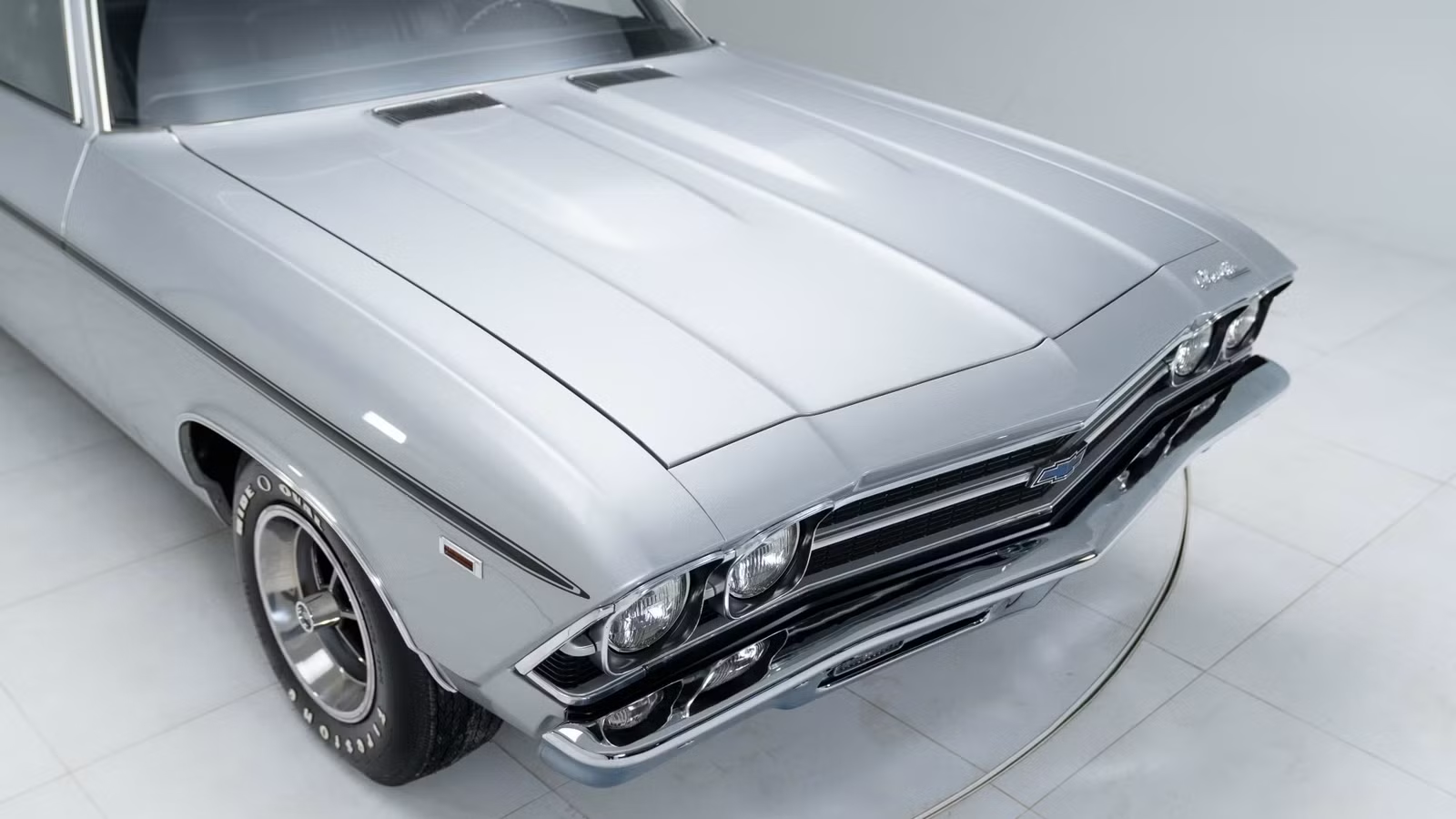
By 1969, Chevrolet had a midsize muscle car that could already scare most of the street. The Chevelle SS 396 was quick, loud, and everywhere. Its parent company, though, had drawn a hard line on how big its intermediate engines could get, and Chevrolet’s biggest big-block sat firmly on the wrong side of it. That should have been the end of the story. It wasn’t. A handful of Chevelles left the factory with an engine General Motors said they couldn’t have, hidden behind a paperwork code built for taxis and fleet trucks.
Chevy’s Secret 427 Chevelles Now Sell For Six Figures

Those cars are the 1969 Chevrolet COPO Chevelles, and the best of them now trade like blue-chip collectibles. The top result so far in 2026 came in January, when a documented Cortez Silver car with a four-speed and its original matching-numbers drivetrain sold for $275,000 at auction in Kissimmee, Florida. It had just two owners from new, and the first kept it for 42 years.
That isn’t quite the ceiling. Back in January 2022, an automatic COPO Chevelle brought $297,000 at the same Florida sale. Still, the 2026 result is the current high-water mark, and it shows where the market sits today for a fully documented, matching-numbers car. Plenty sell for far less, and the reason why comes down almost entirely to paperwork.
How GM’s Displacement Cap Kept The 427 Out Of The Chevelle

The rule was simple and corporate. GM decided no engine bigger than 400 cubic inches could go into anything smaller than a full-size car, with the Corvette the lone exception. Executives framed it as a safety measure, and it applied to every division, so Chevrolet’s midsize and pony cars all stopped short of 400 cubic inches.
That left the Chevelle topping out with the 396. Strong, yes. But down the hall sat the 427, an engine reserved for the Corvette and full-size cars such as the Impala, Biscayne, and Caprice. Racers and performance dealers knew exactly what that engine could do in a lighter body, and they wanted it badly.
COPO 9562 Turned A Fleet Order Code Into A Muscle Car Loophole

The workaround was the Central Office Production Order system, usually reserved for special-equipment fleet orders such as taxi packages and special paint. Vince Piggins, Chevrolet’s performance-products manager, saw that the same channel could bypass the displacement rule entirely. Don Yenko, the Pennsylvania dealer already famous for 427 Camaros, pushed for it, because factory installation spared his shop the cost of swapping engines itself.
The result was COPO 9562. Ordered this way, a Chevelle arrived from the factory with the L72 427 already bolted in, and the whole package cost about $860, including $533 for the engine. No dealer swap and no special build. Just a line of paperwork that quietly overruled corporate policy.
The L72 427 Hiding Inside A Plain Malibu Body

The L72 was a solid-lifter, 11:1 compression big-block, and Chevrolet rated it at 425 horsepower at 5,600 rpm with 460 lb-ft of torque at 4,000 rpm. It breathed through an aluminum intake manifold and a 780 cfm Holley four-barrel, with four-bolt main caps holding the bottom end together. Few believed the 425 hp rating. When the NHRA set the car’s stock drag-racing class, it used a truer 450 hp figure instead.
The car around it gave almost nothing away. None of the 323 COPO Chevelles were Super Sports. Standard cars wore no exterior performance badges, the cabin was plain Malibu, and the unmarked engine could pass for a 396 at a glance. Buyers chose between heavy-duty four-speed manuals or a strengthened Turbo Hydra-Matic, all feeding a 12-bolt Positraction rear axle with 4.10 gears.
Why Only 323 COPO Chevelles Left The Factory

The accepted production figure is about 323 cars, and auction houses still describe it as approximate. Yenko took 99 of them and turned them into Yenko Super Chevelles, with his own stripes and badging. That leaves roughly 224 plain, non-Yenko COPO cars, which is the group the 2026 record-setter belongs to.
The splits get thinner from there. Only about 96 COPO Chevelles left the factory with the automatic, and an estimated 17 to 22 went new to Canada. Every one of those subgroups changes what a buyer pays, because rarity inside a rare car still counts.
What Separates A Top-Dollar COPO Chevelle From The Rest

The spread in prices is huge. A COPO Chevelle that crossed the block in Scottsdale in 2024 sold for $123,200, less than half the 2026 high. Same engine, same factory loophole, same basic body. The difference is almost never the hardware.
Look at what the $275,000 car brought to the block. It had GM of Canada documentation, its original bill of sale and warranty plan, photos from new with its first owner, and an expert inspection certifying its matching-numbers drivetrain. That paperwork matters because COPO cars looked so ordinary, and a Malibu with a crate 427 is easy to build today. Without proof, a buyer pays for a Chevelle. With it, they pay for one of the 323. GM wrote a rule to keep the 427 out of these cars, and now the paper trail proving it got in anyway is worth more than the engine itself.
Sources: Mecum

Related posts



Latest Post


No Comments