
The 70-HP Military Truck That Swept The 1980 Paris-Dakar
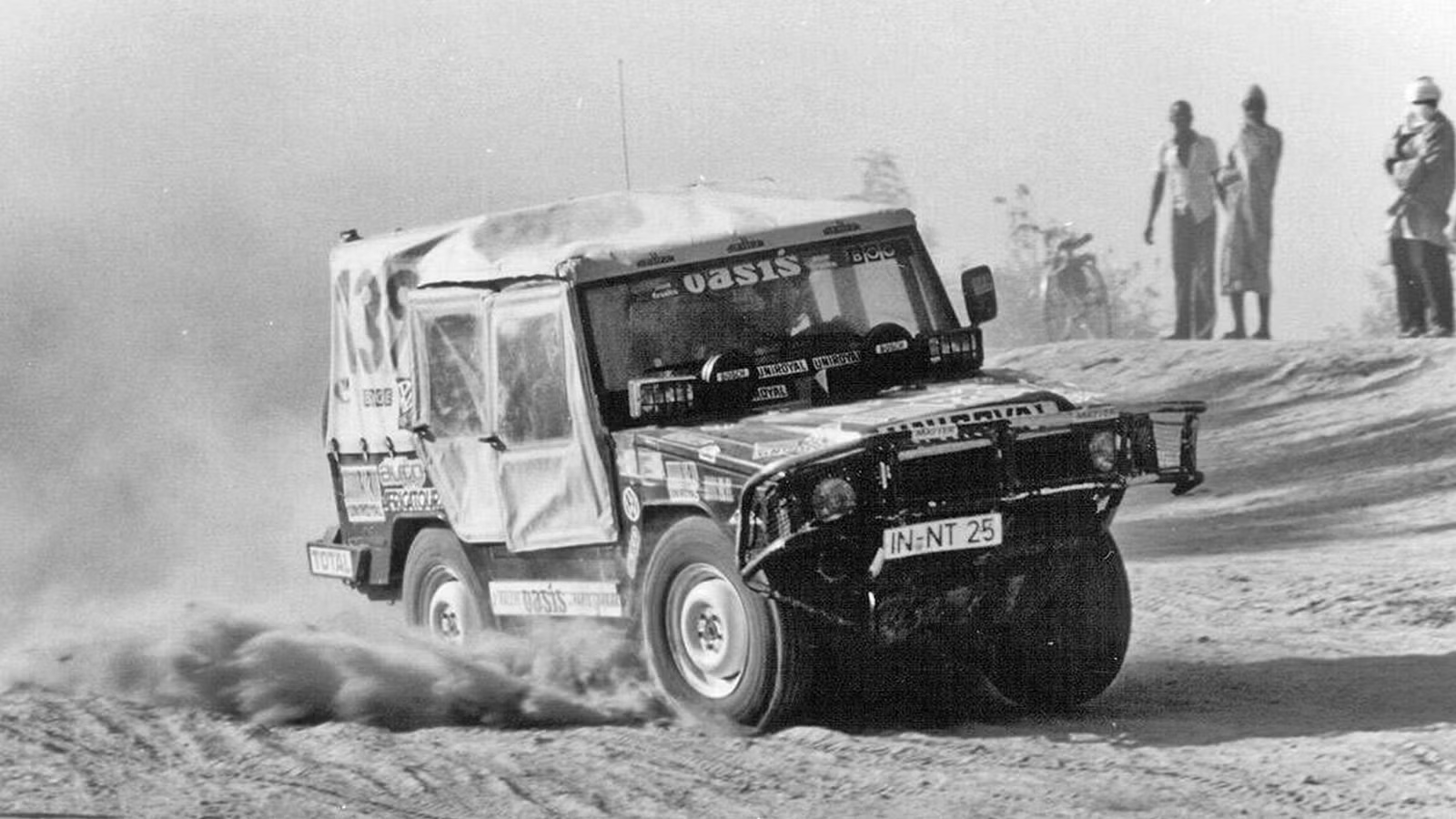
Rally cars and military pickup trucks are usually two entirely different species, though they share a surprising number of similarities. Both need to perform under pressure, both need to face tricky conditions and surfaces, and both need to be easy to repair. Yet nobody expected this military truck to excel in the unforgiving Paris-Dakar, and even fewer could have predicted what this car would lead to.
The War-Torn Road To German Performance

While it enjoys a positive reputation today, four-wheel-drive was still seen as rugged and utilitarian in the late 1970s. Something reserved for military vehicles, utility vehicles, and off-roaders meant for tackling snow, mud and ice rather than something that you needed on your school run, and certainly not something you needed on the racetrack. What was missing was a convincing demonstration that four-wheel-drive could be more than just functional, and that it could actually make a fast road car.
Volkswagen’s DKW Munga — a four-wheel-drive off-road vehicle primarily used by the military and border police — was aging, and needed refreshing. Audi engineers had also been experimenting with ways to make existing components work harder and more efficiently, while rallying was becoming an increasingly important battleground for manufacturers as they fought to find sporting answers to everyday questions.
These two worlds had largely worked on similar issues in isolation, but Volkswagen and Audi converged on an unlikely solution. What had begun as a relatively straightforward attempt to replace an aging military vehicle would give Audi engineers an example of how four-wheel-drive could redefine how a vehicle put power down. And before long, it would find its way to one of the harshest motorsport environments on the planet.

When Reliability Became A Weapon

While the two German powerhouses were working on ways of improving traction, rally was becoming more important. The sport thrives in low-grip conditions and, with the cars getting faster and the competition getting tougher, it was the perfect place for manufacturers to push their limits in full view of potential customers. The Group 4 regulations (the precursor to Group B) were also entering their seventh season by 1979, thus giving manufacturers ample time to adapt. And while the World Rally Championship was the main season-long championship, the brutal Paris-Dakar rally was the biggest event.
But while some manufacturers entered for glory, it was more than “just” a trophy for Volkswagen. The German manufacturer had its eye on the French military market, given its fleet of Hotchkiss Jeeps (licensed variants of the Willys Jeep) were rapidly aging. A successful show of force could help them to secure a lucrative contract, and motorsport offered a neat avenue for them to demonstrate how their vehicles could handle adversity. But while some would have gone for more conventional vehicles, VW opted to field a comparatively under-powered, far more rudimentary vehicle to act as a high-stakes sales pitch. And it would work far better than even they could have expected.
Meet The 70-HP Military Mule That Beat The Factory Teams

When you really think about it, a military vehicle is almost the perfect thing to tackle the Paris-Dakar with. They’re built specifically for harsh, unforgiving battlefields, made to be so durable that they can handle whatever is thrown (or launched) at them, and are utterly devoid of any creature comforts that might add unnecessary weight. Not to mention that they need to be simple enough that they can be fixed in the middle of a war zone with little to no support. 1979 had actually seen quite a few military vehicles enter the Paris-Dakar, including a Mercedes-Benz Unimog and a Steyr-Puch Pinzgauer 6×6, though neither of these were factory-backed. But the 1980 iteration saw
The vehicle was the Volkswagen Iltis, which was officially known as the Type 183. It had been developed primarily by Audi engineers under the stewardship of Ferdinand Piëch, though there was nothing particularly exciting about it.
The Iltis had a 1.7-liter inline-four engine that made around 70 horsepower, had a deliberately simple 4×4 system, and was built with a parts-bin approach taking parts from Volkswagen-Audi group cars like the Audi 100, Volkswagen Golf, and the VW Beetle. Even after being prepared for the Paris-Dakar, the Iltis only made it to between 100 HP to 110 HP thanks to a larger carburetor and camshaft. But with the exception of a 90-liter auxiliary fuel tank added to help cope with the incredible distances (the 1980 Paris-Dakar lasted 23 days and roughly 6,200 miles), it was fairly standard. And that’s what made the story even more interesting.

116 cars total entered the 1980 event, including four plucky Iltises alongside others like Renault 4 Sinpars (a 4×4 version of the little French hatchback), Range Rover V8s, and Toyota BJ 43s. Tough competition. But as the rally wore on and teams dropped out (67 of the 116 cars failed to finish), the Iltises forged on. By the end of the rally they’d not only completed it but actually won it, finishing 1st, 2nd, 4th, and 9th against considerably better-backed factory teams. It was an incredible result, and one which had far wider-reaching ramifications than “just” winning the Paris-Dakar. And they were both good and bad.
The bad news was that, despite the win, it wasn’t enough to convince the French military to place an order. Despite the entire project being a marketing ploy to convince the French of the Iltis’ superiority, it went for the homegrown Peugeot P4 instead. The German military did still place an order, taking delivery of 8,800 cars for the Bundeswehr. However, it wasn’t the success that VW had been hoping for.
The good news, though, was that the Iltis’ four-wheel-drive system proved both rugged and dependable in challenging conditions, and had already caught the attention of Audi’s engineers during testing. Its ability to maintain traction offered a glimpse of what all-wheel-drive was capable of in a performance scenario, and if a relatively crude military vehicle could outperform far more capable machines in the unforgiving Sahara, it could have real competitive applications. So Audi got to work.
From Army Truck To Quattro Blueprint

Audi’s engineers had already begun to adapt the Iltis’ four-wheel-drive lessons for a very different kind of vehicle after seeing its remarkable traction during winter testing. The result was the Audi Quattro, which brought all-wheel-drive into the performance market and would reshape rallying entirely.
The Quattro was already in development by the time the Iltis dominated Dakar, but the system was clearly too good to pass up. Adding not just more traction but motorsport credibility, VW and Audi have proved that four-wheel-drive can compete and win against much more powerful competitors. The Quattro used it to devastating effect, securing its maiden victory in its second rally in 1981, and helping Michele Mouton to her historic first rally win in the same year. The car went on to take both the 1982 and 1984 World Rally Championship titles, cementing its place in motorsport history in doing so. And while the Quattro is remembered as the legend it is today, it wouldn’t have been possible were it not for the Iltis.
The Forgotten Vehicle Behind Audi’s Revolution

Despite the Iltis’ enormous impact on rallying, its reputation today is one of an obscure military vehicle from the 1980s. A little over 9,000 were made in total before its production rights and facilities were sold to Bombardier Inc in 1982, with production ultimately ceasing in 1988.
It’s an interesting legacy for the car. It was never meant to be a performance icon, yet it was an unlikely winner in the harshest conditions, provided the blueprint for one of Audi’s most important technological breakthroughs, and it helped to usher in a new age in rally. But while the Quattro may get all the glory today, its story can be traced back to a 70-HP military workhorse that won its race, then disappeared into obscurity.
Sources: Dakardantan, VW

Related posts

Latest Post


No Comments