
Japan Built A Sleeper Sedan Before BMW—And It’s Crazy Cheap
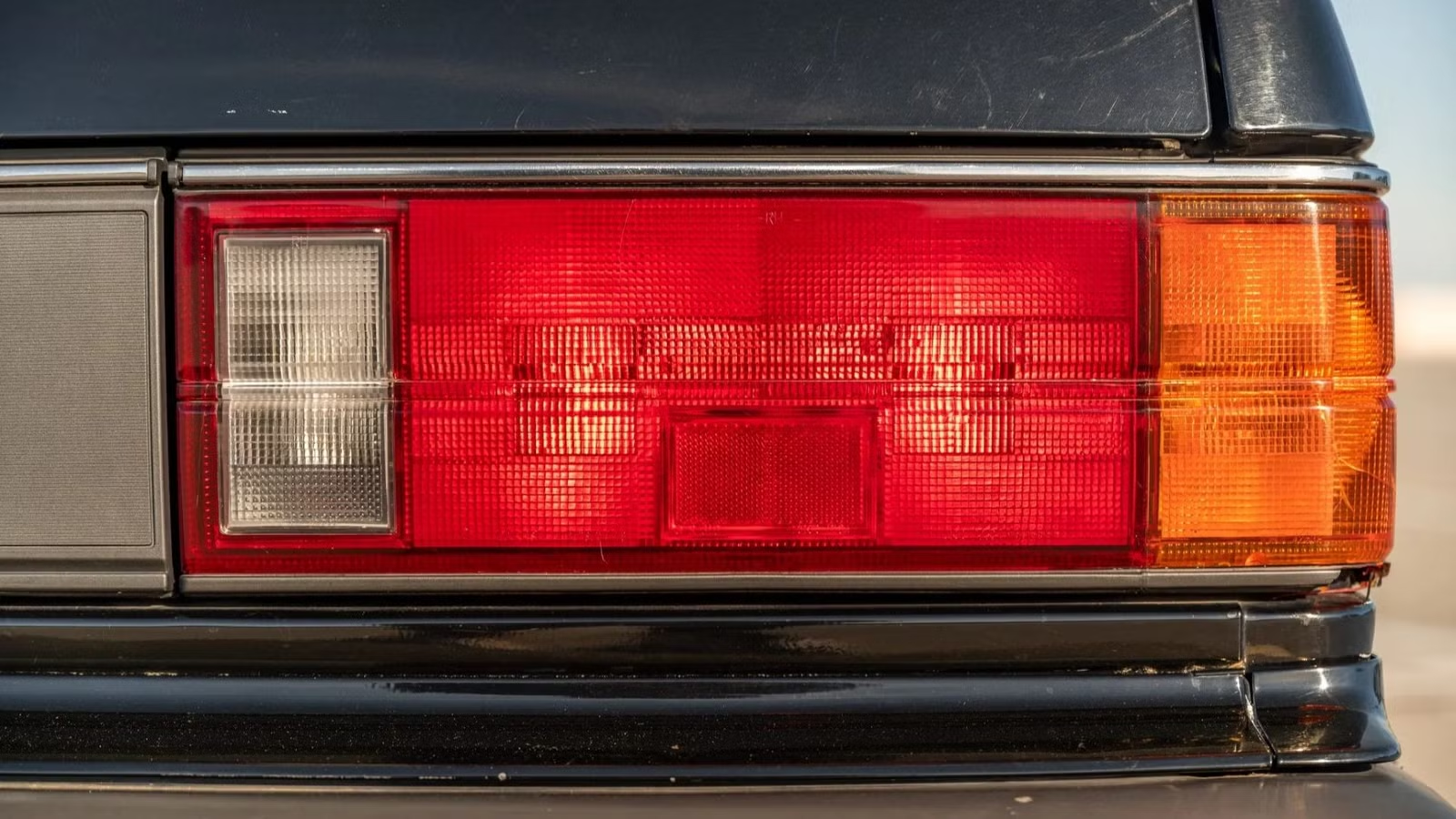
Sleeper sedans are like Dr. Watson. While supercars are Sherlock Holmes, dramatic and brimming with brilliance, eccentricity, and the occasional flaw, the sleeper sedan is intelligent, practical, and relatable — and you don’t really notice it until you need to. These high-powered four-doors used the parts of sports and supercars, blended into an innocuous-looking silhouette that didn’t give the game away. If you know, you know. But while the Germans have turned making Sleeper Cars into a fine art, there was a Japanese model that got there before a lot of the big names. And it’s cheap too.
Sleeper Sedans Were Made Famous By The Germans

The BMW M5 not only changed the game for sports sedans, it put the Bavarian brand on a whole new trajectory too. True, the M1 supercar of the late ’70s was the first real “M car”, but it was marred by bad timing and controversy, leaving BMW to go back to the drawing board for its performance division. The M5 was launched in 1985 and cleverly used a revised version of the ill-fated supercar’s M88 engine, designated the M88/3.
One could argue that the two-door E30 M3 that arrived a year later went on to be the more iconic car, but it was the 286-horsepower M5, with its four doors and very lightly adorned executive body, that set the template for fast BMW sedans of the future. By matching sports car power to an unassuming body, BMW had created the modern sleeper. This was a new type of car for those who found supercars a tad too garish but appreciated a single-minded focus on performance and driving pleasure, combined with contemporary luxury. But the M5 didn’t strictly get there first — another carmaker launched its “four-door sports car” a few years earlier.
Nissan Was Years Ahead Of The M5


Think JDM style and tasty Japanese coupes and sedans, and your mind will likely zoom in on the ’90s, or possibly the late ’80s. This is the period when Japanese firms went into overdrive, crushing the competition with high-tech vehicles across the board. Cars like the Acura NSX changed our perception of what a supercar could be, while the A80 Toyota Supra was an everyman’s Ferrari 550 Maranello. But rewind to the very start of the ’80s, and Nissan was busy creating a new type of sedan. Nissan, or rather Datsun’s Maxima name started as the 810 Maxima trim in 1981, before becoming the standalone Datsun/ Nissan Maxima in 1982. So far, so boring. But the new Maxima was anything but dull underneath its boxy skin. Here you would find a powertrain borrowed from the company’s most exciting, forward-thinking sports car. Sounds familiar?
The Maxima Borrowed From Nissan’s Z Cars

At its heart, the G910 Maxima had the engine of the groundbreaking 240Z sports car. The L24E 2.4-liter inline-six had been slightly retuned for lower torque and better efficiency. It was also fitted with a Bosch K-Jetronic mechanical fuel injection system found in the 280ZX. In the base model 810 Deluxe, the engine was linked to a five-speed manual gearbox from the Nissan 71B family, related to the transmission in the 280Z.
The Maxima sedan rode on independent front suspension with coil springs and struts, with an independent rear suspension (although wagon versions used a leaf-sprung live rear axle). In fact, the suspension engineering shared a lot with the 280Z. No wonder the Maxima got the official signature tagline: “4-Door Sports Car”, or 4DSC.
BMW Styling Was Matched To Mercedes Comfort

It may not seem like it now, but the Maxima’s squared-off lines were cutting edge at the time. The previous Bluebirds were still a bit ’60s/’70s in their gentle Coke-bottle styling, but the Maxima was much more aligned with the brand-new BMW E30. The hood was long, and the car seemed to visually focus the eye on the back wheels, which sat right beneath the C-pillar and were responsible for drive.
Nissan didn’t seem quite sure which way to go with the interior, sidestepping the austere upmarket practicality of a BMW for a more plush and squidgy look that wouldn’t seem out of place in a ’70s American luxury car. The velour seats with floating cushions sure were comfy though. Then there was the tech. The Maxima has the honor of being the first car to talk back to you, with a female voice reminding you that the keys were still in the ignition or that you had left your lights on. This is the kind of forward-thinking idea that you would expect from an S-Class, only to trickle down into lesser cars in years to come.
The Maxima Was A Missed Opportunity

It wasn’t just the styling inside and out of the Maxima that seemed a bit confused. That 2.4-liter inline-six was detuned to around 125 horsepower, whereas an early ’70s 240Z had a healthy 151 hp. The 280Z had 170 hp. While 125 hp was enough to make the 2,870-pound Maxima feel quick and sporty, its sprint to 60 mph was around 10 seconds. Not bad for the Malaise Era, considering the groundbreaking Golf GTI would have a hard time shaking it off, but it could have been so much quicker. With 150 hp, the Maxima’s power-to-weight ratio would have been similar to that of a late ’80s CRX or many warm hatches. With 170 hp, it would have really lived up to its four-door sports car billing.
But the truth is that the Maxima needed to appeal to a wide range of customers, and that 2.4-liter six was the only gas engine on offer (with a 2.8-liter diesel an option). If the Maxima had an entry-level powertrain, the six-pot could have been a more focused range topper. But when you think of it as a reasonably lightweight, manual RWD sedan with cool retro styling, it makes a lot more sense in 2026. And then there are the prices.
The Maxima Is The Forgotten Bargain Japanese Sleeper Sedan

The Maxima has long been a slept-on sleeper. It doesn’t have the kudos of late ’80s and ’90s JDM sedans and coupes, which were ingrained into popular culture, and as a result many of them would have been run into the ground. But it has some great ingredients, and as with any boxy retro Japanese car, it needs only a chunky set of period alloy wheels to really set it off.
But the fact people forget the Maxima is a good thing. No, it’s a great thing. These rare rides sell for just a few thousand bucks when they do pop up. When a 1982 Datsun 810 Maxima GL 5-Speed cropped up on Bringatrailer.com in 2022, showing just 60,000 miles and in original order, it fetched just $5,482. Show me a sedan with a sports car engine that is cooler than that. A 1988 BMW M5 has a good condition price of $57,500, says Hagerty. Maximas are the kind of cars unlikely to appear at showcase auctions; they will pop up on local classifieds with one or two owners and low miles. Keep your eyes peeled.
Sources: Japanesenostalgiccar, Curbsideclassic, Hagerty

Related posts




Latest Post


No Comments