
The 1940 Indian Chief Tribute Kawasaki Built A Decade Before Polaris Revived Indian
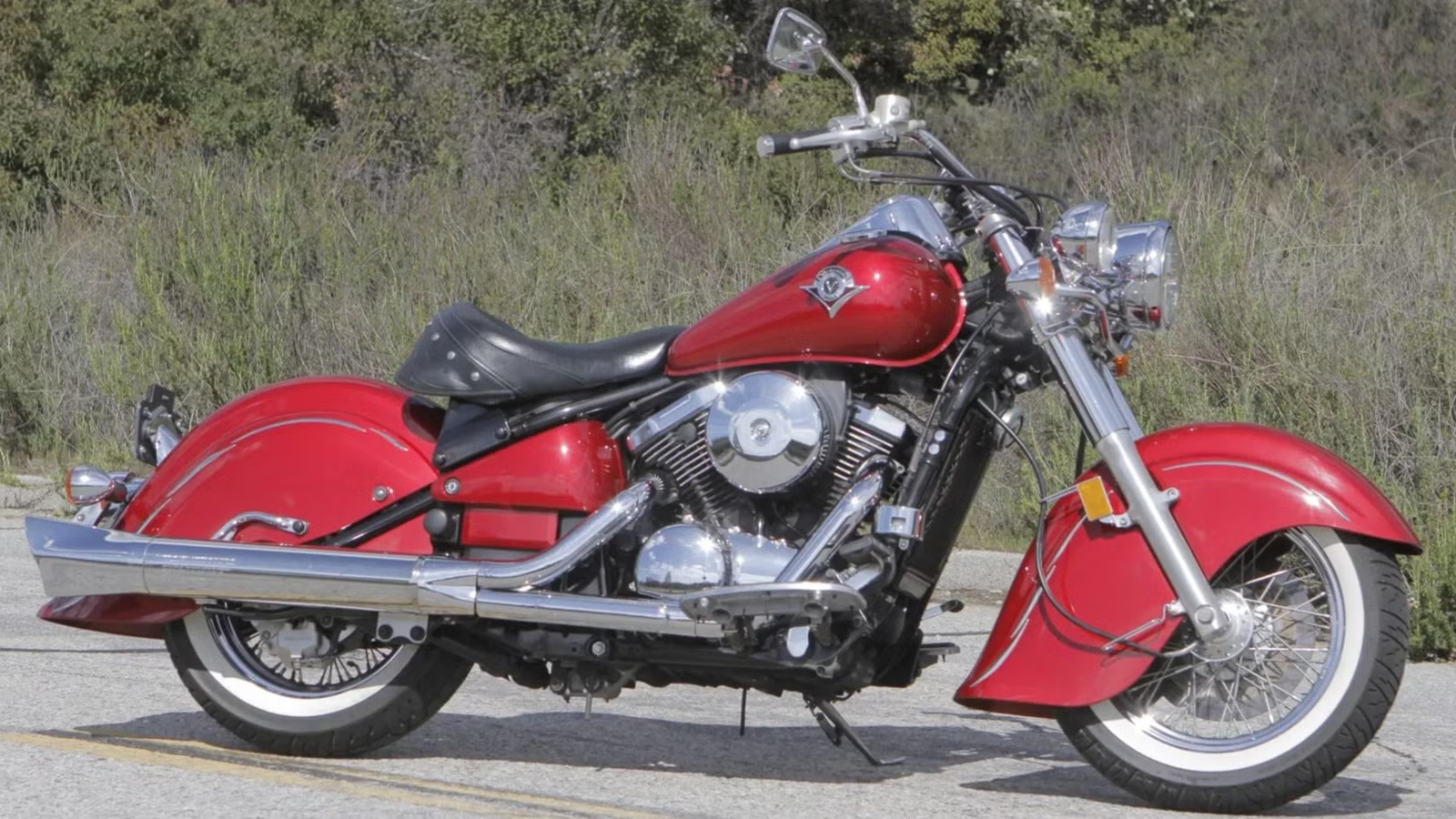
Indian’s sweeping fenders were recognizable long after the original Springfield factory stopped building motorcycles. They belonged to an American styling tradition that offered something different from Harley-Davidson’s exposed wheels and increasingly stripped-down customs. By the late 1990s, Kawasaki saw an opportunity to bring those curves into its own showrooms.

The idea started with a custom motorcycle, then became a production family. Buyers could get the generous bodywork and relaxed riding position without taking on the restoration, starting procedure, or mechanical demands of a prewar machine.
Indian’s 1940 Chief Established A Lasting American Cruiser Look
For 1940, Indian introduced the deeply skirted fenders that became one of its strongest visual signatures. They wrapped around the wheels, hiding much of the mechanical clutter and giving the motorcycles broad, flowing sides. The Chief became particularly closely associated with that shape. Those fenders made an Indian recognizable from across a parking lot. Where bobbers removed bodywork for a more naked and raw look, the Chief used flowing lines to deliver a more automotive sense of sweep.
A Custom Vulcan Called The Super Chief Caught Kawasaki’s Attention


Custom builder Denny Berg, Don Emde, and Cobra Engineering’s Ken Boyko developed the Super Chief from a Vulcan 1500 Classic. Berg gave the Kawasaki Indian-inspired bodywork, morphing a contemporary Japanese cruiser into something that recalled the look of the American motorcycles Emde’s family had sold.
The custom appeared at Kawasaki’s dealer meeting, where dealers and company engineers responded enthusiastically. At the time, reports described Kawasaki exploring production almost immediately. The connection between the custom and the showroom motorcycle was direct: Kawasaki subsequently sent the machine to Japan for its engineers to examine.
Kawasaki Put That Indian-Inspired Styling Into The Vulcan 800 Drifter

The Vulcan 800 Drifter brought the treatment to Kawasaki’s smaller cruiser platform for the 2000 U.S. model year, following the 1500 Drifter. Deep fenders covered its spoked wheels, and a single fishtail muffler extended along the right side. Its early blacked-out finish helped the bodywork dominate. Riders attracted to prewar American motorcycles could buy that appearance through a Kawasaki dealer, with electric starting and contemporary brakes already fitted. The smaller engine also offered an alternative to buying a heavyweight cruiser simply to get elaborate vintage styling.
Hidden Rear Suspension Preserved The Vintage Silhouette

Kawasaki concealed the rear shock and linkage, using a triangulated steel swingarm to suggest the lines of a rigid frame. An exposed pair of rear shocks would have interrupted the uncluttered profile beneath the saddle. The rear wheel could still move over bumps through Kawasaki’s Uni-Trak suspension. Highly similar to Harley’s softail frame, this setup is a must for modern classics, as a hard tail for daily use is just too rough on the lower back.
The Drifter’s 805cc V-Twin Used Modern Hardware Beneath Its Cooling Fins

The cylinder fins suggested an older air-cooled engine, but coolant circulated through the 805cc V-twin’s cylinders and heads. An electric fan assisted cooling in traffic, where airflow alone would fall away. Each cylinder used four valves operated by a single overhead camshaft.
A 36mm carburetor supplied fuel. Kawasaki also fitted a throttle-position sensor linked to the ignition, allowing timing to change with throttle opening and engine speed. The rider still had a carbureted motorcycle, but its ignition could account for changing engine load.
A Single-Pin Crankshaft Supplied The Pulse While A Balancer Controlled Vibration

Both connecting rods worked from a shared crankpin, giving the engine its characteristic V-twin firing rhythm. Kawasaki paired that arrangement with a gear-driven balancer to reduce vibration. It’s a nice compromise that allows for engine character without rattling the rider around too much.
The distinction suited the Drifter’s purpose. Its exhaust could deliver the pulse buyers expected from a traditional cruiser, while the balancer moderated the shaking during longer rides. Cooling fins and a fishtail exhaust supplied the period appearance around a substantially newer engine design.
The 800 Offered Drifter Styling In A Smaller, More Affordable Package

A contemporary RoadRUNNER comparison listed the 2000 model at $7,299. That put the elaborate fenders within reach of buyers who wanted a distinctive cruiser without paying for the larger Drifter. Kawasaki listed its dry weight at 536 pounds for that model year.
It remained a sizable motorcycle, although the smaller package made more sense for someone reluctant to maneuver a heavyweight around a driveway. Wide floorboards offered room to reposition the feet, and the heel-toe shifter let riders change gears without hooking a boot beneath the lever.
Later Updates Added A Solo Saddle And More Chrome

For 2001, Kawasaki replaced the two-person saddle with a contoured solo seat. Removing the passenger portion opened up the view of the rear fender, emphasizing the sweeping bodywork. The previous dual seat remained available as an accessory for owners carrying a passenger.
Chrome also replaced several dark finishes, including those on the engine covers, headlight shell, and other fittings. Candy Cardinal Red gave the revised motorcycle a brighter appearance. These changes pushed the Drifter toward a dressed-up personal custom, rather than the more subdued finish of the earlier version.
The Drifter Predated Polaris’s Indian Revival By More Than A Decade

Polaris bought Indian in 2011 and introduced its own Chief Classic, Chief Vintage, and Chieftain in 2013. The 800 Drifter’s U.S. arrival preceded the acquisition by eleven years. Indian had already returned under earlier owners, so Kawasaki’s tribute belongs before the Polaris chapter, rather than before every Indian revival.
The Drifter sits in an unusual place in cruiser history as a Kawasaki-made, Indian-inspired motorcycle with a middleweight engine and familiar dealer support years before Polaris developed its Chiefs. For someone who wanted the fenders more than the badge, the 800 provided a particularly accessible way into the look.
Sources: Kawasaki, Motorcycle Cruiser, Cycle World, RoadRUNNER, Smithsonian National Museum of American History, Indian Motorcycle, Polaris, Total Motorcycle

Related posts



Latest Post


No Comments