
Suzuki Built A V-Twin Sportbike With A Rotary Rear Damper That Became Its Biggest Problem
Suzuki has never been afraid of experimenting with motorcycle engineering. From its two-stroke racing machines to the Hayabusa, the Japanese manufacturer has built several motorcycles that challenged conventional thinking. However, one of its most ambitious sportbikes from the 1990s became infamous for an engineering decision that undermined an otherwise impressive package.

The idea was straightforward: combine a powerful 1,000cc V-twin engine with an exceptionally compact chassis and an unconventional rear suspension technology. The result was a motorcycle with serious performance credentials, distinctive styling, and handling characteristics that generated considerable controversy. Today, the motorcycle remains an interesting chapter in Suzuki’s sportsbike history.
A 996 V-twin Designed To Challenge the Ducati
Suzuki developed the motorcycle during the period when Ducati’s 90-degree V-twin sportsbikes were becoming increasingly influential. The Italian bikemaker’s 916 and 996 had demonstrated that a large-capacity twin could compete with powerful four-cylinder superbikes, and Suzuki wanted in on the game.

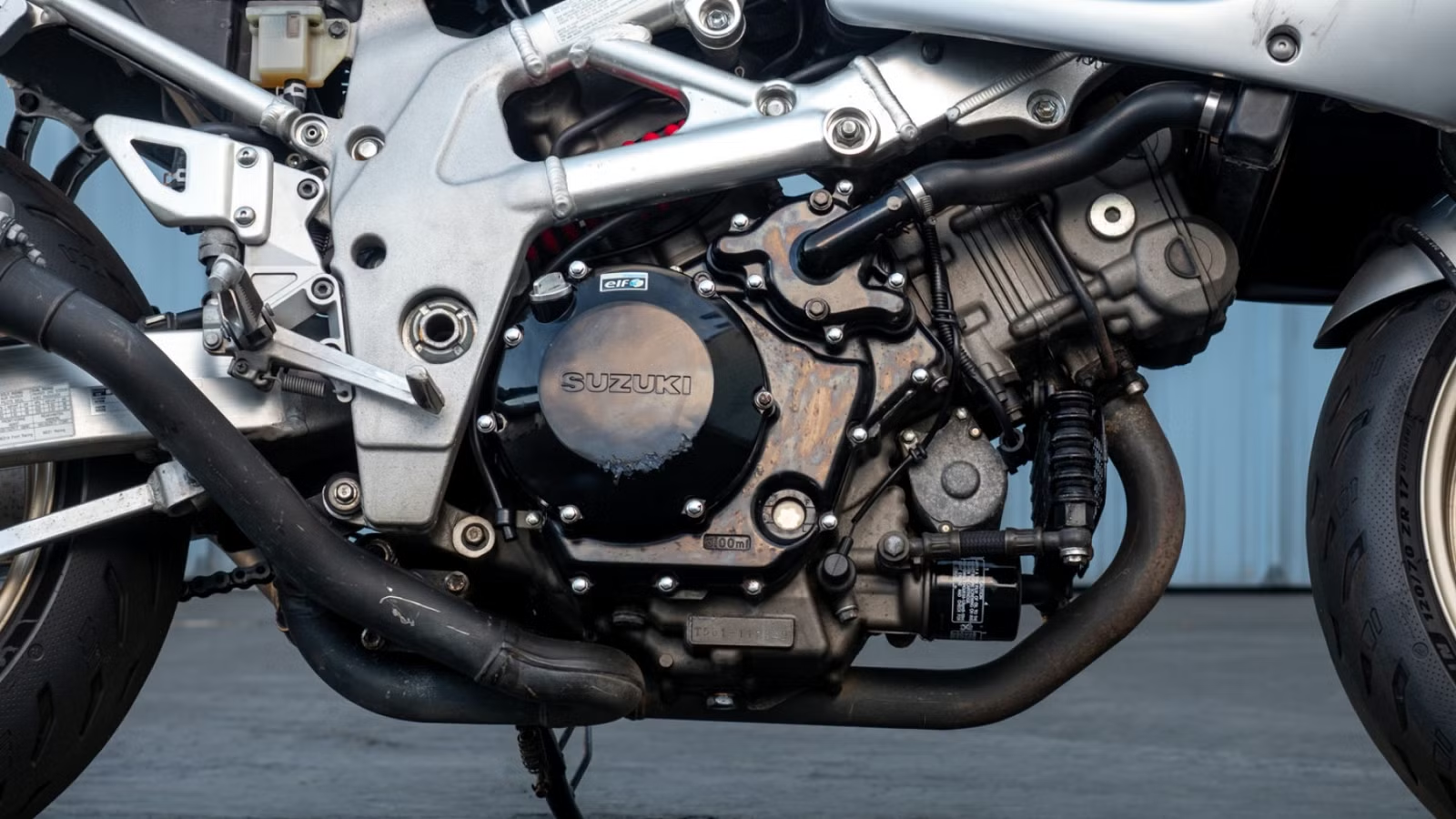
Its answer was a newly developed, liquid-cooled, 996cc, 90-degree V-twin with DOHC cylinder heads, eight valves and electronic fuel injection. The engine featured a hybrid chain-and-gear cam drive, while its 98mm bore and 66mm stroke helped deliver strong midrange performance. Suzuki claimed an output of 123 HP and 76 lb-ft of torque.
The engine was paired with a six-speed gearbox and back-torque-limiting clutch, which helped prevent rear wheel lockup during aggressive downshifts. Suzuki also added its Ram Air Direct (SRAD) intake system to improve breathing at higher speeds.
The engine was housed inside an aluminum truss-style frame, an unusual construction for a mass-production motorcycle at the time. With a relatively short 55.7-inch wheelbase, the objective was to deliver the agility of a middleweight sportsbike without sacrificing the performance of a liter-class machine. It was an ambitious project, and early road tests suggested that Suzuki had created a genuine alternative to Ducati’s expensive V-twin motorcycles.
The Suzuki TL1000S Had An Unusual Rotary Rear Damper

Introduced in 1997, the Suzuki TL1000S featured one of the most unusual rear suspension arrangements fitted to a production sportbike. Instead of using a conventional coil-over shock absorber, Suzuki separated the spring and damping functions into two different components.
The coil spring was positioned behind the lower right frame spar, while a compact rotary hydraulic damper sat above the swingarm pivot. Both components used separate linkages, allowing Suzuki to tune them independently.
The arrangement was primarily a packaging solution. The V-twin occupied considerable space, while the rear cylinder’s exhaust header also needed room to pass through the chassis. A conventional shock absorber would have complicated this layout. Separating the spring and damper allowed Suzuki to retain a relatively compact rear end and achieve its short wheelbase.
In its March 1997 road test, Cycle World praised the suspension’s performance, noting that it behaved much like a conventional setup during track riding and that the rear damper showed no signs of fading during extended sessions.
However, the rotary arrangement had an inherent weakness. Positioned close to the rear cylinder and exhaust system, the damper could experience considerable heat buildup. Its limited adjustment characteristic also made achieving consistent damping performance difficult.
Handling Problems Turned The TL1000S Into A Controversial Sportbike

The Suzuki TL1000S had the ingredients for an exciting sportbike, but its handling proved considerably more complicated than Suzuki had anticipated. Reports of violent headshake and tank-slappers began emerging after production motorcycles reached European markets. The problem was particularly experienced when accelerating hard out of corners or encountering uneven road surfaces.
The rotary damper was widely blamed because it struggled to deliver consistent damping under demanding conditions. Heat buildup could affect its performance, while its limited adjustment range made fine-tuning difficult. However, the suspension was not the only contributing factor. The motorcycle’s short wheelbase, sharp steering geometry, strong low-end torque, and weight distribution also played a role in its lively front-end behavior.
Following growing complaints and serious accidents, Suzuki recalled the motorcycle to install a steering damper. The company also revised its engine management for subsequent model years, retarding ignition timing in the lower three gears to make power delivery less aggressive. This move reportedly reduced the motorcycle’s output from 123 HP to 110 HP.
The modifications helped, but the damage to the TL1000S’ reputation was already done. It acquired the infamous widow-maker nickname, and prospective buyers became wary of its handling characteristics.
The Suzuki TL1000S Left A Complicated Legacy In Sportbike History

The Suzuki TL1000S was an expensive motorcycle by Japanese standards, with the 1997 model priced at $8,999 in the US. The price did put it below the Ducati 916, though, while offering comparable engine displacement and serious performance. By the time it was discontinued in 2001, the price had marginally increased to $9,099. Today, a used example is considerably more accessible, with prices hovering between $2,500 and $5,000. Particularly clean, low-mileage examples or extensively upgraded models can command more.
Suzuki introduced the fully faired TL1000R in 1998, developing it as a more track-focused alternative with a different chassis and revised suspension packaging. However, it struggled to establish itself against its rival superbikes, particularly the Ducati 916.
The TL1000S also received several updates during its production run. Suzuki addressed early engine-management and clutch issues, while later examples benefited from the factory steering damper. Nevertheless, the rotary rear suspension remained a defining feature, and many owners eventually replaced it with conventional aftermarket shock absorbers.
Today, the Suzuki TL1000S occupies an interesting position among 1990s Japanese sportsbikes. Its powerful engine, aluminum frame, and unconventional engineering make it an appealing alternative to more predictable four-cylinder machines.

Related posts


Latest Post


No Comments