
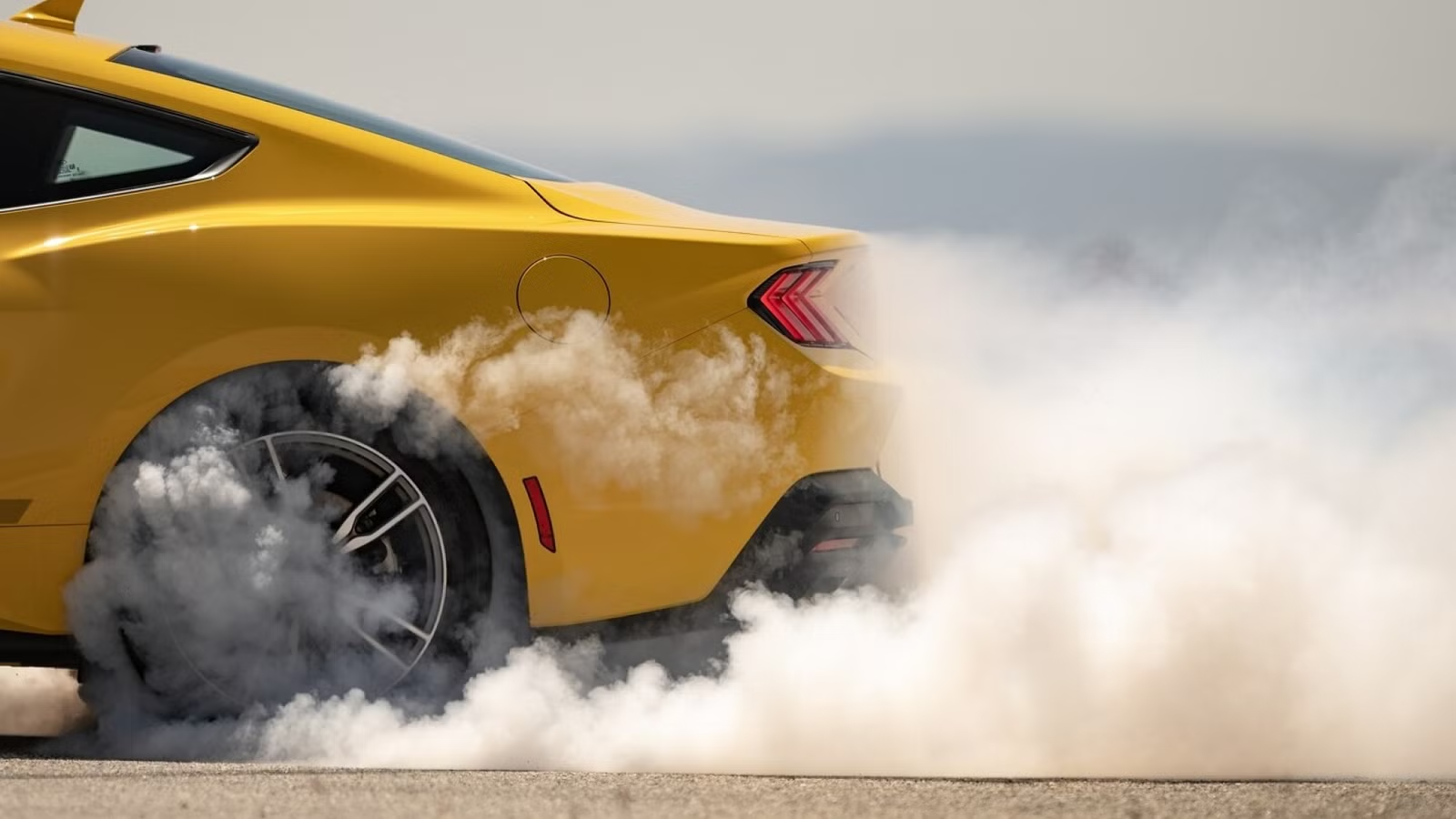
“It drives like a German car” remains one of the most respectful compliments in the world of automobiles. And for a good reason. From a performance hatchback like the Volkswagen Golf GTI to an Autobahn-bred high-performance sleeper like the BMW M5 Competition, cars made in Germany have earned a reputation for feeling remarkably composed when everything around us is moving fast. It’s safe to say that even American enthusiasts appreciate the sure-footed nature of these well-engineered machines.

On the other hand, America’s performance car legacy was built on muscle cars. Unlike the Germans, American cars were all about more displacement (usually a V8 under the hood), smoking tires, and loud exhausts to wake up an entire neighborhood, which definitely meant more drama. Those two worlds rarely overlapped until one brand from Detroit decided to change this formula. And it did so while retaining the character of a typical American classic, adding the kind of composure you’d expect from a German car. And the best part, it remained surprisingly affordable in the process.
Built More Like A Sports Coupe Than A Traditional Muscle Car
Long before it became one of America’s performance icons, this coupe was simply an answer to a very simple question: What did young buyers really want in this evolving era of the 1960s? Ford Motor Company realized that its existing lineup no longer reflected the aspirations of the younger generation. To better understand this shift, Ford conducted extensive market research to find out exactly what these customers were looking for. The survey found that young enthusiasts wanted something that looked fast, felt exciting, and didn’t cost a fortune.

Ford wasn’t just targeting buyers with established careers and healthy paychecks, but also wanted to capture the attention of young enthusiasts who were just starting their careers. The mission was clear but far from easy: to develop a stylish performance coupe that was engaging to drive without putting ownership out of reach. All of those findings led Ford to create a car that would become one of the biggest success stories in the company’s history. The rest, as they say, is automotive history.

It was in 1963 when the Mustang made its first appearance as a concept. Turning it into a production car was still far from straightforward. In fact, every aspect — from styling, performance, and pricing — was thoroughly evaluated. Instead of sticking to the core American formula of a long hood and large-displacement engine, the Mustang also incorporated subtle European design cues. All of this made it look sophisticated without sacrificing its unmistakable American identity. In April 1964, the production-spec Mustang made its market debut, and it didn’t take long to become the talk of the automotive world. From that moment, Ford never looked back.
Fast-forward to today, the Mustang wears many hats. Are you an old school guy who still believes there is no replacement for displacement? Ford still has you covered with its V8 option. But there’s another side to the pony car that often flies under the radar. If you’re drawn to the Mustang’s timeless coupe proportions but want something that’s easier to live with every day, the EcoBoost steps in as a surprisingly convincing and affordable alternative. It may give up a few cylinders, but it loses none of the character and feels like a German performance car.
The EcoBoost Isn’t Just The ‘Base’ Mustang

For purists, the Mustang EcoBoost may be a compromise. What would you expect from a coupe that starts at around $32,995 and has an inline-4 engine configuration? But that assumption misses the point entirely. If you’re stepping out of a midsize sedan with modest power and torque figures (or any ordinary commuter car), the EcoBoost isn’t a compromise. In fact, it’s a genuine leap into the world of rear-wheel-drive sports coupes.
One area where the Mustang EcoBoost refuses to feel like an entry-level model is its styling. Visually, it shares almost everything with its V8-powered sibling, from the signature tri-LED headlights to the long hood, muscular haunches, and fastback silhouette. Better still, many of those proportions still echo the original Mustangs of the 1960s.
The EcoBoost rides on 18-inch Shadow Silver-painted cast-aluminum wheels, although Ford offers a variety of wheel designs, sizes, and color schemes for buyers willing to spend a little extra. Those seeking open-air freedom can also opt for the “Convertible”, which commands roughly an $8,000 premium.
`;
}
itemsHtml += `

`;
itemsHtml += `
${price}
${isGreat ? ‘Great price‘ : ”}
${below ? `
${below}
` : ”}
View full listing
${src.title || ”}${src.type !== ‘car_bid’ ? ‘ ‘ + (props.trim || ”) : ”}
`;
if (src.dealername) {
itemsHtml += `
${src.dealername}${props.address ? ‘,’ : ”}
${address}
` : ”}
${distance ? `
${distance}
` : ”}
`;
}
itemsHtml += `
`;
}
if (!itemsHtml) return;
section.innerHTML = “;
initCarousel(section);
})
.catch(function () {});
function initCarousel(section) {
var track = section.querySelector(‘.listing-marketplace-carousel__track’);
var container = section.querySelector(‘.listing-marketplace-carousel__items’);
var cards = section.querySelectorAll(‘.listing-marketplace-carousel__item’);
var leftBtn = section.querySelector(‘#carousel-left’);
var rightBtn = section.querySelector(‘#carousel-right’);
var index = 0;
function cardStep() {
var gap = parseFloat(getComputedStyle(container).gap || 0) || 0;
return cards[0].getBoundingClientRect().width + gap;
}
function maxIndex() {
var visible = Math.max(1, Math.floor(track.clientWidth / cards[0].getBoundingClientRect().width));
return Math.max(0, cards.length – visible);
}
function go() {
index = Math.max(0, Math.min(index, maxIndex()));
track.scrollTo({ left: index * cardStep(), top: 0, behavior: ‘smooth’ });
}
var sendCarouselNav = function () {
if (!window._carouselNavFired && window.websiteSentinel && typeof window.websiteSentinel.sendEvent === ‘function’) {
window._carouselNavFired = true;
window.websiteSentinel.sendEvent(‘Car Marketplace’, ‘listingscarousel_nav’, window.location.href);
}
};
rightBtn.addEventListener(‘click’, function () { index++; go(); sendCarouselNav(); });
leftBtn.addEventListener(‘click’, function () { index–; go(); sendCarouselNav(); });
var scrollNavFired = false;
var scrollNavTimeout;
track.addEventListener(‘scroll’, function () {
if (!scrollNavFired) { scrollNavFired = true; sendCarouselNav(); }
clearTimeout(scrollNavTimeout);
scrollNavTimeout = setTimeout(function () { scrollNavFired = false; }, 1000);
});
window.addEventListener(‘resize’, go);
}
}
if (document.readyState === ‘complete’) {
setTimeout(init, 200);
} else {
window.addEventListener(‘load’, function () { setTimeout(init, 200); });
}
}());
Turbocharged 4-Cylinder That Punches Well Above Its Weight

A turbocharged inline-4 powering a Mustang? For a nameplate that built its reputation on rumbling V8s, that might seem unfair. But writing off the EcoBoost because it has two fewer cylinders wouldn’t be right. Before diving into more details, let’s break down the numbers and see how the Mustang EcoBoost compares to one of its closest German rivals on paper:
Engine Specifications
|
Specifications |
Ford Mustang EcoBoost |
BMW 230i Coupe |
BMW 230i xDrive Coupe |
|
Engine |
2.3-liter GTDI inline 4-cylinder turbo |
2-liter inline 4-cylinder turbo |
2-liter inline 4-cylinder turbo |
|
Drive type |
Rear-wheel-drive |
Rear-wheel-drive |
All-wheel-drive |
|
Power |
315 hp @ 5,500 rpm |
255 hp @ 5,000–6,500 rpm |
255 hp @ 5,000–6,500 rpm |
|
Torque |
350 lb-ft @ 3,000 rpm |
295 lb-ft @ 1,550–4,400 rpm |
295 lb-ft @ 1,550–4,400 rpm |
|
Transmission |
10-speed, auto |
8-speed, auto |
8-speed, auto |
|
Acceleration 0–60 mph |
4.5 seconds |
5.5 seconds |
5.3 seconds |
When the specifications are laid side by side, the Mustang EcoBoost has the upper hand. It not only produces more horsepower but is also quicker, all while undercutting the BMW by around $9,205, giving buyers considerably more performance for their money.
The BMW 230i does have one trick up its sleeve: it’s available with BMW’s optional xDrive all-wheel-drive system. But even with the Mustang sending power only to the rear wheels, it still gets to 60 mph quicker than the German coupe. The Mustang also comes with a limited-slip differential, giving it better traction off the line while improving stability and control through corners.
Interior Prioritizes The Driving Experience Over Flash

From the inside, the Mustang EcoBoost may not feel as sophisticated as a BMW, but it offers a clean, understated cabin that does exactly what it needs to. It comes with an all-black theme, complemented by black fabric bucket seats as standard. Buyers can also choose from a range of upholstery colors, along with different seat belt finishes, by paying an additional premium. You also get a 12.4-inch digital cluster along with a 13.2-inch touchscreen. Other amenities include dual-zone auto climate control, auto headlights, and rain-sensing wipers.
For Buyers Wanting More, There’s the EcoBoost Premium
If the standard equipment doesn’t appeal to you, Ford also offers the Mustang EcoBoost Premium, which starts at $36,345. For the additional cost, buyers get heated and ventilated front seats, a 9-speaker sound system (three more speakers than the standard model), a heated steering wheel, and an integrated curved digital display.
How The Mustang EcoBoost Stacks Up Against The Competition

The BMW 230i Coupe is one of the closest rivals to the Mustang EcoBoost. And it’s the American coupe that delivers the more convincing package and leads the comparison. It strikes a sweeter balance between performance, styling, and features buyers actually need, all while making a stronger case for its asking price. The BMW 230i, despite coming from the land of the Autobahn, surprisingly trails behind when it comes to outright performance. And, true to German tradition, it also demands a noticeably steeper price.

Even if you’re willing to spend more than $42,000, there are better performance-focused alternatives at the same price point, such as the Nissan Z. Under its hood is a 3.0-liter twin-turbo V6 that churns out an impressive 400 hp, putting it in an entirely different league when it comes to outright pace. That only highlights how far behind the BMW 230i feels in the affordable performance coupe segment. The Ford Mustang EcoBoost, meanwhile, manages to hit the sweet spot. It delivers strong performance, everyday usability, and a price tag that makes far more sense, making it one of the best value-for-money coupes you can buy today.
Sources: Ford Corporate, Ford USA






No Comments