
Oldsmobile’s Gentlemen’s Muscle Car Is The GTO Rival You Can Snag For Cheap
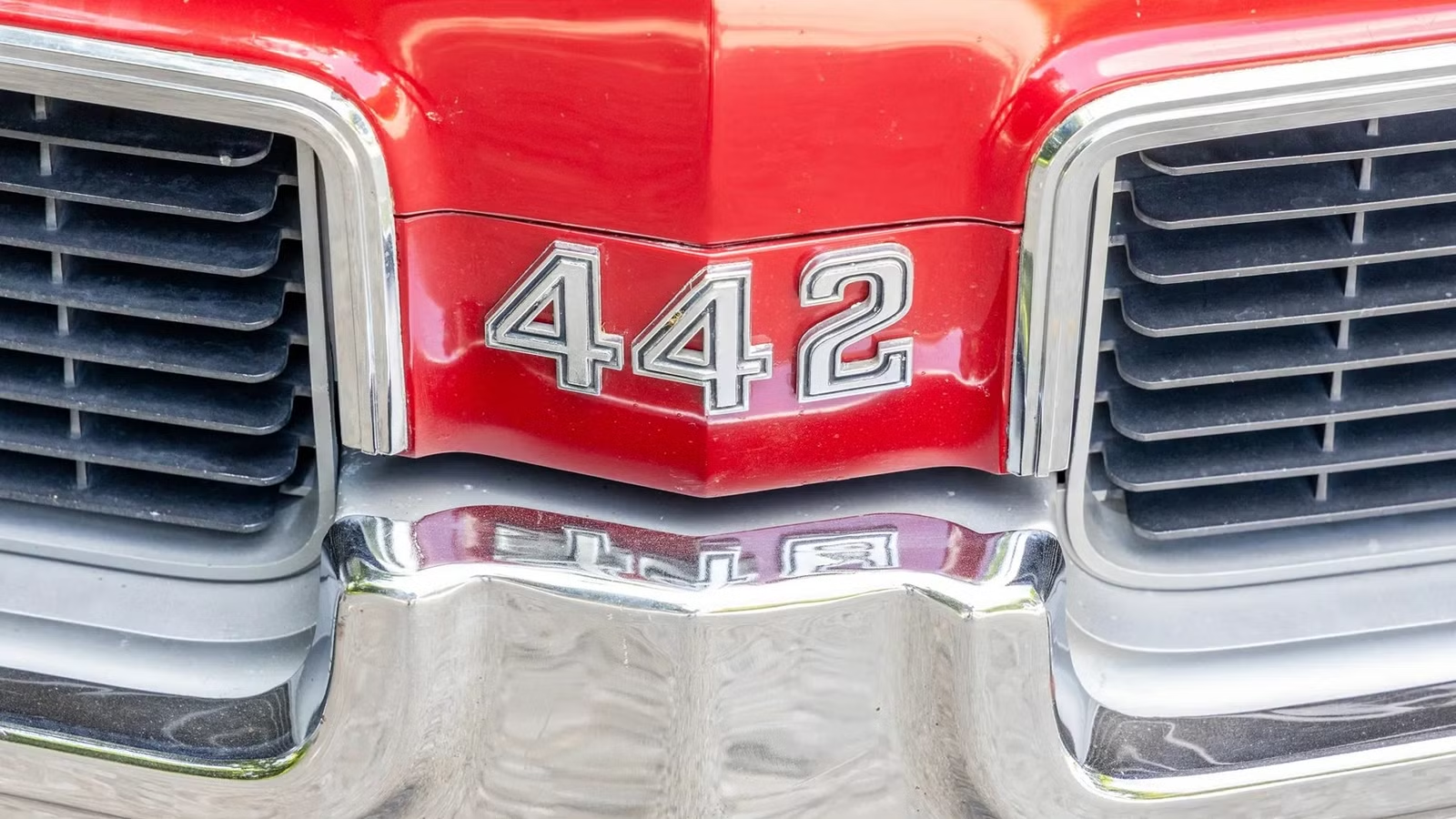
The golden era of American muscle was defined by two main features: the V8, how fast it could reach the ton, and bold styling. Cars with that bravado captured American audiences. The poster child of this combination was undoubtedly the Pontiac GTO, which became the country’s poster car. While Pontiac captured the public imagination, General Motors was developing a car that traditionally wouldn’t be seen as the GTO’s peer, but rather as a more subtle power cruiser with the power and dynamics to go toe-to-toe with it.
The Fundamental Chassis Flaw Of The 1960s Horsepower Wars

By the late 1960s, the classic muscle formula was well established after the early-1960s muscle explosion. Manufacturers took a mid-size sedan, dropped the largest V8 they had on the shelf, and painted the body bright colors; the result was cars that could out-accelerate almost anything on the road, but dynamics were an afterthought. Mechanically, these cars were mainly built on live-axle rear-suspension setups, which saved costs but didn’t provide the required turn-in. Cars suffered from body roll, high-speed understeer, and wheel hop at launch.
As a result, this generation of muscle cars was seen as straight-line merchants that couldn’t tackle anything beyond the quarter mile. Pontiac found an untapped market by offering pure performance for younger buyers with the GTO, but the GTO was louder in appearance; Oldsmobile wanted to use the same chassis and make something more refined for a more mature set of buyers. Oldsmobile also realized the engine alone wouldn’t cut it; the architecture needed to be sound so the car could handle better. It needed to be comfortable for long distances, yet still engaging enough to keep the driver interested.
The ‘Gentleman’s Muscle’ Car


Oldsmobile created a new kind of performance machine, one that redefined the car’s dynamics. It targeted a mature audience and was subtly positioned as the “Gentleman’s Muscle Car.” It intentionally avoided the flashy racing stripes and loud exterior trim of its Pontiac counterpart. Instead, Oldsmobile invested time and budget in chassis reinforcement, sophisticated suspension geometry, and premium interior acoustic insulation. Oldsmobile wanted to prove that an intermediate performance car could serve as a refined daily commuter while offering an elevated driving experience that prioritized mechanical balance over theatrics.
To achieve that balance, Oldsmobile engineers thoroughly re-engineered the suspension on the corporate GM A-body platform. While rivals relied on flexible open-channel rear trailing arms that couldn’t handle heavy lateral loads, Oldsmobile equipped its car with seam-welded boxed lower control arms, higher-durometer rubber bushings, a heavy-duty front stabilizer bar, and a standard 0.875-inch rear sway bar bolted directly to the lower trailing arms.
This critical chassis upgrade transformed the car’s dynamic prowess, neutralizing rear-axle twist and boosting rear roll stiffness by nearly 30%. While rivals understeered through tight bends, the Gentleman’s Muscle Car stayed remarkably flat, carving through corners with neutral handling characteristics.
The Oldsmobile 442: Peak Engineering at a Discount

The Oldsmobile 442 debuted in 1964 as an optional performance package on the Cutlass; in 1968, it became a standalone model to challenge the GTO head-on. When introduced in 1964, the “442” designation stood for a four-barrel carburetor, four-speed manual transmission, and dual exhausts. By 1965, Oldsmobile redefined it to mean a 400-cubic-inch engine, four-barrel carburetor, and dual exhausts.
Oldsmobile reached its production peak in 1968, moving a record 33,607 442 units as a standalone model. While Pontiac moved roughly 87,000 GTOs that same year, the volume figures alone don’t reflect the 442’s engineering superiority. Under the hood, the 1968 model had a high-torque 400-cubic-inch Rocket V8 that produced 440 lb-ft of torque for effortless performance and a surge of power. In 1968, the W-30 option package, with force-air induction and aggressive 4.33 rear-axle gears, could run the quarter mile in 13.30 seconds at 103.30 mph. The 442’s exclusivity peaked with special collaborations like the legendary 1968 Hurst/Olds, of which only 515 units were ever hand-crafted.
In today’s 2026 collector market, the average classic 442 hovers around $65,000, making it one of the most compelling value plays in the vintage car scene. When comparing apples-to-apples baseline 400 V8 configurations, the Oldsmobile 442 consistently sells for less than equivalent Pontiac GTOs and Chevrolet Chevelle SS models. While ultra-rare halo models such as a 1969 Hurst/Olds command massive auction results—like an example that sold for $187,000 in May 2026 or a pristine 1970 W-30 convertible that sold for almost a quarter million dollars—the standard 442 model remains remarkably accessible to everyday enthusiasts compared to cars with equivalent performance from that era.
How Oldsmobile Made a Muscle Car That Actually Corners

While standard A-body muscle cars suffered from front-end dive and sluggish steering response because of soft front spring rates and flexible linkages, Oldsmobile re-engineered the front suspension geometry under the FE2 package with a heavy-duty 0.9375-inch front anti-roll bar and heavy-duty steering spindles.
By pairing this stiffer front assembly with higher-durometer control arm bushings and a retuned steering gear, Oldsmobile engineers raised the front roll center, drastically reducing body lean and dynamic camber loss under cornering loads. At the rear, the boxed lower trailing arms worked in tandem with the solid 0.875-inch sway bar to act as a structural cross-brace across the rear frame rails, maintaining fixed rear track width and preventing live-axle lateral displacement when accelerating hard out of turns.
Under the hood, the engine prioritized low-end grunt over peak RPM. For the 1968 model year, Oldsmobile redesigned its 400-cubic-inch Rocket V8 with an undersquare cylinder architecture featuring a 3.87-inch cylinder bore and a long 4.25-inch stroke geometry shared with the larger 455 block. With a high-capacity 750-CFM Rochester Quadrajet four-barrel carburetor and high-flow D-port cylinder head castings, this undersquare configuration produced 440 lb-ft of torque at a low 3,000 RPM.
The Smart-Money Muscle Car Buy Of The Collector Era

The Pontiac GTO was the 1960s pop-culture hero car. Still, for enthusiasts who want a fun, lower-cost GTO alternative, the 442 is becoming a compelling option. It is arguably the best-engineered GM A-body vehicle of the muscle car decade. Oldsmobile prioritized chassis balance, driver feedback, and structural integrity over visual gimmicks.
While the Pontiac GTO and Chevrolet Chevelle remain valuable for nostalgia, pragmatic buyers can get a 1968-1970 Oldsmobile 442 with superior suspension and muscle-car engineering, plus unmatched road manners, for significantly less. The Oldsmobile 442 remains the ultimate thinking enthusiast’s muscle car, delivering an unbeatable blend of history, usability, and long-term value that outshines its rivals.
Source: Classic.com, Bring a Trailer.

Related posts



Latest Post


No Comments