
This Forgotten American Off-Road Wagon Was Decades Ahead Of Its Time
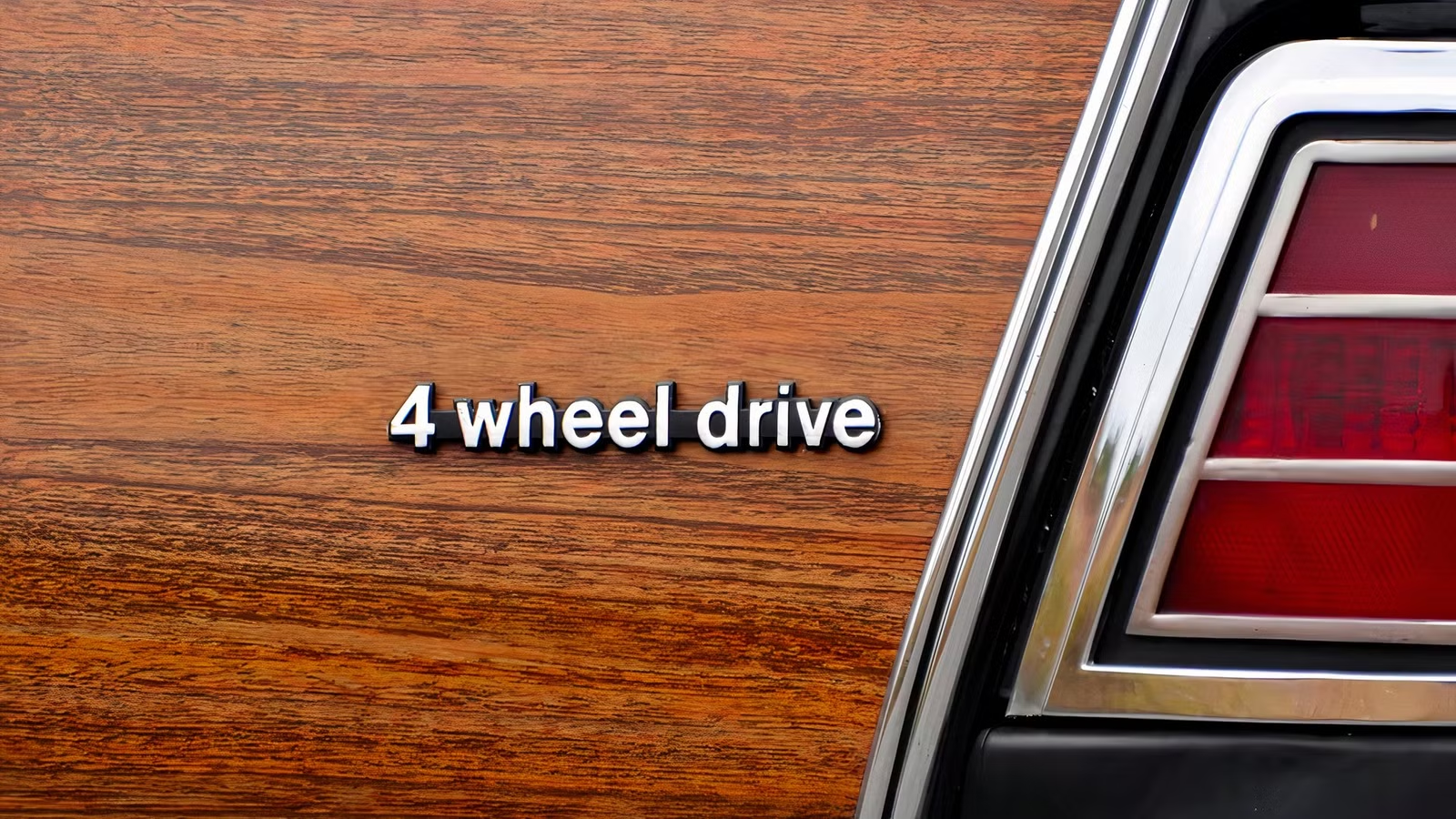
Long before crossovers became the default choice for American families, one domestic automaker quietly built something that should have changed everything. The AMC Eagle looked like a station wagon, pulled power from a muscle-car-worthy drivetrain, and tackled terrain that would humble most trucks — yet history largely passed it by. It combined rally-car stance with commuter comfort and pioneered technology that wouldn’t go mainstream for another two decades. If you’ve never heard of it, that’s exactly the problem this article aims to fix.
The 1980 AMC Eagle Was Decades Ahead Of Its Time

The AMC Eagle was one of the most innovative vehicles of its era. Introduced in 1979, the Eagle was a rugged off-road wagon or sedan that predated the crossover SUV by decades. Developed by American Motors Corporation (AMC), it combined the comfort and styling of a passenger car with the all-weather traction of a four-wheel-drive system, making it one of the first mass-produced four-by-four wagons in the U.S. If that formula sounds familiar, it’s precisely what crossover SUVs have been selling ever since.
AMC Eagle Key Specs
|
AMC Eagle |
|
|---|---|
|
Engine |
 37 autotech 112-hp 4.2-liter inline-6, 82-hp 2.5-liter 4-cylinder, or 150-hp 3.6-liter turbodiesel inline-6 |
|
Drivetrain |
Quadra-Trac four-wheel drive |
|
Transmission |
3-speed automatic, 4-speed manual, or 5-speed manual |
|
Ground clearance |
6.9 inches |
|
Max towing |
3,500 pounds |
Built on the AMC Concord platform — a compact passenger-car architecture — the Eagle featured a lifted suspension, protective body cladding, and a full-time four-wheel-drive system with a viscous coupling center differential. Later models added a shift-on-the-fly transfer case operated by a dash-mounted switch, a genuinely advanced feature for the period. It resembled a family wagon, but the Eagle was engineered to handle snow, dirt, and gravel with equal confidence. In the late ’70s, most Americans associated off-roading with trucks or Jeeps, yet the Eagle delivered go-anywhere utility in a far more livable package. Sales never reached their potential, and AMC ceased production in 1987 — but the Eagle’s influence paved the way for modern crossovers like the Subaru Outback.
The AMC Eagle Was The First Mass-Produced 4×4 In America
Long before all-wheel-drive crossovers became mainstream, the AMC Eagle stood as the first mass-produced four-wheel-drive passenger car in America. It used a unibody car platform paired with a full-time four-wheel-drive system, and unlike pickup trucks or Jeeps, the Eagle offered everyday comfort and usability alongside genuine off-road capability — making it a true trailblazer for the crossover SUV segment. While the Eagle borrowed elements of Jeep’s Quadra-Trac system, AMC partnered with Ferguson Engineering, a British firm renowned for its all-wheel-drive expertise, to develop a more sophisticated drivetrain. The result was a single-speed transfer case paired with a viscous coupling center differential, enabling seamless, continuous power delivery to all four wheels without any driver input. In later models, AMC introduced the Select-Drive system, which let drivers switch between two-wheel drive and four-wheel drive to improve fuel economy. These drivetrains, combined with the Eagle’s raised suspension and rugged construction, made it a capable all-season, all-terrain vehicle long before the word “crossover” existed.
The AMC Eagle Is Dirt Cheap And Overlooked
According to Classic.com, the average sale price for an AMC Eagle is approximately $12,968, with recorded sales ranging from $3,300 to a notable high of $41,250 for a 1984 Eagle Limited Wagon. This makes it a true hidden gem of the used car market. Recent sales include a 1986 Eagle Wagon fetching $16,500 and a 1986 Eagle Limited Wagon selling for $28,600. Well-kept AMC Eagles are becoming increasingly attractive to collectors and enthusiasts seeking a versatile, historically significant vehicle with a devoted cult following.
Used AMC Eagle Sales
|
Model Year |
Mileage |
Price |
|---|---|---|
|
1986 AMC Eagle Wagon |
75,000 miles |
$16,500 |
|
1986 AMC Eagle Limited Wagon |
51,000 miles |
$28,600 |
|
1980 AMC Eagle 2-Door Sedan |
60,000 miles |
$9,000 |
|
1983 AMC Eagle Limited Wagon |
124,000 miles |
$3,300 |
|
1983 AMC Eagle |
29,000 miles |
$6,000 |
|
1982 AMC Eagle Limited Wagon |
101,000 miles |
$13,200 |
|
1984 AMC Eagle Wagon |
67,000 miles |
$5,300 |
Other Early All-Wheel-Drive Cars
The AMC Eagle was discontinued in 1987, but other automakers soon began introducing all-wheel-drive and four-wheel-drive cars inspired by the Eagle’s innovative concept. While the Eagle was the first U.S.-built vehicle to combine passenger car comfort with four-wheel-drive capability, a number of mass-produced vehicles followed in its tire tracks, bringing traction-enhancing drivetrains to mainstream sedans, wagons, and hatchbacks.
Subaru Legacy

Subaru introduced the Legacy in 1989, designed to compete directly with midsize sedans like the Toyota Camry and Honda Accord. The Legacy was available in both sedan and wagon body styles and came with either front-wheel drive or Subaru’s all-wheel-drive system, which helped establish the brand’s enduring reputation for year-round capability and safety.
Audi Quattro

The 1980 Audi Quattro was a groundbreaking performance coupe that brought all-wheel drive to high-performance road cars. Powered by a turbocharged 2.1-liter inline-five producing 200 horsepower, the Quattro delivered exceptional grip and acceleration — particularly in poor weather or on rough terrain. Its rally-inspired technology and angular design made it an icon, and it dominated the World Rally Championship throughout the ’80s.
Toyota Tercel

In 1983, Toyota introduced an all-wheel-drive wagon version of the Tercel, an economical sedan that had been sold in the U.S. since 1980. The part-time system could be engaged manually for better fuel economy, and the car also featured a six-speed manual transmission with a short-ratio EL (extra-low) first gear for driving on slick surfaces. Sources: Classic.com.

Related posts

Latest Post


This Forgotten American Off-Road Wagon Was Decades Ahead Of Its Time
Long before crossovers became the default choice for American families, one domestic automaker quietly built something that should have changed everything. The AMC Eagle looked like a station wagon, pulled power from a muscle-car-worthy drivetrain, and tackled terrain that would humble most trucks — yet history largely passed it by. It combined rally-car stance with commuter comfort and pioneered technology that wouldn’t go mainstream for another two decades. If you’ve never heard of it, that’s exactly the problem this article aims to fix.
The 1980 AMC Eagle Was Decades Ahead Of Its Time

The AMC Eagle was one of the most innovative vehicles of its era. Introduced in 1979, the Eagle was a rugged off-road wagon or sedan that predated the crossover SUV by decades. Developed by American Motors Corporation (AMC), it combined the comfort and styling of a passenger car with the all-weather traction of a four-wheel-drive system, making it one of the first mass-produced four-by-four wagons in the U.S. If that formula sounds familiar, it’s precisely what crossover SUVs have been selling ever since.
AMC Eagle Key Specs
|
AMC Eagle |
|
|---|---|
|
Engine |
 44 autotech 112-hp 4.2-liter inline-6, 82-hp 2.5-liter 4-cylinder, or 150-hp 3.6-liter turbodiesel inline-6 |
|
Drivetrain |
Quadra-Trac four-wheel drive |
|
Transmission |
3-speed automatic, 4-speed manual, or 5-speed manual |
|
Ground clearance |
6.9 inches |
|
Max towing |
3,500 pounds |
Built on the AMC Concord platform — a compact passenger-car architecture — the Eagle featured a lifted suspension, protective body cladding, and a full-time four-wheel-drive system with a viscous coupling center differential. Later models added a shift-on-the-fly transfer case operated by a dash-mounted switch, a genuinely advanced feature for the period. It resembled a family wagon, but the Eagle was engineered to handle snow, dirt, and gravel with equal confidence. In the late ’70s, most Americans associated off-roading with trucks or Jeeps, yet the Eagle delivered go-anywhere utility in a far more livable package. Sales never reached their potential, and AMC ceased production in 1987 — but the Eagle’s influence paved the way for modern crossovers like the Subaru Outback.
The AMC Eagle Was The First Mass-Produced 4×4 In America
Long before all-wheel-drive crossovers became mainstream, the AMC Eagle stood as the first mass-produced four-wheel-drive passenger car in America. It used a unibody car platform paired with a full-time four-wheel-drive system, and unlike pickup trucks or Jeeps, the Eagle offered everyday comfort and usability alongside genuine off-road capability — making it a true trailblazer for the crossover SUV segment. While the Eagle borrowed elements of Jeep’s Quadra-Trac system, AMC partnered with Ferguson Engineering, a British firm renowned for its all-wheel-drive expertise, to develop a more sophisticated drivetrain. The result was a single-speed transfer case paired with a viscous coupling center differential, enabling seamless, continuous power delivery to all four wheels without any driver input. In later models, AMC introduced the Select-Drive system, which let drivers switch between two-wheel drive and four-wheel drive to improve fuel economy. These drivetrains, combined with the Eagle’s raised suspension and rugged construction, made it a capable all-season, all-terrain vehicle long before the word “crossover” existed.
The AMC Eagle Is Dirt Cheap And Overlooked
According to Classic.com, the average sale price for an AMC Eagle is approximately $12,968, with recorded sales ranging from $3,300 to a notable high of $41,250 for a 1984 Eagle Limited Wagon. This makes it a true hidden gem of the used car market. Recent sales include a 1986 Eagle Wagon fetching $16,500 and a 1986 Eagle Limited Wagon selling for $28,600. Well-kept AMC Eagles are becoming increasingly attractive to collectors and enthusiasts seeking a versatile, historically significant vehicle with a devoted cult following.
Used AMC Eagle Sales
|
Model Year |
Mileage |
Price |
|---|---|---|
|
1986 AMC Eagle Wagon |
75,000 miles |
$16,500 |
|
1986 AMC Eagle Limited Wagon |
51,000 miles |
$28,600 |
|
1980 AMC Eagle 2-Door Sedan |
60,000 miles |
$9,000 |
|
1983 AMC Eagle Limited Wagon |
124,000 miles |
$3,300 |
|
1983 AMC Eagle |
29,000 miles |
$6,000 |
|
1982 AMC Eagle Limited Wagon |
101,000 miles |
$13,200 |
|
1984 AMC Eagle Wagon |
67,000 miles |
$5,300 |
Other Early All-Wheel-Drive Cars
The AMC Eagle was discontinued in 1987, but other automakers soon began introducing all-wheel-drive and four-wheel-drive cars inspired by the Eagle’s innovative concept. While the Eagle was the first U.S.-built vehicle to combine passenger car comfort with four-wheel-drive capability, a number of mass-produced vehicles followed in its tire tracks, bringing traction-enhancing drivetrains to mainstream sedans, wagons, and hatchbacks.
Subaru Legacy
Subaru introduced the Legacy in 1989, designed to compete directly with midsize sedans like the Toyota Camry and Honda Accord. The Legacy was available in both sedan and wagon body styles and came with either front-wheel drive or Subaru’s all-wheel-drive system, which helped establish the brand’s enduring reputation for year-round capability and safety.
Audi Quattro
The 1980 Audi Quattro was a groundbreaking performance coupe that brought all-wheel drive to high-performance road cars. Powered by a turbocharged 2.1-liter inline-five producing 200 horsepower, the Quattro delivered exceptional grip and acceleration — particularly in poor weather or on rough terrain. Its rally-inspired technology and angular design made it an icon, and it dominated the World Rally Championship throughout the ’80s.
Toyota Tercel
In 1983, Toyota introduced an all-wheel-drive wagon version of the Tercel, an economical sedan that had been sold in the U.S. since 1980. The part-time system could be engaged manually for better fuel economy, and the car also featured a six-speed manual transmission with a short-ratio EL (extra-low) first gear for driving on slick surfaces. Sources: Classic.com.
Related posts



No Comments
Leave a Reply
This Forgotten American Off-Road Wagon Was Decades Ahead Of Its Time
Long before crossovers became the default choice for American families, one domestic automaker quietly built something that should have changed everything. The AMC Eagle looked like a station wagon, pulled power from a muscle-car-worthy drivetrain, and tackled terrain that would humble most trucks — yet history largely passed it by. It combined rally-car stance with commuter comfort and pioneered technology that wouldn’t go mainstream for another two decades. If you’ve never heard of it, that’s exactly the problem this article aims to fix.
The 1980 AMC Eagle Was Decades Ahead Of Its Time

The AMC Eagle was one of the most innovative vehicles of its era. Introduced in 1979, the Eagle was a rugged off-road wagon or sedan that predated the crossover SUV by decades. Developed by American Motors Corporation (AMC), it combined the comfort and styling of a passenger car with the all-weather traction of a four-wheel-drive system, making it one of the first mass-produced four-by-four wagons in the U.S. If that formula sounds familiar, it’s precisely what crossover SUVs have been selling ever since.
AMC Eagle Key Specs
|
AMC Eagle |
|
|---|---|
|
Engine |
 92 autotech 112-hp 4.2-liter inline-6, 82-hp 2.5-liter 4-cylinder, or 150-hp 3.6-liter turbodiesel inline-6 |
|
Drivetrain |
Quadra-Trac four-wheel drive |
|
Transmission |
3-speed automatic, 4-speed manual, or 5-speed manual |
|
Ground clearance |
6.9 inches |
|
Max towing |
3,500 pounds |
Built on the AMC Concord platform — a compact passenger-car architecture — the Eagle featured a lifted suspension, protective body cladding, and a full-time four-wheel-drive system with a viscous coupling center differential. Later models added a shift-on-the-fly transfer case operated by a dash-mounted switch, a genuinely advanced feature for the period. It resembled a family wagon, but the Eagle was engineered to handle snow, dirt, and gravel with equal confidence. In the late ’70s, most Americans associated off-roading with trucks or Jeeps, yet the Eagle delivered go-anywhere utility in a far more livable package. Sales never reached their potential, and AMC ceased production in 1987 — but the Eagle’s influence paved the way for modern crossovers like the Subaru Outback.
The AMC Eagle Was The First Mass-Produced 4×4 In America
Long before all-wheel-drive crossovers became mainstream, the AMC Eagle stood as the first mass-produced four-wheel-drive passenger car in America. It used a unibody car platform paired with a full-time four-wheel-drive system, and unlike pickup trucks or Jeeps, the Eagle offered everyday comfort and usability alongside genuine off-road capability — making it a true trailblazer for the crossover SUV segment. While the Eagle borrowed elements of Jeep’s Quadra-Trac system, AMC partnered with Ferguson Engineering, a British firm renowned for its all-wheel-drive expertise, to develop a more sophisticated drivetrain. The result was a single-speed transfer case paired with a viscous coupling center differential, enabling seamless, continuous power delivery to all four wheels without any driver input. In later models, AMC introduced the Select-Drive system, which let drivers switch between two-wheel drive and four-wheel drive to improve fuel economy. These drivetrains, combined with the Eagle’s raised suspension and rugged construction, made it a capable all-season, all-terrain vehicle long before the word “crossover” existed.
The AMC Eagle Is Dirt Cheap And Overlooked
According to Classic.com, the average sale price for an AMC Eagle is approximately $12,968, with recorded sales ranging from $3,300 to a notable high of $41,250 for a 1984 Eagle Limited Wagon. This makes it a true hidden gem of the used car market. Recent sales include a 1986 Eagle Wagon fetching $16,500 and a 1986 Eagle Limited Wagon selling for $28,600. Well-kept AMC Eagles are becoming increasingly attractive to collectors and enthusiasts seeking a versatile, historically significant vehicle with a devoted cult following.
Used AMC Eagle Sales
|
Model Year |
Mileage |
Price |
|---|---|---|
|
1986 AMC Eagle Wagon |
75,000 miles |
$16,500 |
|
1986 AMC Eagle Limited Wagon |
51,000 miles |
$28,600 |
|
1980 AMC Eagle 2-Door Sedan |
60,000 miles |
$9,000 |
|
1983 AMC Eagle Limited Wagon |
124,000 miles |
$3,300 |
|
1983 AMC Eagle |
29,000 miles |
$6,000 |
|
1982 AMC Eagle Limited Wagon |
101,000 miles |
$13,200 |
|
1984 AMC Eagle Wagon |
67,000 miles |
$5,300 |
Other Early All-Wheel-Drive Cars
The AMC Eagle was discontinued in 1987, but other automakers soon began introducing all-wheel-drive and four-wheel-drive cars inspired by the Eagle’s innovative concept. While the Eagle was the first U.S.-built vehicle to combine passenger car comfort with four-wheel-drive capability, a number of mass-produced vehicles followed in its tire tracks, bringing traction-enhancing drivetrains to mainstream sedans, wagons, and hatchbacks.
Subaru Legacy
Subaru introduced the Legacy in 1989, designed to compete directly with midsize sedans like the Toyota Camry and Honda Accord. The Legacy was available in both sedan and wagon body styles and came with either front-wheel drive or Subaru’s all-wheel-drive system, which helped establish the brand’s enduring reputation for year-round capability and safety.
Audi Quattro
The 1980 Audi Quattro was a groundbreaking performance coupe that brought all-wheel drive to high-performance road cars. Powered by a turbocharged 2.1-liter inline-five producing 200 horsepower, the Quattro delivered exceptional grip and acceleration — particularly in poor weather or on rough terrain. Its rally-inspired technology and angular design made it an icon, and it dominated the World Rally Championship throughout the ’80s.
Toyota Tercel
In 1983, Toyota introduced an all-wheel-drive wagon version of the Tercel, an economical sedan that had been sold in the U.S. since 1980. The part-time system could be engaged manually for better fuel economy, and the car also featured a six-speed manual transmission with a short-ratio EL (extra-low) first gear for driving on slick surfaces. Sources: Classic.com.


No Comments