
Plymouth Dealers Once Trashed The Wings On A Car Now Worth $1.65 Million
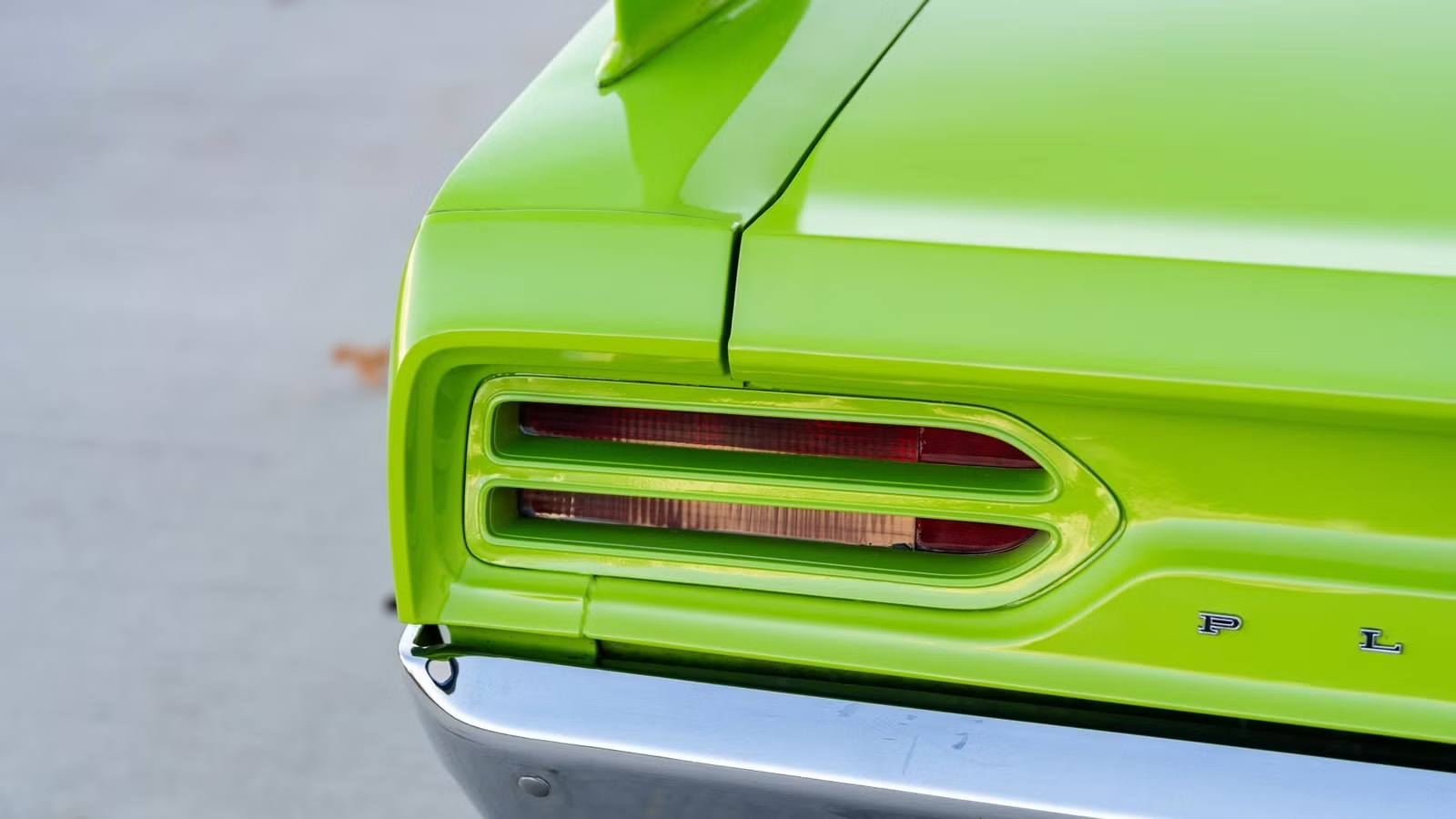
Expensive mistakes were made as Plymouth dealerships didn’t know what they had. Iconic features such as massive wings were unbolted from cars and thrown in the trash simply because they were considered ugly. But if the cars were left intact, they could be worth millions. Extremely valuable parts were left to rot in dumpsters simply to move a rare car off the lots. Dealership owners had no idea that they were discarding their opportunities to cash in on massive paydays.
The Winged Cars Weren’t Designed For The Public

In the late 1960s and 1970s, automakers felt incredible pressure to show dominance on NASCAR tracks. Winning on Sundays led to more sales on Mondays in the golden era of muscle cars. So multiple cars were designed for racing instead of being made for the public, including one ugly Plymouth model.
Cars needed to become more aerodynamic to efficiently handle large amounts of raw power as they surpassed 200 mph. Standard stock bodies faced dangerous front-end lift and instability, and the boxy muscle car shapes struggled against aerodynamic walls of drag. So Chrysler engineers leaned in hard with the use of wind tunnels for the ability to slice through the air and remain stable as higher speeds were achieved.
As a result, a Plymouth car gained a new radical design that dealerships immediately hated. It got a pointed beak to replace the flat front grille. The 18-inch fiberglass nose cone is massive, but effective for reducing frontal drag. Wind tunnel data also showed that the spoiler needed to sit higher than the roofline, leading to the implementation of a massive 23-inch wing to generate crucial rear downforce. But hey, the car has only a 0.28 drag coefficient!

Due to homologation rules at the time, many automakers were forced to provide production-ready race car models to the public to meet NASCAR requirements. In 1970, one production street model had to be built for every two dealer franchises. So, dealerships were embarrassed to have such an unsightly model on the lot.
The 1970 Plymouth Superbird Was An Eyesore

Dealerships didn’t give the 1970 Plymouth Superbird a chance. They were embarrassed by it. Its style was so radically different from typical muscle car designs at the time. It was referred to as looking like an alien spaceship. The Superbird was also an impractical nightmare for buyers. The long nose cone scraped on driveways, and the massive rear wing impacted visibility. This led to high insurance rates that turned buyers away. It was also a bit more expensive than other high-performance muscle cars, with a price of $4,298. The Ford Mustang Boss 302 rang in at $3,720 with a more attractive style.
The Plymouth Superbird seemed impossible to sell. They sat on back lots for months to years, and some even had to be placed in long-term storage. The cars collected dust as dealerships became desperate and provided massive discounts. Eventually, they began unbolting the nose cone and rear wing to convert the Superbird cars into normal-looking standard Road Runner models.
But The Ugly Car Became A Legend

The 1970 Plymouth Superbird is known as the ugly duckling that eventually became a swan. The cars immediately began gaining iconic lore as they lured Richard Petty back to Plymouth. He won 18 races during the 1970 season, and Pete Hamilton drove a Superbird to victory at the Daytona 500. It was the first NASCAR car to break the 200 mph speed threshold on super speedways!
It’s also a pop culture icon, as it incorporated officially licensed Warner Bros. Road Runner cartoon decals on the wing and nose cone. The car was also equipped with the specialized ‘Beep-Beep’ Road Runner sound effect horn. The decals feature the famous cartoon bird wearing a helmet.

Additionally, the Superbird appears in the animated Disney film Cars as the Strip “The King” Weathers character. The character is voiced by the legendary Richard Petty himself and features Petty’s iconic Blue #43 livery paint.
The car is also featured in numerous TV shows and movies as a retro 1970s visual. It’s in Dazed and Confused, Gone in 60 Seconds, Joe Dirt, the Fast & Furious franchise, The Good The Bad and The Ugly, and more. Plus, it’s a popular Hot Wheels model and immortalized by die-cast replicas.
Now 1970s Dealership Owners Are Kicking Themselves

If Plymouth dealership owners held on to Plymouth Superbird models or left the features intact, they could have made millions. Only about 1,935 models were built to satisfy NASCAR requirements, making it incredibly rare. Historians believe that roughly 1,000 models may still survive.
These cars had an original price of about $4,298, and now the value for unrestored project models with the 33 civic-inch four-barrel V8 ranges between $220,000 to $250,000. Project cars with the 440 six-pack V8 go for about $260,000 to $330,000, depending on condition. Models with the 426 HEMI V8 with 425 hp and 490 lb-ft of torque fetch over $530,000.

Of course, the Superbird is worth even more if found in better condition. In July 2022, a 1970 Plymouth HEMI Superbird sold for a world-record auction price of $1.65 million at the Barrett-Jackson Las Vegas auction. Only 135 Superbird models received the highly coveted 426 HEMI V8 engine. Also, models equipped with the four-speed manual transmission often hold more value.
The model that got the record-selling price was meticulously restored to revamp its eye-catching shade of Toro Red paint that pairs well with the black interior. It features the factory tachometer, AM radio, and three-spoke steering wheel. But not all of these features are necessary for a solid payout.
Source: Hemmings, IMCDB, Top Speed

Related posts



Latest Post


No Comments