
The First Factory Supercharged Muscle Wagon Ever Sold
Long before the Dodge Challenger SRT Hellcat made superchargers synonymous with American muscle, and well before the Audi RS2 Avant convinced the world that a wagon could be genuinely fast, a quiet revolution was happening in Ford showrooms. Tucked among the chrome-laden family haulers of the late 1950s was a station wagon packing a factory-fitted supercharger — a detail so unlikely that most automotive historians have all but forgotten it. This is the story of Ford’s pioneering blown wagon, a machine that combined NASCAR-derived technology with the inoffensive looks of a Wurlitzer jukebox.
Why Ford Built A Supercharged Wagon In The First Place

To understand why Ford was selling supercharged wagons to the public in the 1950s, you first have to understand the American racing scene back then. After World War II, America saw a massive surge in car culture and racing, eventually leading to the birth of racing organizations like NASCAR in 1949 and the NHRA in 1951. As racing exploded in popularity, manufacturers realized that if their car won a high-profile race over the weekend, dealerships across the country experienced a direct surge in sales the very next Monday. As such, Detroit began increasing its involvement in stock car racing during the early to mid-1950s.
As competition from Chevrolet and Chrysler intensified in the mid-1950s, Ford executives launched a program aimed at “the maintenance of the Ford car and Thunderbird performance reputation,” according to a 1956 memo by the Blue Oval. The program set out to equip the existing Y-block engine with a supercharger for racing purposes, while also making the engine available in 1957 Ford passenger cars — including an unassuming wagon that looked far more cruiser than bruiser.
The F-Code Country Sedan Wagon Is A Supercharged Sleeper


In the 1950s, American car sales were booming. The postwar automotive sector was producing ever more daring models, with fins, chrome, and more color than the “Enchantment Under the Sea” high school dance. Throughout the decade, an estimated 58 million cars were sold, and American carmakers were hitting their stride. But while these flashy automobiles looked like a Burger Chef on wheels, behind the scenes the Big Three were locked in a battle to translate racetrack success into showroom sales, with the mantra “Win on Sunday, sell on Monday” ringing in their ears.
The Supercharged V8 Was Designed For NASCAR Homologation

For the race cars to benefit the road cars, it first had to work the other way around. The major manufacturers discovered they could homologate new engines and technology for the fledgling NASCAR series by producing a minimum of 100 road-going examples for retail sale. Chevy had already introduced a fuel-injected 283-ci V8 for exactly this reason, and Ford followed suit.
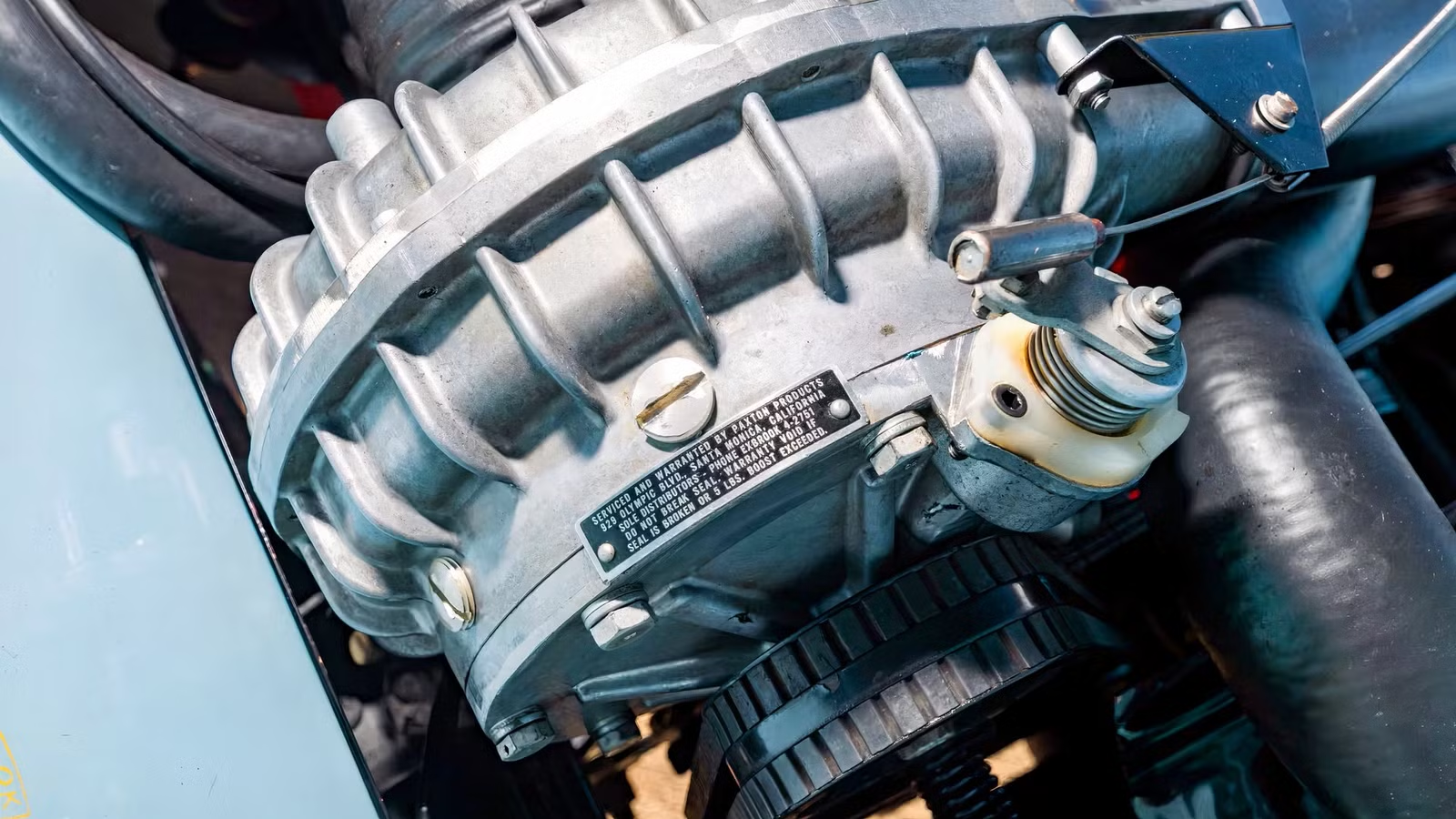
For the 1957 season, Ford settled on a supercharged 312 Y-Block V8, which became known as the F-Code — named for the “F” that appears as the first digit of the VIN on these cars. Buyers could specify a McCulloch/Paxton VR57 centrifugal supercharger. Notably, Ford made this engine available across its entire lineup, including the innocent-looking Country Sedan wagon. Other 1957 models fitted with the unit included the elegant Ford Fairlane 500 Skyliner and the Ford Thunderbird.
The Performance Of Ford’s Supercharged V8 Is Impressive Even By Today’s Standards

|
Engine |
Power |
Torque |
|
Supercharged 312 V8 |
300 hp |
340 lb-ft |
Slotting a supercharged V8 into a family wagon was a genuinely novel idea in 1957. Yet there was the Country Sedan — a mid-range Ford station wagon that had debuted in 1952 and was already on its third generation by 1957 — wearing this potent engine under its hood. The supercharged 312 produced a healthy 300 horsepower and 340 lb-ft of torque.
For context, the Audi RS2 Avant — widely regarded as the godfather of the performance wagon — makes 315 horsepower and 302 lb-ft of torque from its turbocharged 2.2-liter five-cylinder. The F-Code Fords weren’t saddled with power-sapping automatics either; buyers could choose between a three-speed manual or an automatic transmission.

Official performance figures for the Country Sedan F-Code are difficult to pin down, largely due to its rarity, but a modified F-Code 1957 Ford Custom two-door sedan posted a quarter-mile time of 13.73 seconds, demonstrating that the engine had serious potential. Unfortunately, much of the engineering effort behind the F-Code ultimately went unrewarded: NASCAR restricted induction to single normally aspirated four-barrel carburetors early in 1957, and a mutual Automobile Manufacturers Association (AMA) ban on factory-supported racing followed shortly after.
The Hidden Heavy-Duty Upgrades Under The Hood

Superchargers place additional stress on engines, and without the necessary precautions, simply bolting one on can easily reduce an engine to a shower of metal shavings. To survive under the modest 5–6 PSI of boost produced by the Paxton centrifugal supercharger, Ford engineers made several key decisions. They chose the Y-Block, whose deep piston skirting gave it a distinctive “Y” shape and provided exceptional block rigidity that naturally resisted the twisting forces of forced induction. Ford also fortified the bottom end with a forged steel crankshaft, unique high-strength connecting rods, and dished aluminum pistons designed to lower the compression ratio to a boost-friendly 8.5:1.
The real engineering highlight, however, was a cast-aluminum “pressure box” that completely enclosed the Holley four-barrel carburetor. This pressurized enclosure ensured the fuel system operated in a balanced environment, maintaining proper calibration and preventing hazardous fuel leaks.
1957 F-Code Wagon Value And Availability

A Rarely-Ticked Option
The F-Code cars may have thrilled enthusiasts, but they remained extraordinarily rare. Exact production figures vary by source, but RM Sotheby’s reports that fewer than 1,000 full-size Fords of all body styles received the supercharged engine, including fewer than 20 Skyliners. Hemmings puts the number even lower, estimating that between 350 and 450 full-size Fords across all model ranges were ordered with the F-Code supercharged V8 option.
Even on the Thunderbird, the supercharger option was incredibly rare: just 200 of the 21,380 Thunderbirds produced in 1957 received the F-Code engine package, according to RM Sotheby’s. The rarest of all F-Code Thunderbirds is the Phase One D/F Supercharged, with just 15 examples hand-built at Ford’s Dearborn, Michigan, headquarters on January 25, 1957. Production figures for F-Code versions of more everyday models such as the Country Sedan are harder to come by, but given that the wagon was not marketed as a sporting model like the Thunderbird, F-Code sales were almost certainly minuscule. Even a thorough search of the classifieds turns up virtually no F-Code Country Sedans.
Naturally Aspirated Country Sedans Are Affordable, But F-Code Cars Are Hard To Find

Country Sedan prices vary considerably, with many cars having been customized over the years. Generally speaking, 1957 and 1958 examples in good condition hover around the $30,000 to $40,000 range according to Hagerty, though these are all non-supercharged models fitted with engines ranging from a 226-ci inline-six to naturally aspirated 352-ci V8s.
F-Code cars, which surface only rarely, are true unicorns on the secondhand market. F-Code Thunderbirds do come up for sale occasionally, with one selling in 2023 for $224,000. A 1957 Ford Fairlane 500 Skyliner F-Code that sold at auction in Fort Lauderdale, Florida, in 2022 fetched an equally impressive $176,000. For any prospective buyer, verifying the “F” prefix on the chassis number is essential to confirm a true F-Code car.
Why Surviving F-Code Wagons Are Even Rarer Than Production Numbers Suggest
The F-Code Country Sedan was already rare when new, but surviving examples may be even harder to find today for reasons beyond low production. Unlike Thunderbirds or Fairlanes, the Country Sedan was purchased primarily as a family hauler rather than a collector car. Many were used hard, driven through harsh winters, or eventually scrapped once rust and age caught up with them.
Drivetrain survival is another factor. Over the decades, some 1957 Fords lost their original supercharged hardware during repairs or engine swaps, particularly when replacement parts became scarce or owners opted for simpler naturally aspirated setups. That means a true numbers-matching F-Code wagon with factory-correct induction components is likely far rarer than raw production estimates suggest.
This helps explain why authentic F-Code Country Sedans almost never surface publicly today. Their rarity isn’t just tied to how few Ford built — it’s also tied to how few survived intact.
The Other Forgotten Supercharged Wagon From 1957
At the same time that Ford was giving the F-Code treatment to the 1957 Country Sedan, another supercharged wagon option existed in America. The Studebaker President-based Packard Clipper Country Sedan is a four-door station wagon, and for 1957 it was available with just one engine: a 289-cubic-inch Studebaker V8 fitted with a Model VS-575 McCulloch supercharger, breathing through a two-barrel Stromberg carburetor and ready to spool up above 3,000 rpm. The result was a respectable 275 horsepower to motivate the 3,650-pound Country Sedan.
The 1957 Packard Country Sedan Is A Supercharged Classic Wagon For Less Than $40K
If you are searching for a 1957 supercharged wagon, the good news is that these Packards are likely somewhat more plentiful than the F-Code Country Sedan. A total of 4,809 Clippers were produced for 1957, according to RM Sotheby’s, including 869 Country Sedans — so they remain genuinely rare. A pristine 1957 Packard Country Sedan with a Flight-O-Matic automatic transmission that came to market in 2011 fetched $60,500, while another two-tone lilac and white example sold at auction in 2019 for $56,100.
Hagerty’s Valuation Tools places the price of a 1957 Packard Clipper Country Sedan in good condition at around $33,800. Whether you choose a Clipper or an F-Code Ford, either would make a genuinely intriguing addition to any collection — especially for an enthusiast who needs to fit the whole family.
Sources: Hagerty.com; Hemmings.com; Rmsothebys.com, Old Cars Weekly

Related posts




Latest Post


No Comments