
The Lost Mustang Generation That Deserves More Respect
The Ford Mustang launched in 1964½ and has been in continuous production ever since, selling around 10.8 million units on it’s way to the most iconic American car ever made. There have been seven generations of the legendary pony car and everyone has their favorites, but most would probably pick the first-gen that delivered classics like the ’68 GT popularized in the Steve McQueen classic thriller Bullitt and the ’69 Boss 429 that didn’t actually appear in theJohn Wickfilm series. Much like how the Mustang has generations, so do its fans, with Gen-X digging on the ’80s Fox Body 5-Oh!, while Millennials as well as Gen-Z are partial to the insane horsepower of both the sixth and seventh-gens. One generation, however, that nobody picks as their favorite is the second, running from 1974–1978, but there is actually a lot of coolness going on with this forgotten chapter in Mustang history.
The Long And Short Of The Mustang’s Transition

For the 1971 model year, the Mustang was elongated to better accommodate the Cobra Jet big-block engines, which looked cool with the Mach 1 package, but was pretty dorky with the base model. It’s hard to believe this was the same car that caused a sensation in ’64, but these were all first-gen ‘Stangs. The ’65 Mustang had a length of 189.6 inches while the ’71 was almost 9 inches longer, making it more of an intermediate than a pony car. There was an oil embargo in the early 1970s that saw gas prices quadruple as well as shortages that forced American automakers to detune their engines and offer vehicles that didn’t guzzle gas like the Golden Age muscle cars. Then-president of Ford, Lee Iacocca, took a look at the sagging sales of performance cars as well as shifting consumer trends and decided he needed to shrink the Mustang into a more economical ride.
Mustang II Pony Car Pinto Bean

In 1974, Ford shocked the world with the second-gen Mustang II, which was based on the sub-compact Pinto that had been introduced in 1971. Available in either two-door coupe or three-door hatchback style, the Mustang II was nearly 15 inches shorter than the ’73 model and decidedly less cool looking. Even more surprising, in the beginning there was no V8 engine option, which is the only time in the Mustang’s 70+ year history that eight cylinders were unavailable. Trim levels included the base, the Ghia luxury level, and the pseudo-performance Mach 1, which was actually just an appearance package. Despite being everything the Mustang wasn’t supposed to be, the second-gen Mustang II was a massive hit, moving 385,993 units, nearly tripling the sales of the ’73 first-gen.
Fuel Economy Over Performance

There were only two engines available for the Mustang II in its first year: an 88-horsepower 2.3-liter inline-four and a “performance” 105-horsepower 2.8-liter V6. The I4 had a 0-60 time of 16.0 seconds, which wouldn’t even be a good quarter-mile ET, while the V6 was a little quicker, getting up to speed in 13 seconds, which was still an eternity. The upside to a complete lack of performance was that the Mustang II was great on gas. Back then, the EPA’s fuel economy rating system was new, and they didn’t do separate city and highway numbers, but rather used a single laboratory driving cycle. That being said, the Mustang II was a gas pump rock star with the V6 getting 21 MPG and the I4 all the way up to 25 MPG. To put that in perspective, the average big-block muscle car was gobbling gas in the 12–15 MPG range.

The 302 Makes A Comeback

By 1975, the oil crisis was calming down and people were willing to sacrifice some fuel economy for a little more performance. Ford realized that they needed a V8 option for the Mustang II, but obviously not something as extreme as a 429 big-block, which was amazingly in production until 1991. They settled on the 302 V8 that had made the Boss 302 a racing legend, but this was a much tamer version with a single two-barrel carburetor that produced a modest 140 hp. The ’75 Mustang II with a 302 could go from 0-60 in 10.5 seconds which is a snail’s pace, but positively neck-snapping compared to the I4 and V6 options. Ford had to actually redesign the engine bay to accommodate the V8, which means they initially never intended for the Mustang II to have a V8. While not blistering, the 302 was a V8, and it was the beginning of a beautiful relationship between the Mustang and the 5.0-liter engine that is still going strong today.
Mustang II Cobra II Strikes

The Mustang II wasn’t exactly sizzling in the style department, but much like how the super-long ’73 Mach 1 benefited from an appearance package, slapping some racing stripes and mags on the second-gen car transformed it into a badass little ride. In 1976, Ford rolled out the Cobra II package that was reminiscent of the Shelby GT with over-the-top dual racing stripes and lower rocker stripes. It also came with a simulated hood scoop, front and back spoilers, quarter window louvers, and a black-out grille that increased its coolness level by a thousand percent. This was an appearance package, but if optioned with the 302, it was as peppy as anything else in 1976; the most important thing was that the Mustang was finally a hot car again. The first-gen ‘Stang has so many collectible models and special editions that it’s an embarrassment of riches, but for the second-gen, the Cobra II and that sucker below that we see you peeking at already, are the only keepers in the class.
Venomous King Cobra

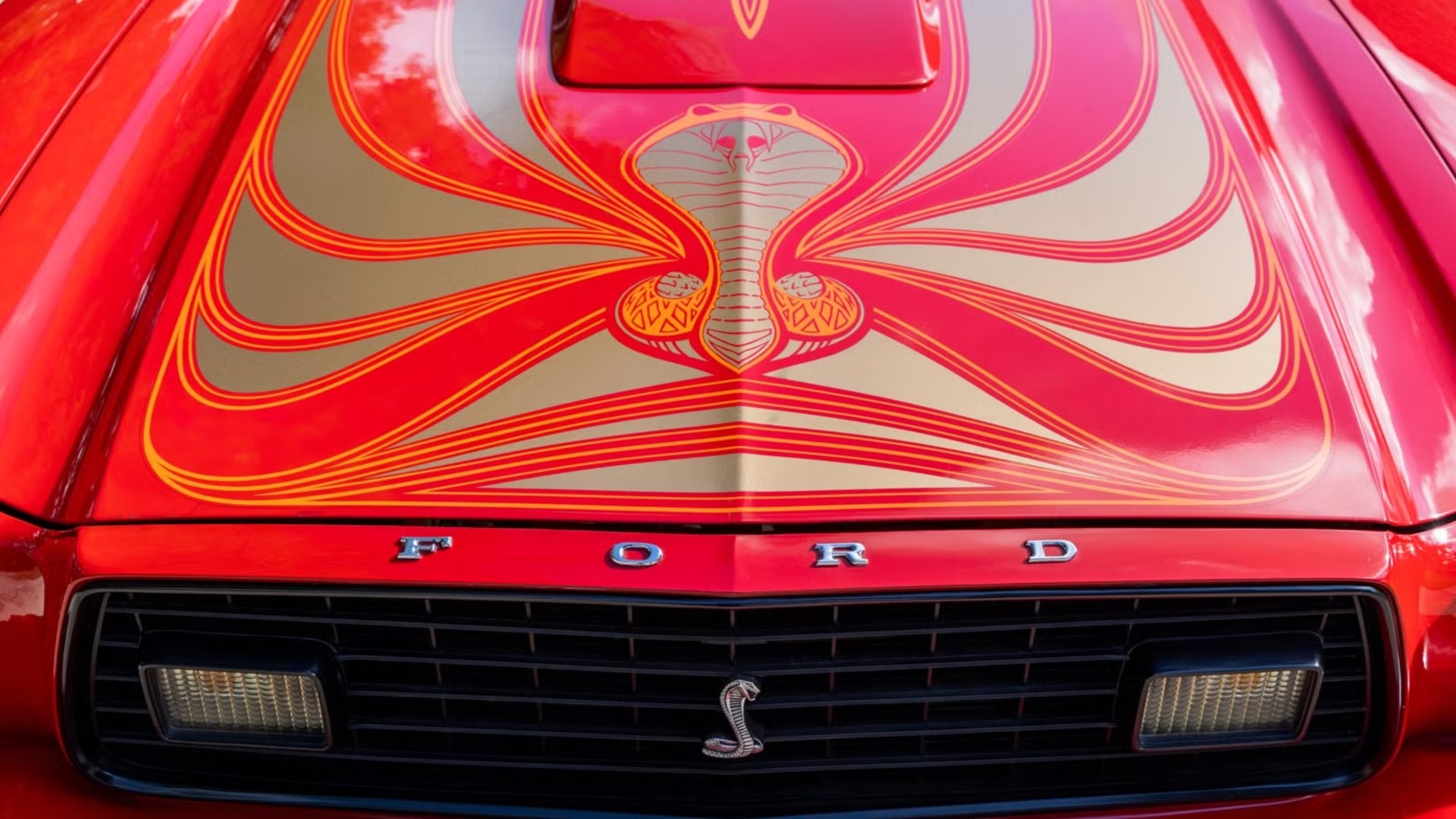
While the Cobra II was a refreshingly sporty ride, the King Cobra made the Mustang II positively wicked. 1978 was the final year for the Mustang II before the Fox Body Era would usher in, and Ford sent it out with a vengeance, introducing the King Cobra package. Limited to 4,313 units, these babies came with a front air dam, rear spoiler, hood scoop, killer mesh wheels, and key-color striping. By far the coolest element was, however, the giant snake decal on the hood meant to mimic the “Screaming Chicken” of the Pontiac Trans Am. The King Cobra wasn’t just an appearance package as all of them came standard with the 302 V8 as well as suspension upgrades. It wasn’t any faster, but it was way badder, and that counts for something. Actually, with a four-speed manual, it was possible to pull a 9.5-second 0-60 time, so maybe some of that snake’s slither got the King Cobra moving with a purpose.
Mustang II Pro Stock Dragster

The Mustang II may not have been a credible street machine, but due to its compact size and light weight, it laid one hell of a foundation for a dragster. That ridiculously awesome set of wheels pictured above is “Dyno” Don Nicholson’s 1978 Mustang II Pro Stock drag car. Two surprising things about this killer app are that it was a factory-backed build and that it has a 351 V8, albeit a completely jacked up version. Dyno Don won the 1977 NHRA Pro Stock World Championship in a Mustang II drag car, and with this particular car, set a record for the Pro Stock class. At the 1978 Englishtown Crazy Eddie’s Night of Thrills, Nicholson made a 7.97-second pass at 175 MPH, becoming the first Pro Stock car to break into the 7s. The Dyno Don Mustang II dragster sold for $107,500 at Mecum Harrisburg 2019, and we’re really hoping it’s someone’s daily driver, but there’s almost a zero percent chance of that.
Modding the Mustang II

The same reason the Mustang II was a great drag car is why people love modding them, and that’s because putting some decent power under the hood of this minuscule Mustang results in an exceptional power-to-weight ratio. The Ford 302/5.0 V8 has so much aftermarket support that cranking up the performance is as easy as bolting some stuff on. The modern Coyote 5.0-liter is up to 500 hp from the factory, and that’s achievable on an original 302 with upgraded compression, induction, and exhaust. Or, you could just swap it out for a Coyote crate engine, which would also require a new transmission and rear end, but those are probably things that were getting replaced anyway. The Mustang II wasn’t built to handle massive amounts of horsepower, so basically everything mechanical needs some beefing up before it’s ready to unleash hell on the streets.
Second-Gen ’Stang is a Builder’s Dream Car

The ideal project car is something that had potential but never realized it, and that’s the best description for the Mustang II that we can think of. Also, it should be something mass-produced so it’s on the buyer’s side of the supply and demand equation, which the Mustang II also nails. Though the Mustang II was only around for five model years, Ford sold 1.1 million of them and, because they don’t have the same level of popularity as other gens, are dirt cheap. The more money you can save on the initial project car purchase, the more there is left over for building it out. Combined with the fact that Ford parts are easy to come by and the healthy aftermarket performance parts industry, the Mustang II makes for a budget builder’s dream. This does come with a caveat though, because, as you will soon see, these cars are not that valuable in any condition, so build one to enjoy it, not to flip it.
Mustang II Values And Collectibility

First-gen Mustangs can sell in the millions and there are some six-figure Fox Bodies, but the most we could find a Mustang II going for at auction was around $57,000. The top seller on Bring a Trailer was just $35,000 for a 44,000-mile ’78 King Cobra in 2026. That might actually be a solid score for the seller as Hagerty puts the value for a 1974 Mustang II at between $5,400 and $21,600. For a 1976 Cobra II, the prices are a little higher, ranging from $12,200–$46,900, and the 1978 King Cobra maxes out the generation with a value of $13,900–$52,900. Of course, as we already mentioned, there are virtually no cars selling for the Concours condition values, but this might be an up-and-comer.
The Mustang II was almost completely erased from our collective consciousness, but seeing how cool the Cobra II and King Cobra look is awakening those memories for a lot of collectors. Driving either of these cars around town is going to garner attention because most people have never seen one, and that’s what an enthusiast is looking for, so demand might just take an upswing.
Sources: Bring a Trailer, Hagerty, Mecum, Ford

Related posts





Latest Post



No Comments