
This Car Is The Closest Thing To An American Time Machine
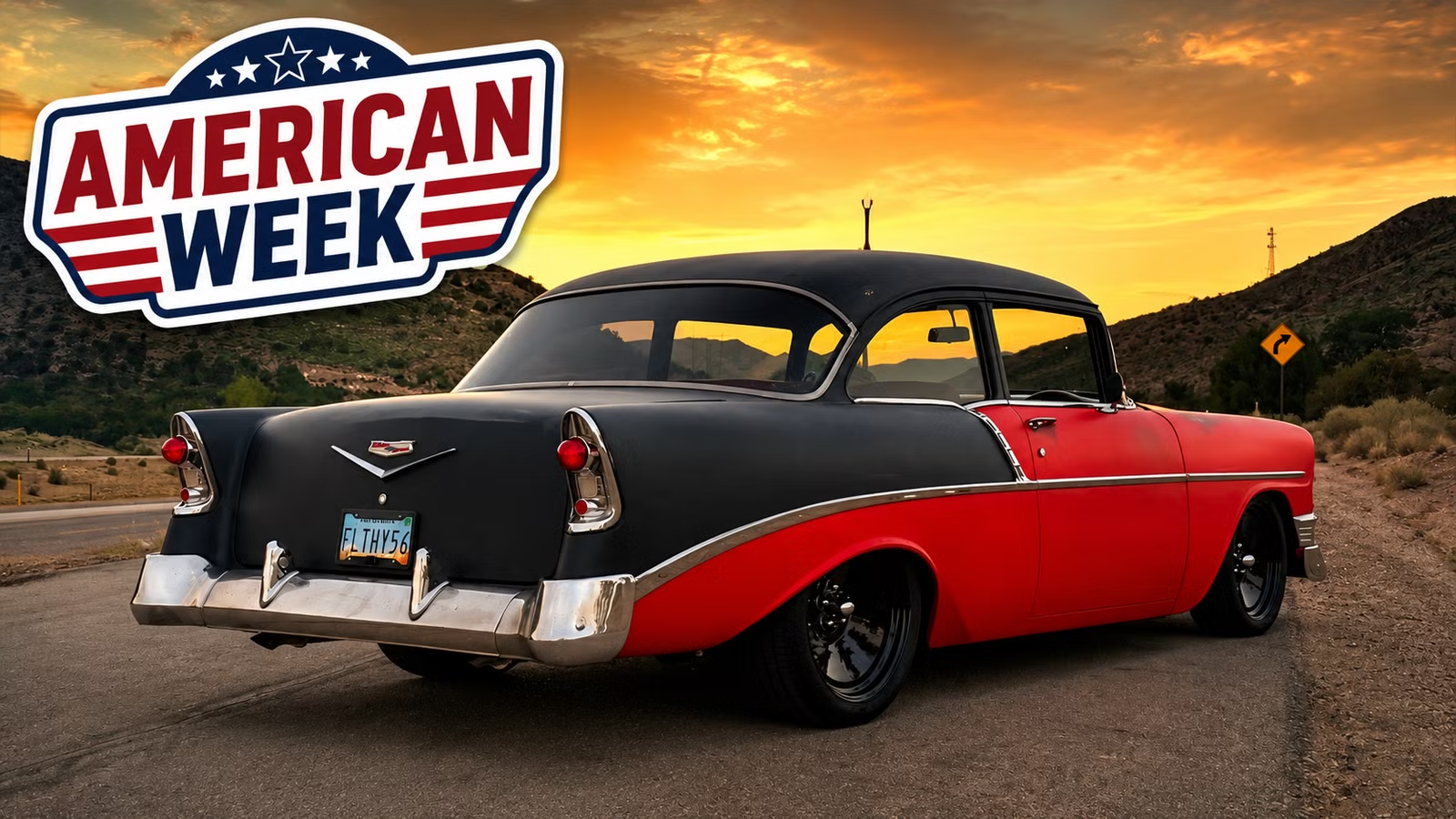
Every generation has a car. Rarely does that car become the car of every generation. Some cars are built rocket-quick to win races and shatter speed records. Some become showcases of innovative engineering. Others are the household’s steel workhorse – transporting families to work and school – quietly transforming a vehicle into the unspoken center of everyday life, without fanfare, stress or glory. A rare few evolve into more than inanimate objects—named, babied, and treated like a member of the family.

Purpose-purchased as a “need”, or sometimes as a got-to-have-it “want”, cars become part of our lives, but in the end, they eventually wear out, and owners move on. While the majority of cars just become old, a select few become timeless. But do any of those things—even timelessness—actually make a car a time machine—one that transcends decades, connects generations—all while remaining relevant and so instantly recognizable that at a single glance, the car evokes thoughts of America’s past ?
A Car Through The Ages: Defining A Time Machine
A car that qualifies as a time machine can’t belong to only one generation. It would have to span many generations, creating a connection to each one. This car wouldn’t need an introduction. Boomers would have to remember it. Millennials may have ridden in it. Gen A should, at the very least, recognize it, if not have driven it in gamer favorites like Cyberpunk 2077.
America’s time machine would’ve had to be something the everyday driver could afford, would’ve lived with, and built memories around. The car couldn’t have priced out the masses. That eliminates an exotic, a supercar, a halo car, and any exclusive, limited-production boutique builds. It would have to be from the past but still have a future. A true time machine would have been from a golden age, but still be desired now.
It should be sought-after and restorable, so that its ride through life will be preserved, allowing new generations to make its acquaintance. The car should occupy many identities. It would’ve been bought by the family, beefed up by the street-racer, restored by the collector, and customized by the resto-modder. It wouldn’t be defined by one function, but rather by its ability to be what any owner, from any generation, wanted it to be. It must have lived, survived, and still be coveted.
Meet America’s Time Machine – The Chevrolet Tri-Five

This is where the 1955–1957 Chevy Tri-Five rolls in. It’s quintessential America. It’s hot dogs and apple pies—cruise nights and drive-ins. It’s American Graffiti and Rebel without a Cause.
- It’s the ‘50s that it was made in: The affordable family car, rising out of America’s postwar optimism.
- It’s the ‘60s that it was raced in: It became a hot rod, with a new life on the drag strip.
- It’s the ‘70s that it was coveted in: It became the dream car, filling movie screens and hanging on bedroom walls.
- It’s the ‘80s that it was collected in: It became the car that enthusiasts refused to let disappear.
- It’s the ‘90s that it was resto-modded in: It became a blank canvas for every builder’s imagination.
- It’s the Millennium that it was immortalized in: It was placed on a pedestal, revered as an American icon.
- It’s the modern day that is all of the above, plus more.
It became a legend as one of the few classics loved as much in today’s garages as it was in yesterday’s driveways. It’s a boomer and a little one’s weekend project car. It’s rolling mid-century art. It’s a concours restoration. The 1955–1956 Chevy Tri-Five is anything, from anytime, that anyone dreams of.
It’s the car that is America’s time machine. Not because Chevy declared it, but because seven decades of Americans made it so.
1955-1956 Chevy Tri-Five Trim Levels
- Series A: 150 – Base-level, No Frills
- Series B: 210 – Balanced Value And Upgrades
- Series C: Bel Air – Top-Tier Luxury
Chevy’s Advertising Paralleled The Iconic Tri-Five
1950s

Looking back through the decades, Chevrolet’s changing slogans unintentionally trace the Tri-Five’s place in American culture. The Tri-Fives were Chevy-born in the ‘50s, when their slogan was “See the U.S.A. in your Chevrolet… America, the greatest land of all.” The auto manufacturer invited Americans to explore their nation in a Chevrolet. Millions did, and for many of them, that Chevrolet was a Tri-Five.
1970s

Although it was two decades after inception, the Tri-Five’s popularity skyrocketed through the mid-1970s. That rise coincided with Chevrolet’s now-famous slogan, “Baseball, Hot Dogs, Apple Pie and Chevrolet.” Coincidence or not, as the Tri-Five’s pop culture identity reached new heights, Chevrolet found itself celebrating the very symbols of traditional Americana that the Tri-Five had come to embody.
1980s

The momentum didn’t stop there. As Chevrolet introduced “The Heartbeat of America” campaign during the 1980s, enthusiasts were restoring, collecting, and preserving Tri-Fives in growing numbers. While the company looked toward the future, Americans were making sure the Tri-Five remained Chevy-strong.
2000s

Even after more than a half-century, the shoebox Chevy refused to fade. Into the new millennium, Chevrolet promoted an “American Revolution” built around a new generation of performance cars, including the Chevrolet Corvette C7. But was Chevy’sreal revolutiontheir latest innovation, or was it the enduring love of a car engineered nearly 50 years earlier—the Tri-Five?
Tri-Five Trim Levels And Engine Specs
|
1955 |
1956 |
1957 |
|
|---|---|---|---|
|
150 Trim Level Models Offered |
Four |
Four |
Four |
|
210 Trim Level Models Offered |
Eight |
Eight |
Seven |
|
Bel Air Trim Level Models Offered |
Six |
Eight |
Seven |
|
Six-Cylinder Engine Options |
Two |
One |
One |
|
Eight-Cylinder Engine Options |
Two |
Four |
Seven |
|
Rated Power |
123-180 HP |
140-225 HP |
140-283 HP |
Seventy Years Of Time Travel

An actual time machine may be a sci-fi creation – a hypothetical device that provides travel into the past – but as a car – the Chevy Tri-Five has been transporting Americans through time for over seventy years. It carries people back to their first dates, graduations, and proms. It taxis them to Friday nights spent draggin’ the main, Saturday street racing from stoplight-to-stoplight, and weekend garage projects.
It returns them to the picnic park they were driven to by their grandparents, their way-too-long, way-too-cramped summer vacation family road trip. That time when they were traveling through Cedar City, Utah, and found people so friendly they were sure there was an ulterior motive to bury travelers in the ground behind the local hotel and turn them into beef jerky (digression). Few cars have lived so many different lives, and even fewer continue to create new ones.
Chevy Tri-Five: An American Memory And Its Future

Ultimately, memories are made with cars in the background, but the car remains etched in time along with the memory. A car doesn’t simply remind people of the past – it lets every new generation experience a piece of it for themselves. The Tri-Five is part of a family, a generation, and even a nation’s identity.
The Tri-Five doesn’t belong only to the people who bought one in the three years it was produced. It belongs to the grandkids learning to turn their first wrench or the kids inheriting the family project. It doesn’t only belong to one generation; it belongs to every generation that discovers it and decides its story isn’t over yet. The 1955 -1957 Chevy Tri-Five is America’s time machine because it belongs to every generation that wants it.
Sources: Chevrolet, General Motors

Related posts



Latest Post


No Comments