
The Beginner Sport Bike Experienced Riders Secretly Love
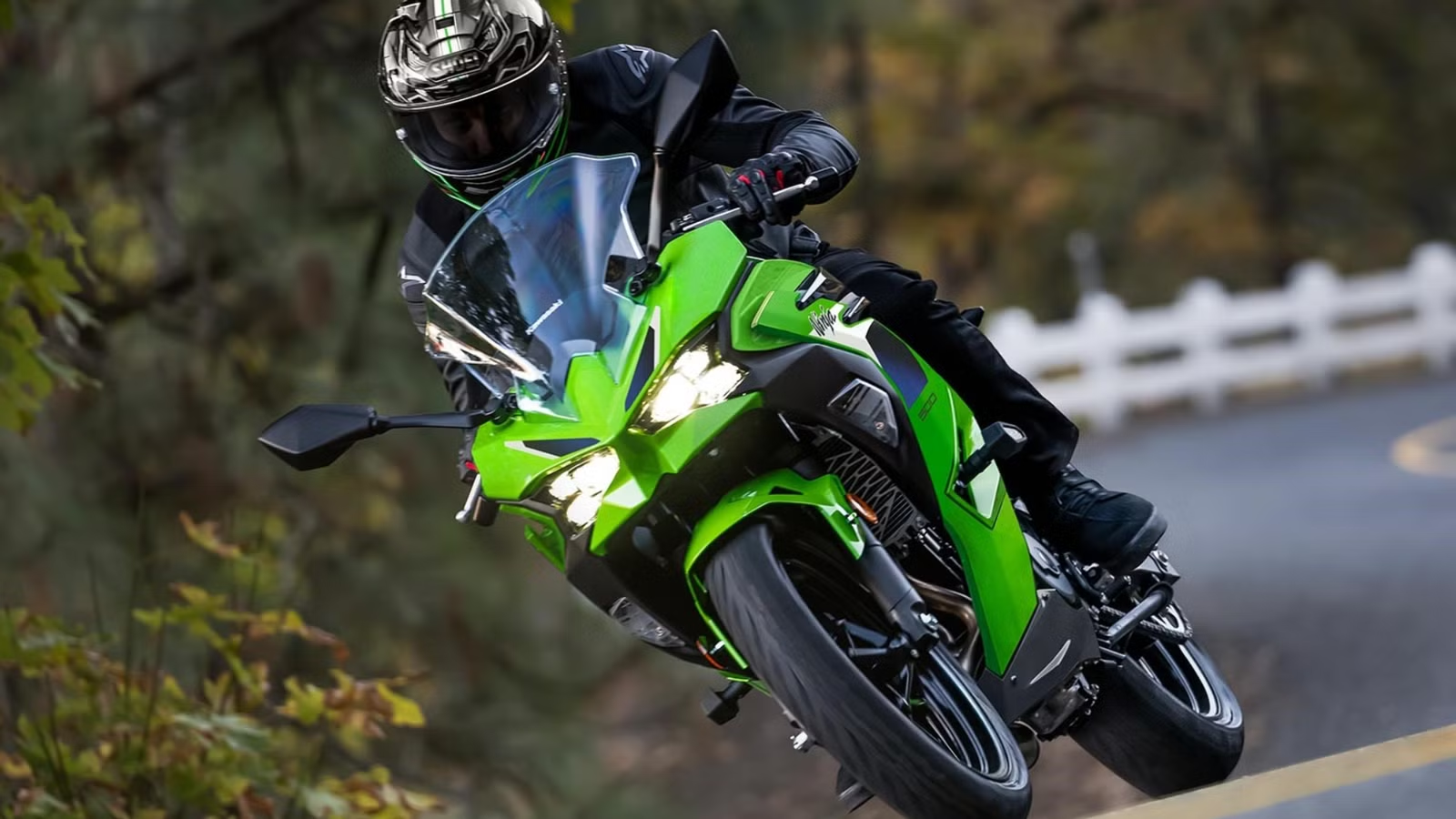
All the way back in the 80s, sport bikes rose to prominence. Initially, it was their pure speed that captured the imagination, with the Japanese manufacturers in particular delivering some astonishingly fast motorcycles for the time. Gradually, efforts shifted towards racing, and instead of pure speed, dynamic handling became the focal point. With this shift, the whole concept of what constituted a sport bike evolved. Today, there is a highly capable sports bike in every cubic capacity range, and that includes the entry-level range. The one we’re talking about here is arguably one of the most credible names you can take home.
The Birth Of More Accessible Sport Bikes

Naturally, the big, powerful sport bikes that were capable of previously unheard-of speeds weren’t exactly accessible. In an effort to tap into a growing customer base, all the Japanese brands rolled out scaled-down 250cc sport bikes for the domestic market. While these incredible little inline-four screamers (Kawasaki ZXR250 above) didn’t get sold everywhere, they certainly proved that there was a market for more approachable “sport bikes.”
Over the years, these lighter entry-level bikes also proved that, under the right conditions, they could be just as fun to ride as any of the bigger bikes. Around tighter tracks, these 250 to 500cc class sport bikes could be taken safely to their limits. Over time, certain models rose to the top and proved that they were far more than simple training wheels, and the bike in question is arguably the best example.
Everyone Loves The Kawasaki Ninja 500
MSRP: $5,399 – $6,499

The Ninja 500 is technically a relatively new model, with an increase in displacement from the previous 400cc model. It was the Ninja 400 that effectively laid the foundation upon which Kawasaki is now building a mini 500cc empire, with several bikes now based on this platform. All these bikes offer an impressive balance between accessibility, features, and performance. The sport bike, in particular, stays true to its roots, offering a dynamic riding experience on a budget.
Proof That A Small Parallel-Twin Can Be Fun
Power: 51 Horsepower

Kawasaki’s little parallel-twin now goes in pretty much every kind of motorcycle you can get, from an entry-level cruiser to an on-trend ADV. But, as versatile as it is, this powertrain was always intended for the Ninja sport bike. While the torque comes in relatively early, and it works just fine cruising around town at lower speeds, it is a quick-revving lump that requires you to keep the revs up if you want to get the most out of it.
Balancing Approachability And Performance

The linear nature of its power delivery is precisely what makes this little engine so effective. It is really approachable and predictable for new riders hopping on their first bike, but still immensely tractable. More experienced riders willing to push the bike to its limits will not be left disappointed, especially on a tighter track or a canyon road where the speed limit would restrict what you could do on anything more powerful anyway.
The Ninja 500 Promises Dynamic Performance

There is an old adage that suggests “it is more fun to ride a slow bike fast than a fast bike slow.” Naturally, there are some slow bikes that will really test this theory, but the Ninja 500 is easily the one bike that can prove it beyond reasonable doubt. When compared to other middleweight bikes, it is rather obviously significantly slower, but its steel trellis chassis more than makes up for that once you get into the twisties. The suspension is non-adjustable (aside from preload on the rear shock), and no great shakes by modern standards, but sufficient for a bike which is this light and only makes 50 horsepower.
With a wet weight of just 373 pounds, the base model (sans ABS) is incredibly light and flickable. One of the reasons why it is so light is because Kawasaki left the base model devoid of modern tech and safety features. It is actually the model that will appeal to more experienced riders after a lightweight sport bike that they can thrash around the track, or take on occasional canyon runs over the weekend.

For new riders, we would recommend the ABS-equipped model, and for those who want more features, the more expensive SE model is certainly worth considering. Unlike Kawasaki’s other SE models, which come with uprated suspension, the Ninja 500 SE simply gets more nice-to-have features in the form of ABS (as standard), keyless ignition, and a TFT dash. Unfortunately, you will pay a weight penalty, with the wet weight of the SE model going up to 382 pounds.
An Enticing Package That Will Appeal To Any Level Rider

Over the years, the Ninja 500 has become the default choice for anyone in the market for an entry-level sport bike. It offers the flexibility to use as a commuter thanks to its relatively (by sport bike standards) relaxed ergos, linear power delivery, and lightweight chassis. Unlike bigger, more dedicated sport bikes, it offers a degree of versatility that will appeal to a wide selection of riders. That said, it certainly is not perfect, and won’t be for everyone.
The relaxed ergonomics and lack of adjustment in the suspension make it a little compromised for track duty. Although aftermarket solutions exist, they will obviously add to the cost of the bike in what is a highly competitive segment. Sport bikes are also rarely the best choice for new riders, with fairings that are pretty expensive to replace when they break. Something that will almost certainly break when you drop it, and you will drop it.

Even the SE model is not as well-equipped as its direct rivals, yet in most cases, it costs more. In fact, the Chinese bikes competing in this space undercut it by a significant amount and still offer more features. But those bikes simply do not offer the same level of quality on offer here with the baby Ninja. You get what you pay for here, whether you are an experienced rider looking for a fun weekend bike or a new rider unwilling to settle for anything less than the very best entry-level sport bike available.
Source: Kawasaki

Related posts

Latest Post


No Comments