
The Last Naturally-Aspirated Japanese Sports Car You Can Still Buy Under $30K
Something is disappearing, and most people have not noticed yet. Walk into a showroom today and try to find a sports car that climbs to redline without a turbo whistling somewhere in the background. Try to find one with three pedals and a shifter you row yourself. Try to find one that sends its power to the rear wheels only, with nothing digitized sitting between your right foot and the road. The list is short. It gets shorter every year.

Here is the thing. The naturally aspirated, manual, rear-drive Japanese sports car is not being replaced. It is being quietly retired, and once it goes, it is not coming back. There is still one sitting at the door, though. It is fast, it is analog, and for the moment it costs less than a loaded family crossover.
Where This Car Fits Into A Vanishing Breed
The math is simple, and it works against enthusiasts. Turbochargers make big power from small engines while keeping emissions and fuel numbers in check. Hybrid systems fill in the low end and let a brand claim performance and efficiency in the same sentence. So that is where the money goes. That is where the engineering goes.

Look at what is left on sale. The Toyota GR Supra leans on a turbocharged BMW straight-six. The current Nissan Z, the direct successor to the car this story is really about, swaps naturally aspirated response for two turbochargers and a fatter torque curve. Both are quick. Both are good. But both trade away the exact quality that made the older car special: that long, linear pull toward a high redline, with power arriving in proportion to how far you push the pedal.

What this really means is that the format is closing. Not fading. Closing. And the cars that defined it are aging into the used market right now, at prices that have not yet caught up to what they are.
Meet The Underdog – The Nissan 370Z NISMO

The car is the Nissan 370Z NISMO. CarBuzz calls it one of the most underrated performance cars of its era, and the label fits. For years the 370Z lived in the shadow of flashier machinery, dismissed as old, heavy, and past its prime. That reputation was never quite fair, and it has aged badly. Because the things critics held against it—the raw edges and the refusal to modernize—are now the whole point. The NISMO is the sharpest version of that idea. It is the 370Z with the volume turned up: more focused, more aggressive, and built by Nissan’s in-house motorsport arm to behave like it means business. If the analog Japanese sports car is going extinct, this is the specimen worth saving.
350 Horses At Your Disposal

The heart of it is a 3.7-liter V6 from Nissan’s VQ family, and it breathes on its own. No turbos. No supercharger. Just 350 horsepower at 6,400 rpm and 276 pound-feet of torque at 5,200 rpm, delivered the old-fashioned way. Numbers only tell part of it. What matters is how the power arrives. You have to chase it. The engine wants revs, and it rewards you for reaching for them, building toward that high peak in a clean, predictable line. Power is routed to the rear wheels via a six-speed manual gearbox with SynchroRev Match. These specs allow the car to sprint from a standstill to 60 mph in five seconds flat.
There is no wall of boost, no sudden shove, no waiting for a turbo to wake up. Your right foot asks, and the engine answers in exact proportion. That honesty is the thing modern turbo motors cannot fake, and it is the thing you cannot buy new anymore for anything close to this money.
Six Speeds And Two Driven Wheels

The layout is as pure as the engine. A six-speed manual. Rear-wheel drive. Nothing clever routing torque to the front axle, nothing second-guessing your inputs. To break it down, this is a car that asks you to do the work. You pick the gear. You match the revs. You manage the balance with the throttle on the way out of a corner. It talks back the whole time, playful and a little raw, and that conversation is exactly what the automotive press praises when it sets the 370Z against the more digitized machinery that has replaced it. Modern performance cars are astonishingly capable. Most of them are also quiet about it. This one is not.
What Makes The NISMO Different

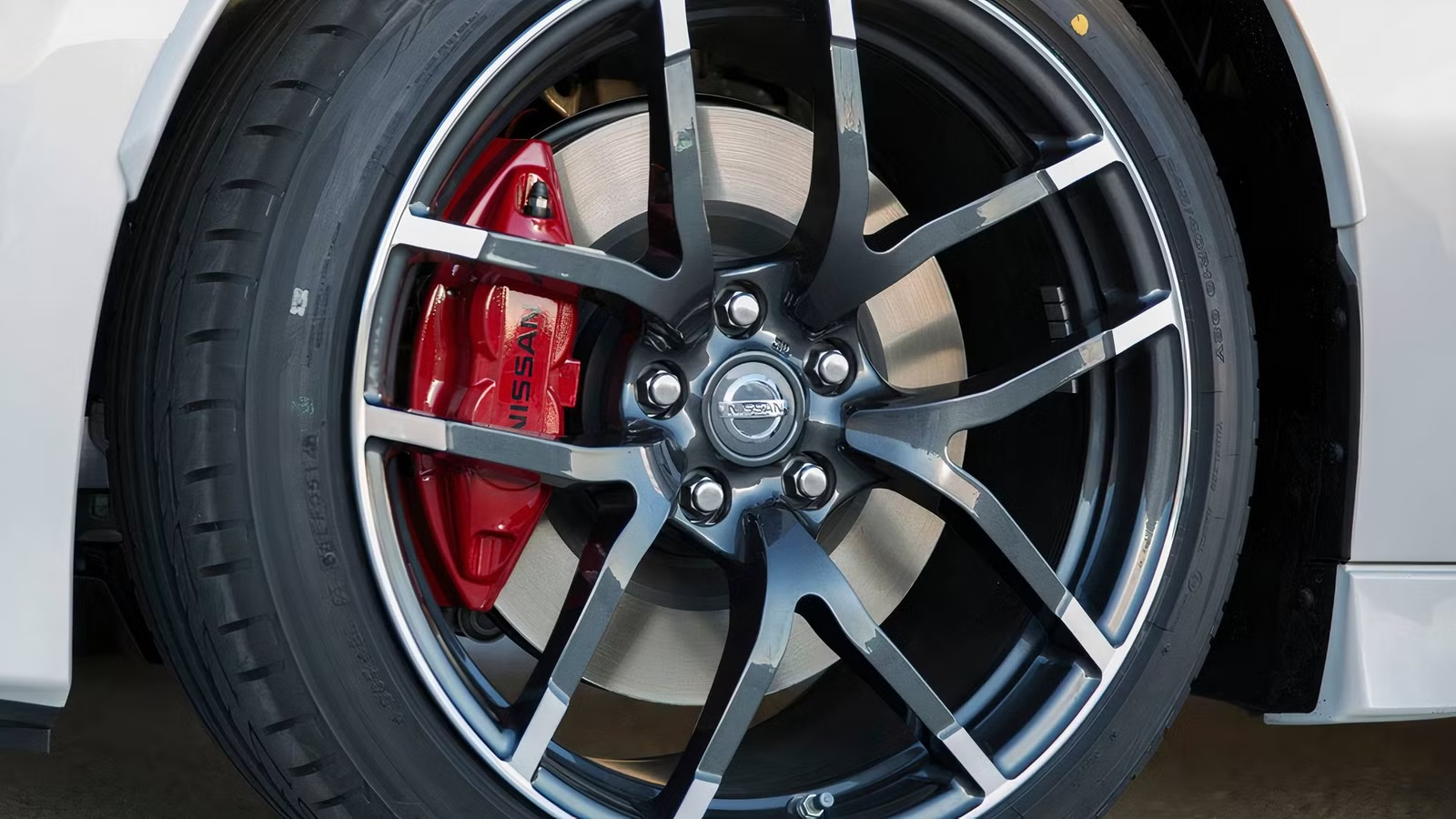
The NISMO badge is not a sticker package. Nissan gave this version hardware that a base 370Z never gets, and the changes go deeper than looks. Start with the 19-inch forged alloy wheels—forged, not cast—which means they are lighter and stronger, cutting the unsprung weight that dulls a car’s responses.
Behind them sit upgraded brakes with more stopping power for track work. Over the body goes a NISMO-specific aero kit, and this part is not for show either. The extended nose, the side sills, and the rear deck are shaped to manage air at speed, adding stability where the base car starts to feel light.
A Chassis Tuned To Play

Underneath, the suspension is retuned specifically for the NISMO. Stiffer, tighter, and set up to sharpen the car’s reactions without turning it into something you cannot live with. The result is a chassis that feels alive rather than merely competent. It moves with you. It lets you feel the weight shift and use it. This is where the NISMO earns its keep over a standard 370Z, and it is why the people who have driven it keep reaching for words like raw and playful and naturally balanced. It is not the fastest thing on any given road. It might be the most engaging one you can buy for the price.
The Value Case

This is where it gets interesting, and where you need to move quickly. The 370Z NISMO carried an original MSRP of $45,790. Today the used market tells a different story, though the picture is shifting as buyers wake up. Right now, clean examples still surface in the high-$20,000s to low-$30,000s, which is the band this car built its reputation on. But that window is tightening.
The cleanest, lowest-mileage manual cars are already pushing past $35,000, with the sharpest examples climbing toward $40,000. Sub-$30,000 is still real, but more and more it means accepting higher mileage rather than a pristine, garage-kept car. So treat the under-$30,000 figure as a current used-market reality, not a promise. The car that fits it today may not fit it a year from now.
Why Collectors Are Starting To Circle


The logic is not complicated. When a format goes extinct, the best examples of it stop being cheap used cars and start becoming something else. The naturally aspirated, manual, rear-drive sports car is on that path. As new performance cars lean harder into turbos and hybrid assistance, the analog ones left behind gain a quality that money increasingly cannot buy: they are the last of their kind.
The NISMO, as the most focused 370Z Nissan built, sits right at the front of that queue. None of this makes it a guaranteed investment, and nobody should buy one expecting a payday. But the direction of travel is clear enough. Cars like this tend to bottom out, sit quietly for a while, and then wake up. The 370Z NISMO looks a lot like a car in that quiet phase right now.

The door is still open. That is the whole story. You can walk in today and drive out in a Japanese sports car that revs to a high redline on its own, that you shift yourself, that drives its rear wheels and talks to you the entire time. It is the sharpest, most focused version of that breed, built by Nissan’s own motorsport people, and it still slips in around the price of an ordinary new commuter.
That combination is not coming back. Every year, the format shrinks, and every year the clean examples get a little harder to find and a little more expensive to buy. Buy it because you want to drive it, not because you expect it to make you money. Drive it hard, keep it clean, and enjoy the fact that you got in before the door closed. Because it is closing. You can hear it from here.
Sources: Nissan, KBB, Classic.com, iSeeCars

Related posts





Latest Post



No Comments