
Audi Nuvolari: From First Sketch To Prototype In 405 Days
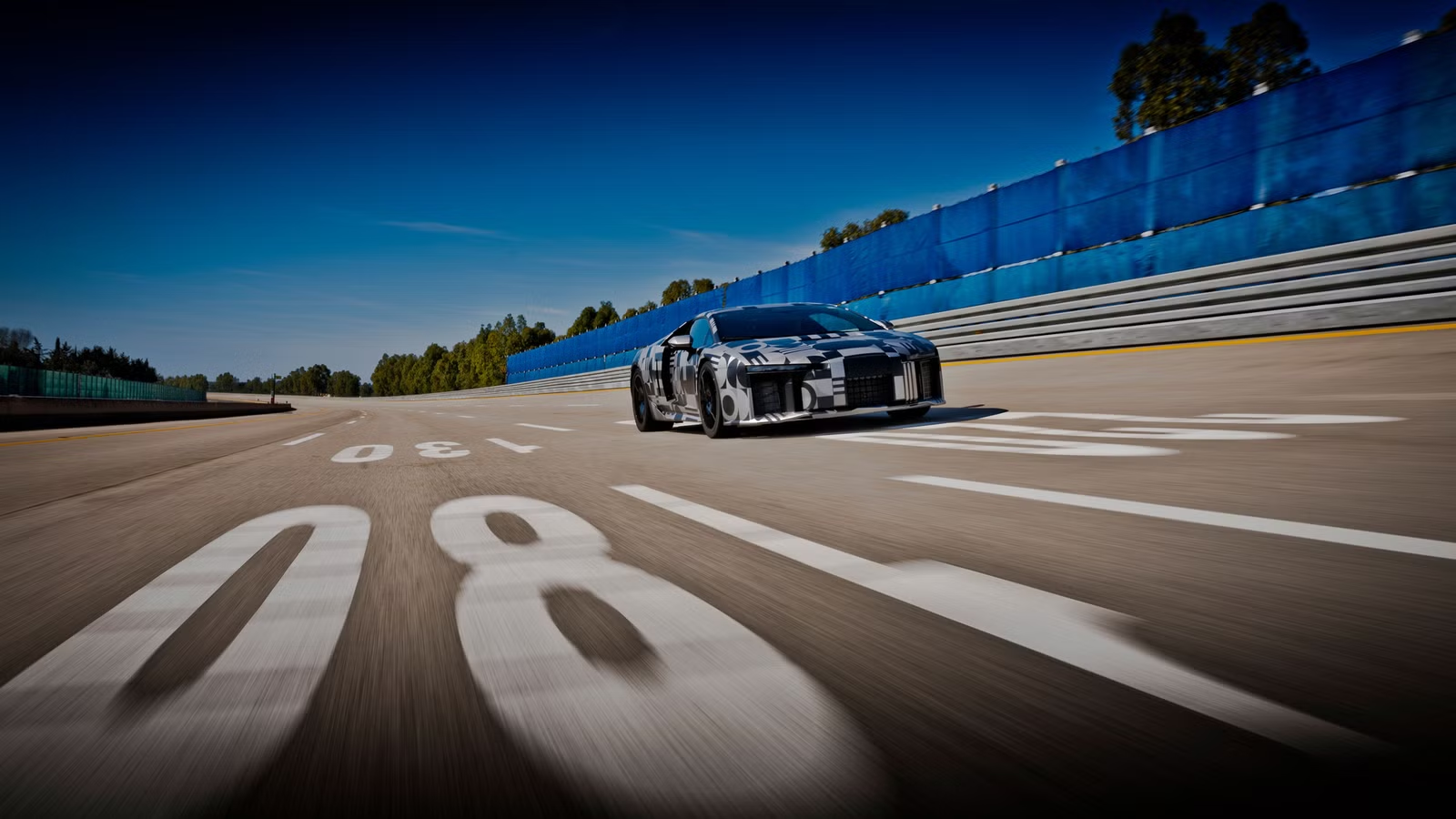
Audi‘s Chief Creative Officer Massimo Frascella had one line in the sand when his team floated a large rear wing for the Nuvolari: “Over my dead body.” That ultimatum — captured on video and published by Motor1 on August 6 — turned out to be one of the defining engineering decisions of the entire program. Rather than bolt on a conventional wing and call it done, Audi’s team had to solve the downforce problem a different way, and the solution they landed on is genuinely clever.

The broader context makes that design standoff even more striking. The Nuvolari went from the first sketch on paper to a fully drivable prototype in just 405 days — an unusually compressed timeline for a ground-up supercar packing a 1,001-metric-horsepower hybrid powertrain and an entirely new design language. Audi CEO Gernot Döllner called it “a striking example of how quickly we at Audi can bring an idea to life,” and the behind-the-scenes documentary the brand released this week shows exactly how close to the edge that sprint ran.
Frascella’s Non-Negotiable And The Adaptive Spoiler That Followed
The wing debate wasn’t just aesthetic posturing. Head of Concept Development Jürgen Meurle framed the Nuvolari as a “gentleman racer” — a car that should read as clean and restrained rather than aggressive and aero-cluttered. Frascella agreed completely, and his refusal to allow a large fixed wing forced the engineering team to develop an active spoiler system that stays flush with the bodywork under normal conditions.

The result works in three modes. On straights, the spoiler sits closed against the body to minimize drag and help the car reach its claimed top speed of more than 217 mph. When braking or cornering, it deploys into a high-downforce position to keep the rear planted. There’s also a steering-wheel-mounted button that triggers an F1-style drag reduction system manually, letting the driver call up lower drag on demand — a direct nod to the Formula One program Audi entered alongside the Nuvolari’s development.
The Engineering Friction Inside A 405-Day Sprint

The compressed timeline created real problems that the video doesn’t shy away from. Early sketches show the Nuvolari’s carbon-fiber body with a largely closed rear section — visually clean, but thermally problematic. The twin-turbocharged 4.0-liter V8 generates serious heat, and without adequate ventilation the temperatures climbed beyond acceptable limits. Audi’s engineers revised the rear bodywork to add vent slats, trading a small amount of the original surface purity for the cooling the powertrain needed.
That kind of mid-sprint revision is exactly what the team structure was designed to handle. Instead of running design, aerodynamics, powertrain, and chassis as separate sequential departments, Audi assembled them into a single autonomous unit from day one. Short communication cycles and fast decisions kept revisions from becoming delays. Testing ran simultaneously across multiple European sites — cold-weather work in Lapland, aero validation in Audi’s Ingolstadt wind tunnel, chassis tuning in southern Spain, and high-speed runs at the Nardò Technical Center in Italy.
What The Nuvolari Actually Is — And What It Isn’t

|
Drivetrain |
Output |
0 – 62 MPH |
Top Speed |
|
4.0-liter twin-turbo V8 + three axial-flux electric |
1,001 HP |
2.6 seconds |
217 MPH |
The Nuvolari sits on the same platform as the Lamborghini Temerario, and the development mule seen in the video wears the Temerario’s body with Lamborghini headrest badges. Calling it a rebadged Temerario would be an oversimplification — the carbon-fiber bodywork, the design language, and the specific hybrid calibration are all Audi’s own — but the shared DNA is real and it’s part of why 405 days was achievable at all.
The powertrain combines a 4.0-liter twin-turbo V8, which revs to 10,000 rpm on its own and produces around 800 hp, with three axial-flux electric motors and a 7.3 kWh battery pack. Combined system output is 1,001 metric horsepower, with a claimed 0–62 mph time of 2.6 seconds. Production is capped at 499 units, with deliveries scheduled for the first half of 2027. The Nuvolari is also the first production Audi to wear the brand’s new design language — one that earned “Design of the Year” at the UK’s CAR Genius Awards, with judges specifically citing its restraint within a segment that rarely practices any.
Whether the 405-day model becomes a template for future Audi halo projects remains to be seen, but the Nuvolari makes a compelling argument that agile development and flagship engineering quality aren’t mutually exclusive. Gearheads waiting on a true R8 spiritual successor should keep watching — 499 units is a small number, but the technology Frascella’s team built into it is clearly pointed at something bigger.

Related posts

Latest Post


No Comments