
The Used Motorcycle That Could Be A Better Bet Than Buying New
New motorcycles are an exercise in brutal diminishing returns. There are freight charges, dealer preparation fees, the cost of finance, and the second you ride them out of the showroom door, they depreciate heavily. It wouldn’t be so bad if the new bikes offered something that couldn’t be found elsewhere. The fact of the matter remains that used bikes are fast becoming a credible alternative for the rider who is willing to put the work in. Modern motorcycles lean toward commonality of parts and profit margins more than visible engineering innovation. This is particularly true for bikes that haven’t had many updates, such as the one we’re going to discuss.
Modular Commuter Platforms Have Diluted Middleweight Naked Personality

Buying a brand-new middleweight naked motorcycle today often means paying premium showroom prices for compromised, cost-cutting engineering. To maximize profits, manufacturers increasingly drop identical, mass-produced parallel-twin engines into shared, utilitarian commuter chassis across entire model ranges.
This cost-effective modularity results in sterile exhaust notes, predictable power curves, and diluted character that struggles to justify a new-bike price tag. Instead of paying inflated prices and suffering instant depreciation on a parts-bin platform, turning to the pre-owned market lets buyers acquire purpose-built, character-rich middleweights engineered with dedicated frames and unique powertrains before platform-sharing became the corporate norm.
The Pre-Owned Market Delivers Superior Mechanical Diversity On A Budget

Go through the classifieds for second-hand motorcycles, and you realize what wide variety is available to you on a good budget. The pre-owned market has genuine powertrain diversity: no ride-by-wire throttles or predetermined ride modes tied to the same old parallel-twin engines. Here, you can find an inline-four, an inline-three, or even a V-twin. The best part is that it leaves a lot of cash in your pocket for suspension upgrades, fresh tires, and, of course, fuel to enjoy your newly acquired motorcycle.
Suzuki Perfected The Bulletproof Middleweight 90-Degree V-Twin Formula


Suzuki spent decades quietly perfecting the accessible 90-degree V-twin format. Engineered with exceptional primary balance and bulletproof mechanical reliability, this middleweight configuration delivers the torque, pulse, and exhaust character that modern commuter platforms lack.
In the pre-owned market, this proven powerplant eliminates the risk of costly surprises while offering vast parts availability. Best of all, Suzuki wrapped this engine in a distinctive, factory-built café racer chassis that depreciated into bargain territory, delivering genuine Japanese performance and timeless styling for substantially less than any entry-level new showroom commuter.
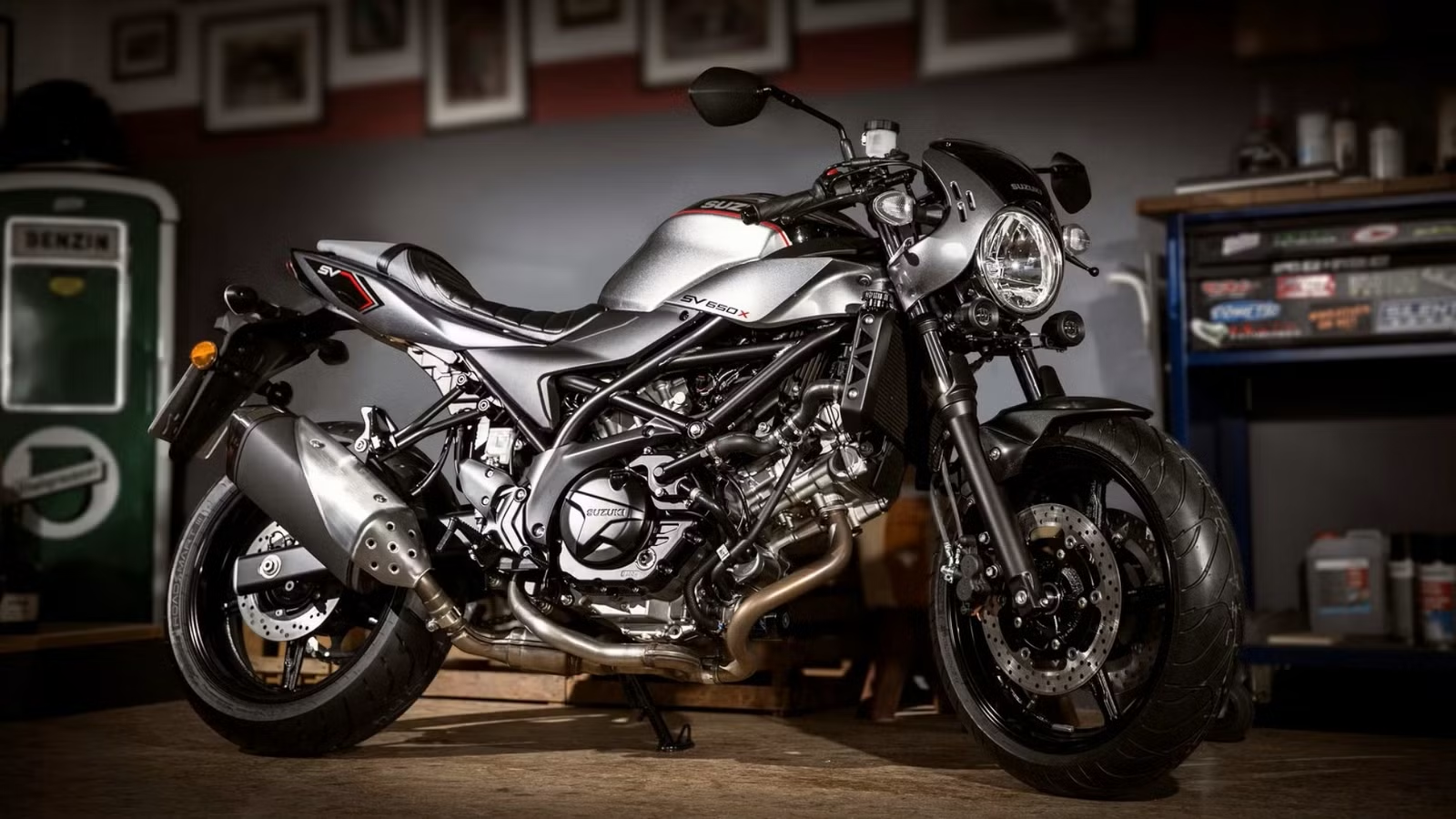
The Suzuki SV650X Café Transforms An Everyday Commuter Into A Factory Racer

This hidden hero is the Suzuki SV650X Café. It is built on the same foundation as the SV650 naked bike that changes what you think you need. The difference is that this variant transforms the bike from an everyday commuter into a factory café racer. Suzuki did this by swapping the standard upright handlebar for low, narrow clip-ons, bolting on a sleek retro headlight cowl, and, for even more visual drama, adding a tuck-and-roll ribbed saddle.

As a result, it has a hunkered-down, aggressive riding stance and offers sharper chassis feedback. The preload-adjustable front forks are another bonus, and with the immense aftermarket support available for the SV650 platform, there is no doubt that the money saved over buying one new could be used to make it ride exactly the way you want. And the soundtrack of that V-twin will be in the background of everything that you do.
A $5,500 Used Market Price Delivers Exceptional Modern-Classic Value

The SV holds its value remarkably well, as it is one of the Suzukis that delivers incredible value even fresh off the showroom floor. A new one today is priced at $8,149. The SV650X was sold for only two model years in the US market: 2019 and 2020. A non-ABS base 2019 model should typically list for $5,570, and a 2020 model with ABS lists for $6,345. The SV650X should be available at the upper end of the spectrum, or maybe a little over, partly due to its rarity and also because of the extra hardware in the front forks.
A 645cc Liquid-Cooled V-Twin Balances High Revs With Tractable Punch

The SV650X’s driveline was no different from the regular SV650, which means it is available to this day, 25 years after it first launched. This is a 90-degree V-twin with liquid cooling, DOHC, and four valves per cylinder. It displaces 645 cc, has two spark plugs per cylinder, a short-stroke configuration, and a compression ratio of 11.2:1. It generates 73 horsepower at 8,500 RPM and 47.2 pound-feet at 8,100 RPM—the same figures as today’s motorcycle because the emissions requirements for it have not changed in the US.
It has a cable throttle, but also has Suzuki’s SDTV system. This puts a second set of electronically controlled throttle bodies in line with the rider-controlled ones to control idle for cold starts and to smooth out power delivery. A six-speed gearbox with final chain drive rounds out the driveline. This engine is so reliable that owners regularly blow past 200,000 miles with nothing but basic maintenance on it, which is incredible considering how much fun it provides as well.
Preload-Adjustable Front Forks And A Steel Trellis Frame Elevate Feedback

The SV650X was identical to the normal street bike; it had a steel trellis frame that is quite reminiscent of a certain popular Italian naked bike. The front suspension is what is different, though: it has the same 41 mm telescopic forks with 4.9 inches of travel, but Suzuki gave the cafe racer version preload adjustment for the front as well. At the rear, there is the same link-type monoshock with seven-step adjustable preload and 5.1 inches of travel.
The brakes consist of twin fully floating 290 mm front discs with Tokico four-piston calipers, while at the rear, a single 240 mm disc with a single-piston caliper is present. These are mounted on 17-inch alloy wheels shod with tubeless radial tires. For such a simple setup, the ride and handling defy expectations.
Aggressive Clip-On Handlebars Load The Front Axle For Sharper Turn-In
The SV650X is nearly identical to today’s SV650 when it comes to dimensions. It is 84.3 inches long, but a little narrower at 28.7 inches thanks to its clip-on handlebars. The seat height was also slightly higher at 31.1 inches, an increase of 0.2 inches over the standard bike today.
Everything else remains identical: a ground clearance of 5.3 inches, a wheelbase of 56.9 inches, a fuel tank capacity of 3.8 gallons, and a curb weight of 437 pounds. The difference is in the feel of the SV650X because it loads more weight onto the rider’s wrists and therefore the front axle thanks to the clip-on handlebars, which are lower and narrower. The front loading makes it steer more sharply at speed, but makes it feel heavier in traffic.
Simplicity Keeps The Focus Strictly On Pure Rider Engagement

Once again, there isn’t much difference between what is available today and the SV650X. It has the same simplicity and timeless appeal, with an LCD instrument cluster that offers a wealth of information but lacks Bluetooth or navigation. It doesn’t have any electronics other than the Suzuki Dual Throttle Valve system and dual-channel ABS. The factory options list was also very small, but that does not matter because the SV’s loyal following means that there is a mind-bogglingly large aftermarket in place, and whatever you want will be available.
Mismatched Footpeg Ergonomics And Basic Damping Limit Comfort

While the SV650X will rarely need repairs, when Suzuki lowered the handlebars of the SV650X Café, it did not reposition the footpegs, which means there is an aggressive position for the top half of the rider and a very relaxed position for the lower half, making for an uncomfortable riding position.
Of course, the aftermarket can address this, but it is something to be aware of. The budget suspension also worked against it because, on a motorcycle designed to encourage the rider to go fast, the unsophisticated damping was exposed more readily. This lack of sophistication was also reflected in the LCD dashboard and the lack of electronics other than ABS.
Used And New Rivals Offer Competing Café Racers On A Budget

The SV650X is a relatively rare motorcycle, having been sold for only two years in the US market, and there are a lot of alternatives in the used market. The Yamaha XSR700 of that era is available for similar money ($7,960 for a 2018 MY); it has a parallel-twin engine, but the 270-degree firing order mimics the feel of the Suzuki’s 90-degree V-twin. It is based on the MT-07, a bike that feels built for real life, so it will last as well.

If you want to go upmarket, you could look at a Triumph Street Twin ($5,435) from 2016, which has the prestige of the Triumph badge. Ducati also sold a Scrambler Cafe Racer from 2017 to 2019. You do have to look out for those Desmodromic valve services, and this is an air-cooled engine, so it will not be as reliable.

If you are looking at new motorcycles, you could get a Triumph Thruxton 400 ($6,295), or if nothing but a twin will do, the Continental GT 650, Royal Enfield’s most powerful motorcycle ever, is available at the upper end of the SV650X’s price range ($6,349) and offers similarly simple motoring fun to the Suzuki.
Source: Suzuki Cycles, KBB

Related posts


Latest Post


No Comments