
The Science Behind Honda’s Solid-State Battery Breakthrough
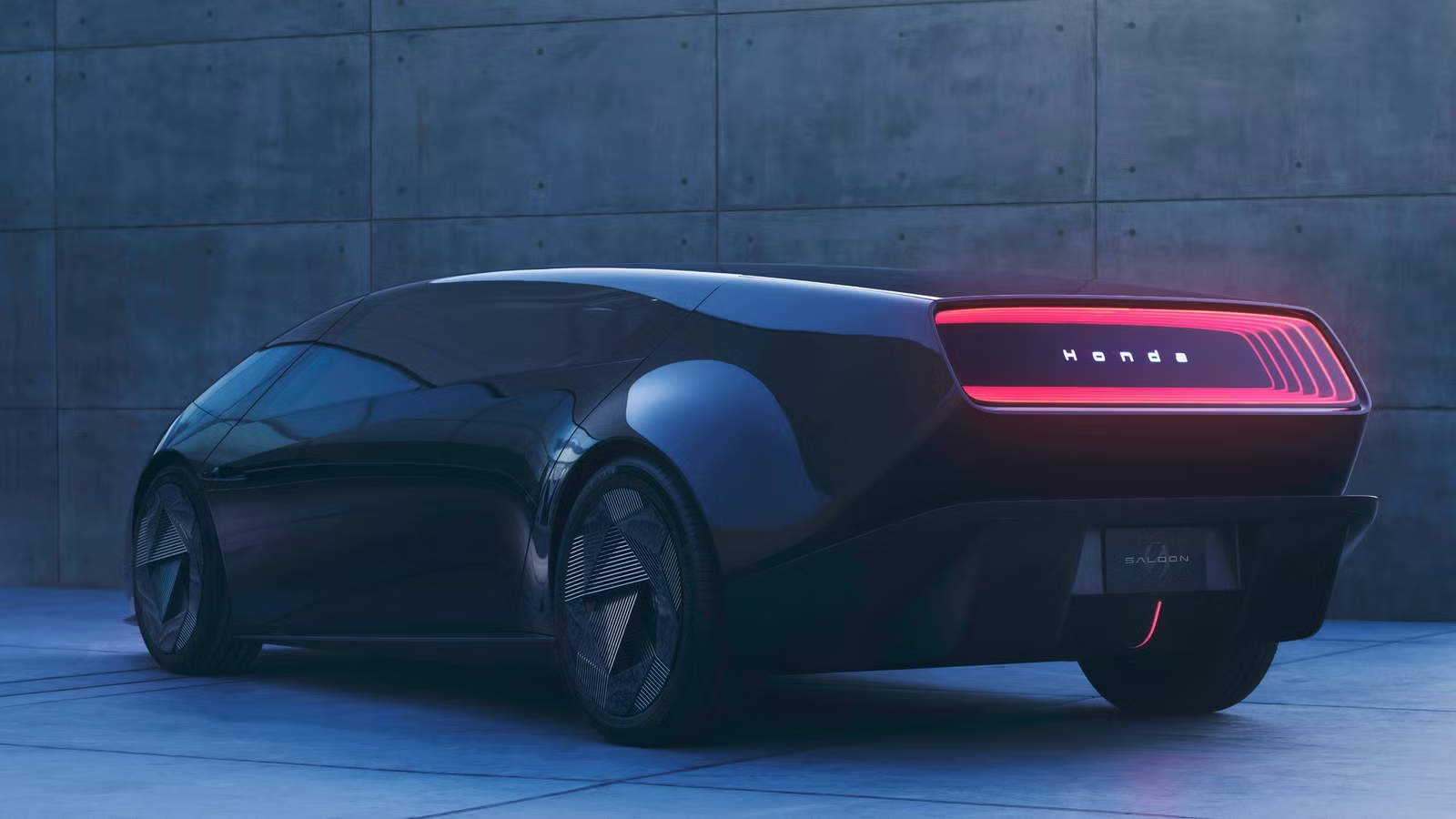
Toyota may have planted the flag on solid-state battery research, but Honda is the one that actually turned on the machines. While the rest of the industry was still trading in press releases and perpetually receding timelines, Honda opened a solid-state battery demonstration line at its Sakura facility in Japan in January 2025 — making it the first automaker to move from promise to production on this transformative technology. solid-state EV batteries Honda has been signaling the arrival of its solid-state battery (SSB) production for several years, and now the project is officially underway. The new facility, situated at the Sakura site in Japan, is focused on validating essential manufacturing processes to support the development of next-generation EV batteries. With a total investment of about 43 billion yen (around $287 million), this plant gives Honda an early advantage in demonstrating the practical potential of solid-state technology.

Solid-state batteries have at times looked like a costly industry-wide folly — not unlike the many years and dollars Chrysler threw away on the Turbine car. Honda’s announcement that it has a facility up and running changes that narrative. Toyota started the solid-state revolution over a decade ago, but its progress has been almost maddeningly slow. If Honda’s momentum holds, it may steal solid-state glory from its crosstown rival.
Revolutionizing Battery Production: Honda’s Demonstration Line
Before everyone gets too excited about ASSB-powered Hondas (the abbreviation stands for All-Solid-State Battery), Honda’s factory is a demonstration line rather than a full-scale production facility. Even so, this marks a massive step in the development of car-sized SSBs. No other company has managed to get an SSB factory running, regardless of size. Many major players have claimed factories under construction, but every announced opening date has remained conveniently vague.
Setting The Stage For Mass Production


Honda officially calls this facility a “demonstration line.” Located in Sakura City, Tochigi Prefecture, it covers 27,400 m² (295,000 ft²) and was partially funded by Japan’s Green Innovation Fund, a government initiative that supports exactly what the name implies. Honda has wasted no time fitting it out with tooling. The buildings were completed in the spring of 2024, and even before the roof had been on for a full year, Honda had nearly finished installing the manufacturing equipment. It cannot be emphasized enough: Honda is actually preparing to produce solid-state batteries rather than merely issuing press releases about them. That puts Honda ahead of everyone else in the industry.
Honda Is Producing The Batteries Of Tomorrow, Not The Batteries Of Next Year

The most significant aspect of Honda’s announcement is timing. Production on the pilot line began in January 2025. Honda’s immediate focus is on verifying mass-production techniques and costs. To that end, the Sakura City facility incorporates technologies for weighing and mixing electrode materials, coating and roll pressing, and module assembly. Mass production has been one of the biggest hurdles to ASSB development. Various companies have produced working battery prototypes, and many have announced factories under construction — but Honda is the only one whose production line is already running.
Roll-Pressing: The Key To Next-Gen Battery Efficiency

- Honda is pressing its batteries together, which makes them work better and also lowers production costs.
- Honda has developed a way to forestall dendrites, which are one of the main killers of solid-state batteries. It puts a plastic barrier over the area where the crystals would otherwise grow.
It should come as no surprise that Honda is ready to spin up a production line. While other automakers were issuing press releases about range projections or predicted lifespan, Honda was already announcing breakthroughs in production techniques. Chief among them is roll-pressing — a method that simultaneously streamlines manufacturing and improves the batteries themselves.
Pressing Ahead With Solid-State Innovation

One of Honda’s biggest breakthroughs in solid-state batteries is its roll-pressing technique. This means that SSB cells are stamped together during assembly, increasing the density of solid electrolyte layers and improving energy efficiency. “Density” and “electrode contact” have been two of the biggest obstacles preventing car-sized SSBs from reaching the road. Most battery types store their energy in a liquid or paste, which naturally conforms to whatever space it occupies and makes near-perfect contact with the electrodes through which electricity flows. Solid-state batteries (as the name implies) store their energy in a solid electrolyte, which is typically a powder.
As with any powder, solid-state electrolytes contain tiny air gaps — and electricity cannot travel through air unless it is arcing, which is decidedly undesirable inside a battery. Pressing the cells together literally squashes out those air pockets, allowing the solid electrolyte to make near-perfect contact with the battery’s electrodes. Pressing also speeds up production. Welding and other assembly methods take considerably longer than running batteries through a press. Honda additionally aims to simplify battery cooling structures: unlike lithium-ion cells, ASSBs are fairly heat-resistant and don’t degrade easily under thermal stress. They still require cooling, but their inherent resilience allows Honda to use simpler, lighter cooling systems.
Honda Is Extending Battery Life With A Simple Sheet Of Plastic

Honda has also developed a way to prevent dendrites, allowing its solid-state batteries to last longer. The solution is almost disarmingly simple: place a layer of plastic — thin enough to permit electrical flow — precisely where dendrites would otherwise take root. Dendrites are small, spiky lithium crystals that form when lithium separates out of compounds inside the battery. As they grow, they pierce through the battery’s internal structures and destroy it from within. They originate in microfissures that develop in the battery’s electrodes over time — the inevitable result of metal repeatedly expanding and contracting with temperature changes. Honda’s polymer barrier prevents the lithium inside the battery from contacting the electrode directly, leaving dendrite crystals nowhere to take root. Dendrites are one of the primary reasons solid-state batteries age and fail. A thin polymer film will not last forever, but it can add meaningful years to a battery’s service life.
Scaling Up: From EVs To Aircraft

- Like its omnipresent crate engines, Honda aims to make its solid-state power systems viable for use over land, sea, air, and possibly even space.
- Honda aims to make its SSBs affordable by producing enough of them to attain economies of scale.
Honda has long been described as “an engine company that happens to make cars.” The company developed its motorcycle division long before it expanded to automobiles, and to this day Honda operates one of the most robust crate engine divisions in the industry. Honda’s engines have powered equipment deep underground, up in space, and in countless power tools. As the internal combustion era gives way to electrification, Honda is already positioning itself for future dominance in power systems.
Expanding Applications Across Mobility Sectors

Honda is already developing solid-state batteries for use on both land and in the air. If things go according to plan, Honda’s solid-state batteries will power cars, trucks, motorcycles, and aircraft. Honda may also be planning to adapt SSBs for marine use, though the company has been quieter on that front — ships rarely make headlines unless they sink. In short, Honda is planning to put solid-state batteries everywhere its engines already go.
Lowering Cost Through Sheer Volume

Of course, another SSB hurdle (there are many) is cost. At present, every would-be battery manufacturer acknowledges that SSBs are costly to produce and likely to remain so for some time. Samsung, for instance, neatly sidestepped the affordability question by announcing that it would only sell its SSBs for use in luxury vehicles. Honda’s answer comes straight out of Unit 1 of any economics textbook: economies of scale. This is an impressive gamble on a technology that has not yet been proven roadworthy at scale. Honda is committing the capital to rapidly produce solid-state batteries even though no consumer has yet purchased a car equipped with one.

However, if solid-state batteries live up to their long-touted promise, they may prove easy to sell. TopSpeed’s own readers have confirmed that range is the biggest reason people haven’t switched to EVs, with cost and charging time close behind. Solid-state batteries can address all three concerns. Range estimates vary by manufacturer but consistently land at 500 miles or more, with many projections falling between 600 and 900 miles per charge — well ahead of most ICE vehicles on a full tank. SSBs are also far more resilient against fast-charging than lithium-ion cells, meaning an SSB-powered vehicle could be topped up in roughly the time it takes to fill a gas tank.
A Vision For Carbon Neutrality By 2050

- Honda aims to be carbon-neutral by 2050.
- Honda plans to produce exclusively electric vehicles (both battery and hydrogen) by 2040.
Carbon neutrality has become one of the most common pledges in corporate communications, and Honda is no exception. It is a natural progression for the company that won over American buyers in the 1970s with vehicles that were both fuel-efficient and genuinely enjoyable to drive — two qualities that domestic automakers never managed to reconcile. While American manufacturers handed buyers punitive econoboxes like the Chevette, Honda offered zippy compacts like the Civic. Even in the 21st century, American automakers continue to struggle with most vehicles that aren’t large enough to accommodate an entire Little League team. It is therefore fitting that Honda would pursue carbon neutrality with concrete targets rather than vague aspirations.
Driving The Future With Sustainable Energy Solutions

Honda’s history with EVs closely parallels that of its closest rival, Toyota. Toyota launched several early, short-lived electric vehicles before eventually introducing the competent but modestly successful bZ4X SUV, while leaning heavily on its lucrative hybrid lineup and its sometimes quixotic hydrogen fuel-cell program. Honda’s trajectory has been remarkably similar — the two companies even introduced their first fuel-cell electric vehicles in the same year. Both are now expanding their EV lineups in earnest.
Honda May Produce Its Last ICE Car In Just 15 Years

It has become fashionable for automakers to announce an end date for internal combustion — or at least a plan to reduce it to a niche. Honda is no exception. The company officially aims to produce exclusively battery-electric and fuel-cell vehicles by 2040. Solid-state batteries are a crucial part of Honda’s plan because they address many of the practical barriers keeping EVs out of people’s garages. SSBs’ high tolerance for heat simplifies battery cooling — a meaningful engineering advantage, since all batteries generate heat during fast-charging or under heavy acceleration. It barely needs noting that EVs also spend most of their lives outdoors, where ambient heat can shorten a battery’s life even when the vehicle is parked.
As Honda president Keiji Otsu stated: “All-solid-state batteries are a game changer in the EV era, driving Honda’s transformation into a leader in electrification.” It is nearly impossible for any executive to discuss solid-state batteries without invoking the phrase “game changer” at least once. But Honda may be the company that actually earns the cliché.

Related posts


Latest Post


No Comments