
Toyota’s 2.4L Turbo Four Is Outclassing The V6 That’s Wrecking Tundra’s Reputation
Since the mid to late 1990s, Toyota trucks have earned an unshakable reputation for bulletproof reliability. However, that long-standing association is undergoing a fundamental shift: Toyota buyers are no longer shopping nameplates like the Tacoma, Tundra, or 4Runner; instead, they are shopping engine codes. The brand’s legendary reputation for long-term durability now splits cleanly along engine-family lines.

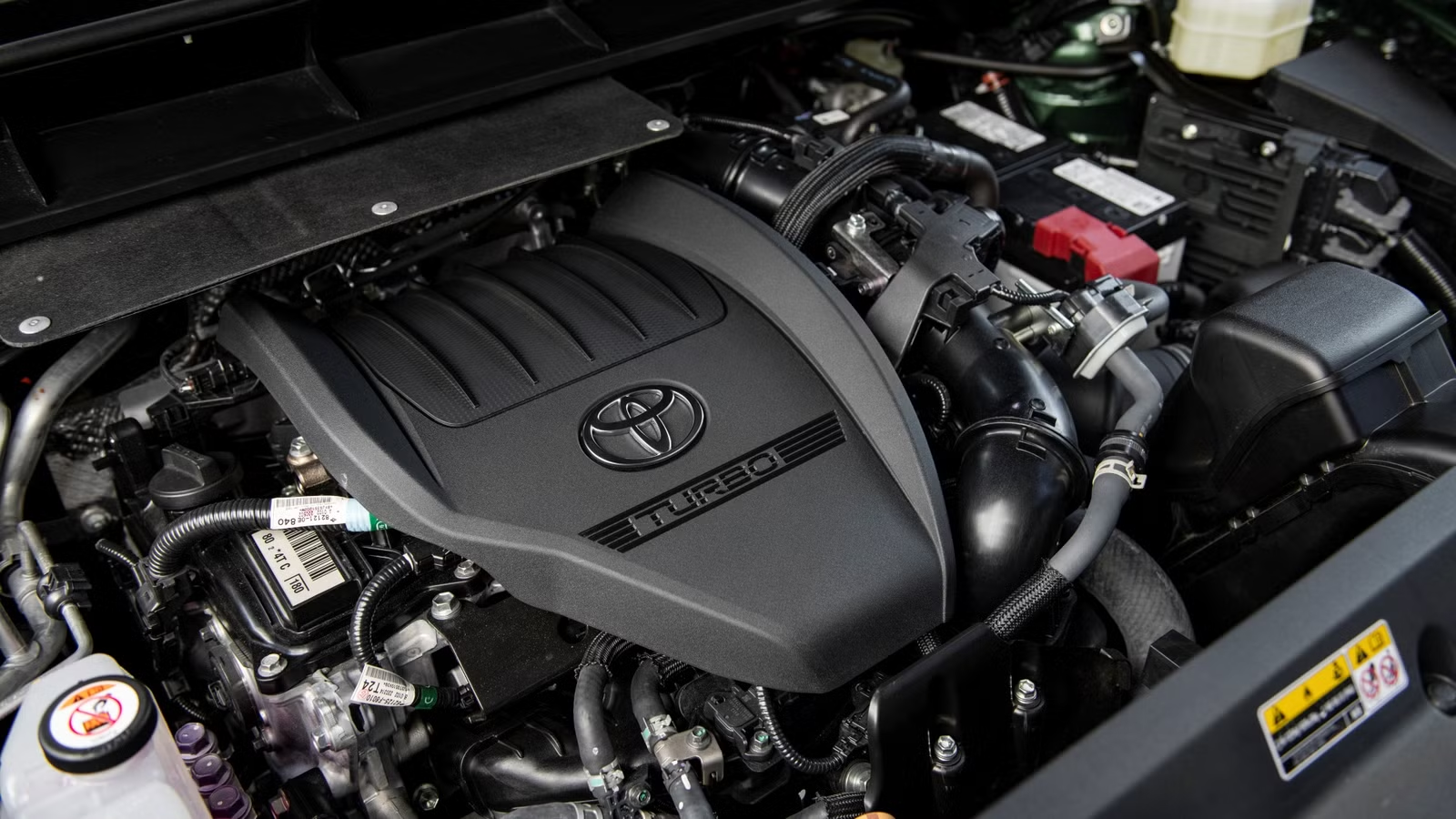
While the V35A-FTS 3.4-liter twin-turbo V6 suffers catastrophic failures, engine replacements, and compounding recall expansions (NHTSA Recall 26V320), the modest T24A-FTS 2.4-liter turbocharged inline-four is quietly proving that Toyota’s small-displacement forced-induction bet was engineered right. The 2.4-liter turbo’s early success isn’t luck; it’s structural. Through purpose-built forced-induction architecture, the T24A avoids the mechanical flaws plaguing the Tundra’s V6, establishing itself as Toyota’s true 200,000-mile engine for the modern era.
The V35A-FTS V6: Anatomy Of A Reliability Nightmare
The Destructive Mechanics Behind The #1 Main Bearing Failures
Toyota initiated its first major safety recall campaign in May 2024, affecting roughly 102,092 model-year 2022 and 2023 Toyota Tundra and non-hybrid Lexus LX 600 vehicles. The initial technical notices cited machining debris left inside the engine block during manufacturing as the root cause of severe main bearing wear. During the factory machining process of the V35A-FTS aluminum blocks, microscopic metal shavings, burrs, and abrasive swarf were left behind and not fully flushed out prior to final engine assembly.

Once operational, these loose metallic particles travel freely through the pressurized oil galleries and become trapped directly at the number-one front main bearing journal. However, forensic teardowns and field data revealed a far more complex structural dynamic: intense timing chain tension combined with front accessory drive loading creates a high-pressure mechanical stack-up.
Under sustained boost, localized flexing leads to oil-film collapse at the number-one bearing, causing extreme friction that fuses machining debris directly to the bearing shell and welds the crankshaft to the block, seizing the engine without prior warning. Toyota initially issued complete long-block engine replacements across the board, but subsequent recall updates shifted toward diagnostic software screenings to detect bearing wear before approving a full crate engine swap.
Scope And Escalation: NHTSA Recall 26V320 Expands

What began as an isolated production anomaly quickly expanded into a systematic crisis across Toyota’s truck and SUV lineup. Following earlier recall actions, a subsequent NHTSA campaign in late 2025 swept in an additional 126,691 units in the U.S. market. The crisis deepened further with NHTSA Recall 26V320, which expanded to capture an additional 43,566 2024 model-year Tundras.
This continuous expansion has created widespread owner uncertainty. Early remedies relied on diagnostic software checks and full long-block crate engine replacements. However, dealership service departments face severe engine replacement backlogs while Toyota engineers continue working to deliver a permanent mechanical and structural fix. For a buyer demographic accustomed to quarter-million-mile operation with basic oil changes, the V35A-FTS has significantly tested customer loyalty.
Engineered For Boost: Why The T24A-FTS 2.4L Turbo Holds
Heavy-Duty Architecture: Integrated Journal Caps And Cylinder Construction

The T24A-FTS completely bypasses the structural vulnerabilities of the V6 by utilizing a bottom-end architectural layout specifically designed for heavy forced-induction loads. Rather than relying on traditional split bearing caps secured individually to the block, the 2.4-liter turbo incorporates a massive, highly rigid lower crankcase integrated directly with the crankshaft journal caps. This unified ladder-frame construction prevents block flexing and maintains perfect crankshaft alignment even under high boost pressures.
The engine uses an open-deck aluminum block equipped with heavy-duty cast-in-iron liners featuring an uneven outer surface treatment. This textured exterior bonds directly with the aluminum block material during casting, providing continuous mechanical interlocking and superior thermal dissipation. The open-deck layout accelerates coolant flow around the top of the combustion chambers, preventing localized hotspots and thermal distortion of the cylinder walls under load.
Reduced Friction And Wear: The 10mm Crankshaft Offset

To further enhance internal durability, Toyota engineers incorporated a 10mm crankshaft axis offset relative to the cylinder bore centerlines. In a traditional engine where the crankshaft centerline aligns perfectly with the cylinder bore, the connecting rod pushes downward at a steep angular vector during the power stroke, driving the piston skirt hard against the cylinder wall (thrust-side lateral loading).
Real-World Track Record And The Software Vs. Hardware Divide
Field Performance Since 2021: Zero Major Mechanical Crates

Since its global debut in 2021 powering high-volume applications across the Lexus NX 350, RX 350, Toyota Highlander, Grand Highlander, Tacoma, and Land Cruiser, the T24A-FTS has built an exceptional field record. Early teardowns, master technician reports, and service telemetry indicate an absence of catastrophic bottom-end hardware failures, spun main bearings, or broken connecting rods.
Where the V35A-FTS V6 requires complete engine block replacements due to structural bearing seizure, issues on the 2.4-liter four have been minor and largely software-driven. Early production models experienced minor electronic throttle body recalibrations or transmission shift-point software updates, all of which were resolved quickly through routine dealer ECM updates without intrusive mechanical repairs.
The Owner’s Prescription: Keeping The T24A Alive Past 200,000 Miles
Protecting The Twin-Scroll Turbocharger Under Severe Service

The T24A-FTS relies on a single twin-scroll turbocharger designed to deliver low-end torque starting as low as 1,700 rpm. While this setup eliminates turbo lag and provides strong low-end pulling power, it subjects oil to continuous thermal and mechanical stress. Under heavy payload hauling, off-roading, high-altitude mountain climbing, or trailer towing, exhaust gas temperatures entering the turbine housing can exceed 1,600 degrees Fahrenheit.
When an engine is shut off immediately after heavy use, residual heat bakes static motor oil inside the turbocharger-bearing housing. Over extended periods, this causes oil breakdown and carbonization (oil coking), leading to abrasive carbon deposits that score turbo bearings and restrict oil passage feed lines.
The Service Interval Strategy That Overrides The Manual

To ensure the T24A-FTS reaches its 200,000+ mile potential, long-term owners should bypass standard factory 10,000-mile drain recommendations in favor of a strict 5,000-mile/six-month major service oil change schedule.
Using high-grade SAE 0W-20 full-synthetic motor oil meeting ILSAC GF-6A specifications provides crucial protection against LSPI while maintaining thermal viscosity stability. Frequent oil changes act as low-cost preventative maintenance. Fresh full-synthetic oil continuously flushes microscopic contaminants from the turbo-bearing housing before thermal coking sets in, while its high shear strength maintains a resilient protective film over the main and rod bearings under peak torque loads. Concurrently, clean detergent additives prevent varnish buildup on the D-4ST direct-injection nozzles, safeguarding precise fuel atomization and preventing destructive cylinder wall washing.
The operational contrast between the V35A V6 and the T24A-FTS 2.4-liter four proves that forced induction isn’t inherently unreliable; it simply demands the right underlying architecture. By addressing crankcase rigidity, journal loading, and piston thrust angles from day one, Toyota built a modern 2.4-liter turbo capable of carrying the brand’s long-term durability legacy forward, provided owners respect its maintenance needs.
Sources: Toyota, ConsumerReports, NHTSA, RepairPal

Related posts






Latest Post


No Comments