
The Performance Car Nobody Wanted Until Cars Like It Disappeared
Over the last five years, the U.S. car market shifted toward electrification, elevated pricing, and altered buying patterns. High inflation, supply chain disruptions, and rising interest rates pushed average new vehicle transaction prices above $47,000. Compact sedans gave way to higher-margin crossovers, SUVs, and trucks.

Electric vehicle sales grew rapidly, driven by federal incentives and expanded charging infrastructure. However, hybrid vehicles recently regained significant market share due to consumer concerns over charging access and cost. One segment that has completely died out is the affordable manual performance sedan.
The Death Of America’s Manual Muscle Sedan
The manual American muscle sedan represented a distinct blend of everyday practicality and high-performance engineering. Its roots trace back to the mid-1960s when manufacturers began pairing heavy-duty, three-pedal manual transmissions with large V-8 engines in four-door passenger bodies. During the mid-to-late 1960s, full-size family sedans equipped with manual gearboxes recorded strong delivery numbers, frequently averaging over 100,000 units annually across major domestic nameplates.

A sharp decline began during the mid-1970s. Stricter emissions standards, rising fuel prices, and insurance surcharges reduced engine output ratings and drove buyers toward automatic transmissions. By the 1990s, the segment shrank to a niche enthusiast footprint. Manual transmission adoption across mid-size and full-size four-door sedans plummeted below five percent of total sales. Rising development costs for low-volume mechanical clutches, consumer preference shifts toward crossovers, and faster automatic transmissions ultimately led to the complete phaseout of the configuration by the mid-2020s. The death of the manual muscle sedan marked the end of an era defined by tactile driver engagement within a four-door chassis.
The Chevrolet SS Was An Underappreciated Performance Sedan

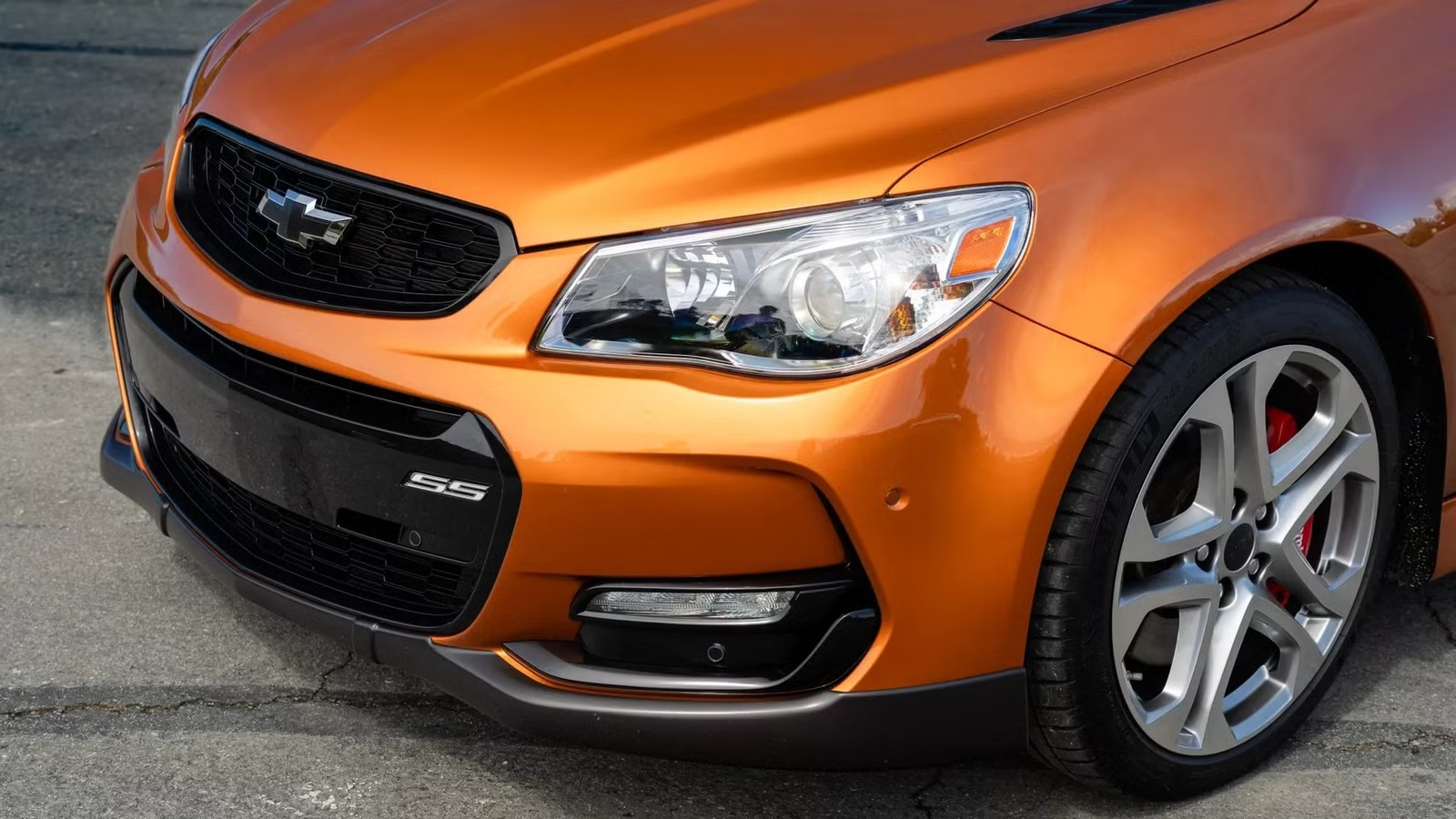
General Motors unveiled the Chevrolet SS in February 2013 at Daytona International Speedway. The performance sedan went on sale in the U.S. in late 2013 as a 2014 model-year vehicle.
The 2014 Chevrolet SS debuted with a starting MSRP of $44,470, which included a mandatory $995 destination fee and a $1,300 gas-guzzler tax. The only factory options were a power sunroof ($900) and a full-size spare tire ($500). By the final 2017 model year, the base MSRP rose to $48,625, including destination and gas-guzzler fees.
Over its four-year production run, General Motors sold 12,953 units in the U.S. Yearly delivery totals started at 2,479 units for 2014, rose to 3,168 units in 2015, moved to 3,225 units in 2016, and ended at 4,081 units in 2017. GM imported the vehicle directly from Holden’s Elizabeth assembly plant in South Australia as a badge-engineered variant of the VF-series Holden Commodore.
LS-Power Gave It Character

The Chevrolet SS features a front-engine, rear-wheel-drive layout built on the GM Zeta platform. A naturally aspirated 6.2-liter LS3 V-8 engine powers the sedan, utilizing a cast-aluminum block, high-flow cylinder heads, sequential fuel injection, and a 10.7:1 compression ratio. The engine produces 415 horsepower at 5,900 RPM and 415 pound-feet of torque at 4,600 RPM, with a redline set at 6,600 RPM.
The 2014 launch model was offered exclusively with the Hydra-Matic 6L80 six-speed automatic transmission featuring paddle shifters and a 3.27:1 final drive ratio. For 2015, Chevrolet added the Tremec TR-6060 six-speed manual transmission with a 3.70:1 final drive ratio as a no-cost option. Power reaches the rear wheels through a mechanical limited-slip differential equipped with external oil and transmission fluid coolers.
Acceleration from 0 to 60 MPH takes 4.5 seconds in automatic models and 4.6 seconds in manual variants. The sedan covers the quarter-mile sprint in 12.9 seconds at 111 MPH, reaching an electronically limited top speed of 160 MPH.
A Suspension That Put American Muscle To Shame

The Chevrolet SS sits on a four-wheel independent suspension system. The front assembly consists of a dual-ball-joint MacPherson strut architecture with a direct-acting stabilizer bar. The rear uses a multi-link independent setup with coil springs and a hollow stabilizer bar. Electric power-assisted rack-and-pinion steering provides 2.4 turns lock-to-lock.
For the 2014 model year, the SS featured conventional dual-rate damped shock absorbers. Starting in 2015, GM made Magnetic Ride Control standard equipment. This magnetorheological damping system adjusts shock stiffness every millisecond across three selectable drive modes: Tour, Sport, and Track.
Four-wheel anti-lock disc brakes developed with Brembo provide stopping power. The 2014 model received front 14.0-inch vented rotors with four-piston Brembo calipers. The 2015 through 2017 models upgraded to four-piston Brembo calipers on both the 14.0-inch front and 14.2-inch rear vented rotors.
Forged aluminum 19-inch wheels come in a staggered setup, measuring 19 x 8.5 inches up front and 19 x 9.5 inches at the rear. Factory tires are Bridgestone Potenza RE050A units sized 245/40R19 on the front axle and 275/35R19 on the rear.
The SS’s Spacious And Well-Equipped Interior

The Chevrolet SS features leather-appointed bucket seats with suede microfiber accents, contrast red stitching, and embroidered “SS” logos on the dashboard and front seatbacks. Front seats offer 10-way power adjustments, heating, and fan ventilation. The cabin seats five adults, offering 39.7 inches of rear legroom.
Standard convenience equipment includes dual-zone automatic climate control, a leather-wrapped flat-bottom steering wheel with tilt and telescoping adjustments, and keyless entry with push-button ignition.
Infotainment runs through an 8-inch high-resolution touchscreen using Chevrolet MyLink, paired with a nine-speaker Bose premium surround sound system. The system integrates SiriusXM satellite radio, Bluetooth phone connectivity, voice recognition, and USB inputs. A standard color head-up display projects vehicle speed, engine RPM, lateral g-forces, turn-by-turn navigation, and audio details onto the windshield.
Active safety technology includes forward collision alert, lane departure warning, side blind zone alert, rear cross traffic alert, an integrated rearview camera, and GM’s automatic parking assist system for parallel and perpendicular maneuvers.
Chevrolet’s Robust And Cost-Effective Servicing Schedule

Routine maintenance for the LS3 engine follows GM’s Engine Oil Life System, which calculates oil change intervals based on engine revolutions, operating temperatures, and driving conditions. Recommended service intervals require Dexos1-spec engine oil changes and tire rotations every 7,500 miles, and cabin air filter replacements every 22,500 miles.
Engine air filter renewals occur at 45,000 miles, transmission fluid changes between 45,000 and 90,000 miles depending on severe or normal duty, spark plug replacements at 97,500 miles, and engine coolant flushes every 150,000 miles or five years. Average annual maintenance costs range between $600 and $850, driven largely by high-wear consumables like 19-inch performance tires and Brembo brake components.
Values Depend On Specification And Condition
The Chevrolet SS retains strong residual values on the secondary market due to low production volume, a rear-wheel-drive platform, and a standard V8 engine. High-mileage early automatic models from 2014 trade between $22,000 and $28,000, while lower-mileage 2015 through 2017 automatic models range from $30,000 to $36,000.
Manual transmission models command a 20 to 35 percent price premium over automatics, selling between $38,000 and $48,000 for well-kept examples. Pristine, ultra-low-mileage manual sedans command upwards of $50,000 to $58,000. Low-volume factory exterior colors, such as Regal Peacock Green, Perfect Blue, Royal Blue, and Slipstream Blue, fetch additional premiums among collectors.
Why The SS Never Took Off

The commercial failure of the Chevrolet SS in North America stemmed from marketing choices, vehicle positioning, and manufacturing limitations. General Motors introduced the SS primarily to satisfy Nascar body homologation requirements rather than to sell high retail volumes. Consequently, GM allocated virtually no television, digital, or print advertising budget to the vehicle. The exterior styling also proved too subtle, closely resembling the front-wheel-drive Impala and Malibu, which masked its underlying performance credentials.
GM imposed a rigid dealership ordering system that limited customer customizations. The single-loaded trim structure pushed MSRP past $45,000, placing the vehicle in direct price competition with established sports sedans like the BMW M3 and Audi S4.
Despite this, the SS remains a highly favored performance sedan. Consumer reviews on Edmunds rate the vehicle near-perfect with a 4.7/5 average score, highlighting its stealth styling, reliable LS3 platform, and spacious five-passenger cabin.
Holden’s Inability To Maintain Operations

In Australia, Holden’s manufacturing division suffered from insurmountable economic pressures. High domestic labor costs, a strong Australian currency, free-trade agreements that brought lower-cost imports, and shifting consumer preferences away from large V-8 sedans toward compact crossovers eroded market share. Reduced government subsidies further weakened the brand’s financial standing.
Because Holden could not remain solvent on domestic sales alone, and because exported units like the Chevrolet SS lacked the volume required to cover plant operating costs, GM shuttered Australian manufacturing operations. On October 20, 2017, the final VF Commodore rolled off the line at the Elizabeth assembly plant in South Australia, bringing domestic Australian vehicle production to an end and retiring the Chevrolet SS nameplate.
Sources: Chevrolet, Motor Reviewer, J.D. Power, RepairPal, and Edmunds.

Related posts


Latest Post



No Comments