
This Luxury Sedan Beat the Hellcat’s Torque by 10 Years—And Nobody Cared
Dodge caused a big stir in the modern muscle car segment with the SRT Hellcat’s release for the model-year 2015. The trim became available on both the Charger and Challenger that year, giving them a supercharged 6.2-liter Hemi V8 capable of unleashing 707 horsepower and 650 pound-feet of asphalt-wrinkling torque. At launch, the Dodge Charger SRT Hellcat was the world’s fastest and most powerful four-door production sedan with a top speed of 204 mph. Its two-door sibling was no slouch, either, able to hit speeds of up to 199 mph and reach 60 from a standstill in about 3.6 seconds. Both cars could be had in Hellcat trim up until 2023, but Dodge still offers it on the Durango to this day.
Applying The Hellcat Formula Before The Hellcat Was Even A Thing

Long before Dodge thought of putting that massive force-fed V8 into its popular sedan, though, the Germans were already thinking along the same lines. As most of you already know, the 2000s were a time when Germany’s automakers didn’t hesitate to show their wild side, which often meant packing ridiculous amounts of power where you’d least expect. BMW launched the E60 M5 with a high-revving V10 in 2005, Audi decided to put a twin-turbo V12 diesel in its Q7 SUV later on, and even Volkswagen couldn’t resist giving its Phaeton luxury sedan a six-liter W12 to spice things up. What’s genuinely remarkable is how unassuming these models look at first glance, easily deceiving those who don’t know their German auto lore until you step on the gas.
Mercedes Had Skin In The Super-Sedan Game, Too

Now, you can’t have a proper conversation about crazy German sleepers from the 2000s without mentioning Mercedes-Benz. Models like the V12-powered S 600 or the smaller (but still very capable) C 32 AMG are deeply ingrained into public consciousness, but the untrained eye would have a hard time understanding what it’s actually looking at. A different Benz is due to step into the spotlight today, though — an understated luxury sedan released in 2003 with more than 500 pound-feet of torque at its disposal. It was an undercover monstrosity at heart, but one that could feel incredibly civilized unless you decided to really put its supercharged power to good use.

The W211 E 55 AMG Hid Supercar Capabilities Below Its Tame Appearance

What do you do when you’ve got a great luxury sedan with heaps of naturally aspirated oomph and want to make it even better? Well, you give it a big old supercharger along with enough twisting force to move mountains, of course, and that’s precisely what Mercedes did when replacing the W210 E 55 AMG with the W211. The updated luxobarge was first presented at the 2002 Paris Motor Show before going into production as a 2003 model, kitted with the legendary M113K powerplant under the hood. This was the forced-induction variant of the M113 and the letter K at the end stood for “Kompressor” (supercharger in German).
The 5.4-liter V8 came with an all-aluminum construction, three valves per cylinder and a single overhead cam, as well as air-to-water intercooling. Its associated blower was a Lysholm-type twin-screw module making about 11.6 psi of boost, which enabled the E 55 to achieve its outrageous power output figures.
The flagship E-Class had a substantial 469 ponies to play with, but the real highlight was its astronomical torque output peaking at 516 pound-feet. All this twisting force was unleashed early at just 2,650 rpm and extended well into the mid-range, giving the E 55 the sort of acceleration to rival that of supercars. And we’re not exaggerating, mind you, because the Benz could go from zero to 60 mph in a mere 4.5 seconds and finish the quarter-mile run at 12.7 ticks. By contrast, a contemporary Ferrari 360 Modena reached 60 mph from a standstill in 4.6 seconds, while its quarter-mile time sat in the low 13s. The 996-gen Porsche 911 Turbo was only slightly faster than the E 55 AMG, hitting 60 mph in 4.2 seconds and passing the quarter-mile mark in 12.6 ticks of the stopwatch.

Direct rivals such as the BMW E39 M5 or the Audi C5 RS6 didn’t stand a chance, surpassed by Mercedes in terms of both acceleration and torque output. The E 55 featured a five-speed automatic gearbox coupled with rear-wheel drive, and its top speed was electronically-limited at 155 mph. Granted, the German sedan didn’t make quite as much torque as an SRT Hellcat, but it did have nearly 80% of it more than a decade earlier. And the car boasted a solid chassis, too, benefiting from Mercedes’ proprietary semi-active air suspension known as Airmatic Dual Control. It kept the E 55 AMG’s ride quality nice and plush for comfort while also making it very capable when driven hard, so you essentially got the best of both worlds.
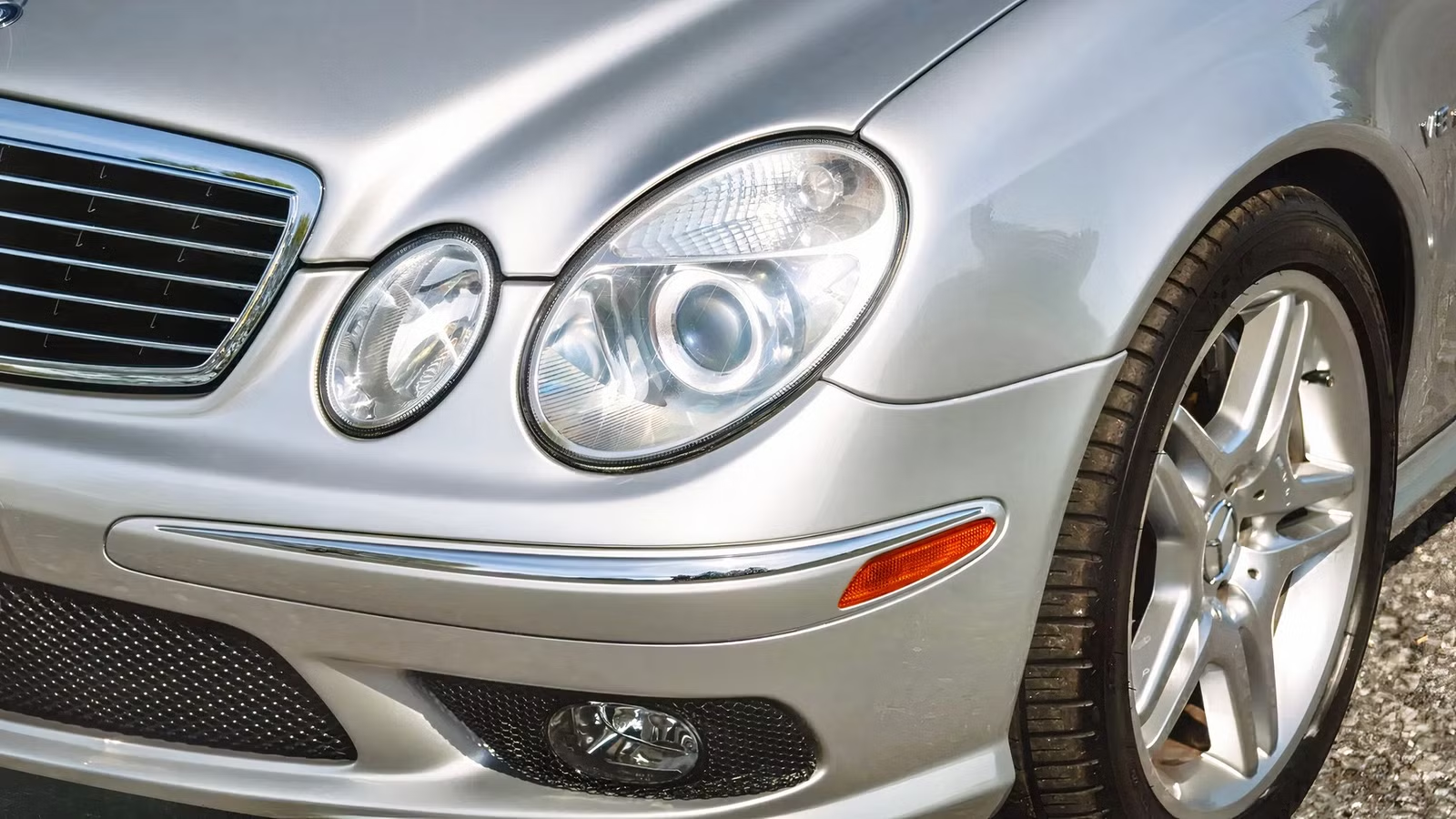
Abundant stopping power was on the menu, as well, originating from eight-piston brake calipers up front and large ventilated rotors all-round. AMG-specific wheels measured 18 inches in diameter at both axles, and the car weighed north of 4,200 pounds with all the necessary fluids. Needless to say, it wasn’t light by any stretch of the imagination, which makes its supercar-worthy acceleration seem even crazier than it already did. And the sedan’s sleeper nature only makes it more intriguing, because there’s hardly anything to indicate what it’s all about from a visual standpoint. Sure, enthusiasts will likely realize they’re looking at an absolute beast, but everyone else might think it’s just a regular E-Class.
A Lavish Sleeper Of The Finest Kind, With A Price Tag To Match

The E 55 could be had with all the sweet luxury amenities you’d expect from a high-end Mercedes sedan. For instance, it featured heated and ventilated front seats wrapped in leather upholstery, automatic climate control and a sunroof, as well as wood trim and premium audio. The list went on and on, but all that opulence and outrageous performance potential didn’t exactly come cheap. Pricing started at $76,000 and would easily climb much higher once taxes and optional add-ons were thrown into the mix. This may not sound too outlandish in today’s economy, but the base MSRP actually comes just shy of $140,000 when adjusted for inflation.
Mercedes kept the E 55 AMG in production until 2006 and had it replaced with the E 63 thereafter, introducing a naturally aspirated 6.2-liter V8 with 507 horsepower on the new model. A lesser-known fact about the W211-gen E 55 is that it was also offered as a wagon for the last two years, yet very few of these variants actually left the factory. Exact production numbers for either version were never made publicly available by the automaker, though, so any discussion in that sense is just pure speculation. What we can say for sure is that they’re not always easy to come by on the second-hand market today.
Owning The Ultimate AMG Super-Sedan Two Decades Later

You will most likely have to do a fair bit of searching and waiting if you want to snatch one of these bad boys for yourself, but the good news is that you might just be able to score a genuine bargain on it. Classic.com lists the average price of an E 55 AMG W211 at approximately $18,000, though market values tend to vary quite a lot as shown by recent listings on Bring a Trailer. For example, a 2003 model with about 22,000 miles was sold for $30,000 back in May of this year, while the less common wagon version tends to fetch approximately 40 grand on average. Either way, though, the E 55 AMG is a fascinating piece of German automotive history, one worth experiencing at least once in your lifetime.
Sources: Mercedes-Benz, Classic.com, Bring a Trailer

Related posts




Latest Post


No Comments