
The One-Of-One Pontiac Ute GM Built From The Parts Bin And Buried
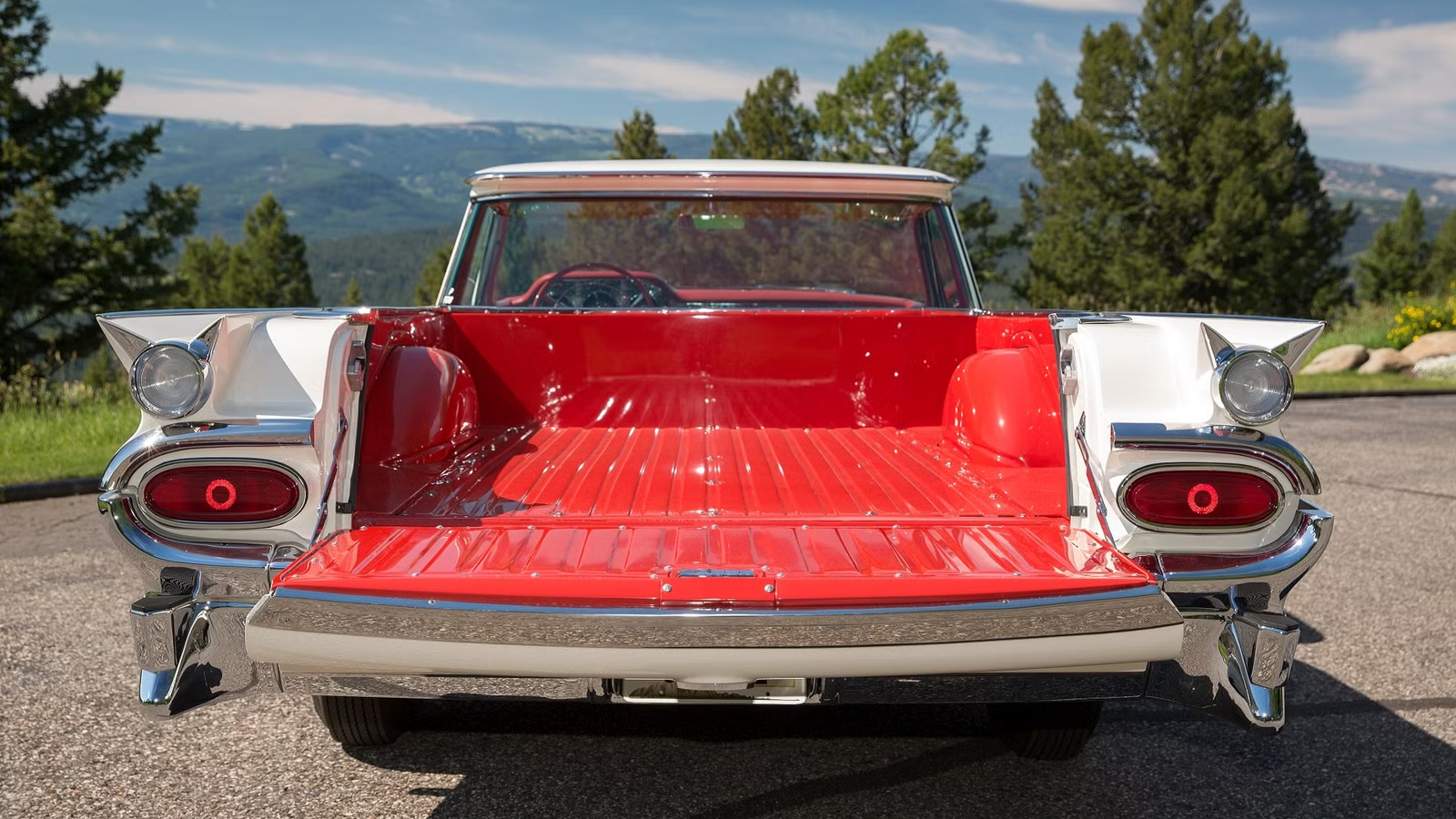
In 1959, a crew of Pontiac fabricators took a hacksaw to a brand-new station wagon. Not to fix a mistake, but they were cutting it apart on purpose, then welding on the cab and bed sections sourced from a Chevrolet El Camino.

Today, just one of these trucks exists. It has no proper VIN, only an engineering serial number and a body tag stamped with a code that officially doesn’t exist in Pontiac’s records. It spent years as a parts-store delivery vehicle and nearly got scrapped entirely.
This is the engineering autopsy of a parts-bin pickup that could have beaten the muscle-truck era by three decades, and the story of why GM buried it before it ever reached a dealer lot.
Ford And Chevy Started A Fight Pontiac Had To Join

Ford kicked off the whole mess in 1957 when it launched the Ranchero, reviving a car-based pickup format that Detroit had mostly abandoned. Chevrolet wasn’t about to let Ford have that lane to itself, so it rushed out the 1959 El Camino, built on the full-size Brookwood wagon platform. That left Pontiac General Manager Semon “Bunkie” Knudsen staring at two competitors and wondering if his division was about to get left behind.
This wasn’t even the first time GM had considered a car-based pickup. Legendary designer Harley Earl had pitched the idea back in 1952, but GM brass shelved it in favor of making existing trucks look more car-like, which is how the 1955 Chevrolet Cameo Carrier came to be. By 1959, with Ford and Chevy both already in the segment, Pontiac couldn’t afford to keep sitting on the sidelines.

So Pontiac’s engineers got their marching orders, and the brief was about as lean as it gets. Build something that could compete with the Ranchero and El Camino, and do it using as many existing GM production parts as possible to keep costs down. There was no budget for a clean-sheet design in a segment this small.
The timing made the constraint even tighter than it sounds. Knudsen was simultaneously pushing Pontiac’s “Wide Track” identity, a styling and marketing push built specifically to separate the brand from Chevrolet. Asking his engineers to borrow heavily from Chevy’s parts bin for this project was, in some ways, working against the very image he was trying to build.
All of this was happening in the shadow of the 1958 recession, when every new program at GM had to justify its cost before a single rivet went in. A low-volume pickup aimed at a niche market was exactly the kind of project that could get killed before it started. Pontiac’s engineers built it anyway.
Pontiac’s Rare Muscle Car That Beat Ferraris On The Track And Then Vanished
It was the fastest muscle car of its era, but it disappeared just as quickly as it appeared.
Meet The Pontiac El Catalina, Built By Cutting Up Two Cars

Pontiac’s engineers called their creation the El Catalina. It started as a 1959 Catalina Safari station wagon, stripped down to its underlying architecture and used as the foundation for everything that followed. Onto that chassis, the team mounted an El Camino cab shell and steel pickup bed, taken straight from Chevrolet’s own ute, and even grafted El Camino window uppers onto the Catalina door frames to make the Chevy roofline fit.
Building it on a tight budget, however, required a masterclass in sheet metal triage. While both divisions shared corporate components, their foundational architectures for 1959 were completely distinct. Chevrolet’s El Camino rode on a narrow, rigid “X-frame,” while Pontiac’s major selling point for 1959 was its ultra-wide perimeter full-size chassis—the backbone of its new “Wide Track” identity.

To merge these two worlds, Pontiac fabricators had to literally cut-and-paste two production vehicles together:
- The Donor Cars: The team rolled a brand-new 1959 Pontiac Catalina Safari station wagon into the shop and cut the body away just behind the B-pillars. Next, they sourced the cab roof, rear window, and inner cargo bed lining from a ’59 El Camino to establish the pickup greenhouse.
- The Hybrid Doors: The fabricators took standard Catalina front doors and expertly skinned them over the El Camino’s inner door frames. This allowed the doors to latch perfectly into the Chevy cab structure while maintaining Pontiac’s signature side body lines on the exterior.
- The Rear Quarters: Chevrolet’s wild, horizontal rear fins were completely chopped away. In their place, the crew welded on the sleek, finned rear quarter panels from a Catalina two-door coupe, flawlessly grafting them to the Chevy bed and capping the back with a heavily modified Safari wagon tailgate.
- The Perfect Wheelbase: Because the Pontiac wagon chassis utilized a 122-inch wheelbase—three inches longer than Chevy’s 119-inch platform—the rear wheel arches lined up beautifully with the elongated Pontiac bodywork, giving the prototype remarkably sleek, stretched proportions.

Instead of finishing the truck with the basic rubber mats and industrial vinyl typical of 1950s work vehicles, the crew opted for a luxury approach. They stuffed the cockpit with the premium dashboard, brightwork, and split-bench upholstery straight out of a production Catalina, creating a luxury performance cabin that looked like it rolled right off the main assembly line.
Pontiac’s Forgotten OHC Six-Cylinder Was Decades Ahead Of Its Time
This forgotten engine bridged American muscle and European sophistication, introducing innovations still used in modern cars today.
The Engine Riddle That Still Splits The Experts

Here’s where things get genuinely murky, and we’d rather be upfront about it. The most widely repeated account, backed by Hemmings and Mecum’s own auction materials, says the Safari donor car came with the optional Bonneville-spec 389-cubic-inch V8, running a single four-barrel carburetor rated at 300 hp.
Conversely, Hagerty suggests the truck may have originally left engineering with a milder two-barrel setup on that same 389, good for roughly 280 hp, with the four-barrel swap coming later. Hemmings disputes that account outright, and neither side has budged.

The reason nobody can settle it is simple: this was a hand-built, off-the-books project with no factory build sheet. There’s no VIN to trace and a body tag code that doesn’t even exist in Pontiac’s records, so there’s no document to check, only restorer testimony and secondhand dealer history passed down for over six decades.
A truck this improvised was never built to be tracked, which is exactly why a spec argument this old can’t be closed with certainty. In a strange way, the disagreement says more about how this car was made than a tidy, unverifiable number ever could.

What isn’t in dispute is the role that 389 played, whichever version sat under the hood. It put the El Catalina at the center of Pontiac’s rising performance story years before “muscle car” was even a category, since the GTO wouldn’t arrive until 1964. This parts-bin pickup was running serious Pontiac muscle five years ahead of the car that supposedly started it all.
GM Did The Math And Pulled The Plug

When Knudsen sat down to review 1959 sales numbers, the picture wasn’t pretty. Ford had moved 14,169 Rancheros and Chevy had sold 22,246 El Caminos, and both figures were already softened by the lingering effects of the 1958 recession. That combined total of roughly 37,000 units across two brands didn’t leave Knudsen much of a case for adding Pontiac as a third competitor.
The math simply didn’t work in Pontiac’s favor. A segment that thin couldn’t be split three ways without Pontiac’s truck eating directly into GM’s own El Camino sales. GM leadership looked at the niche, decided it was already saturated, and chose to leave Pontiac out rather than dilute a market that was barely supporting two players.

There was a bigger issue lurking underneath the spreadsheet, too. Pontiac was in the middle of building a performance identity at this exact moment—the same lineage that would eventually produce the Super Duty program and the GTO. A pickup truck simply didn’t fit the story Knudsen was trying to tell about the brand.
So the project got the axe, and it happened mid-build. Knudsen cancelled the program while a second prototype was still being bodied, and that unfinished truck ended up repurposed as a factory delivery vehicle instead of being completed. The original, fully finished El Catalina was sent down to the basement of the Pontiac Retail Store Parts Department, effectively out of sight and out of mind.
This Rare ’60s Pontiac Muscle Car Was Harder To Find Than A COPO Camaro
This pre-GTO Pontiac packed a 421-cubic-inch Super Duty V8 and ran 11.7-second quarters, influencing the muscle car revolution that followed.
How The Only El Catalina Survived

Rather than getting crushed like most canceled prototypes, the El Catalina got a strange second act. It lived in the basement of the Pontiac Retail Store Parts Department, occasionally rolling out to handle delivery runs. That basement stint is likely the only reason this truck still exists at all.
Eventually, store manager Henry “Hank” Gotham acquired the car and passed it along to his son as a college vehicle. By that point, the prototype had never been primed or painted for real road use, and years of actual driving left it with significant rust. It was being treated like an ordinary used car.

Darrel Lotridge in Michigan first spotted the truck at the parts store back in 1960 and spent the next decade trying to buy it, finally succeeding in May 1969. His restoration attempt dragged on for decades without ever reaching completion, and he eventually sold the car to collector Tom Girrard in 2008.
Girrard handed the project to restorer Tom White of Hopkinton, Massachusetts, who faced a genuinely difficult job. White sourced parts from a Bonneville to rebuild the interior from scratch, working without any blueprints and essentially reverse-engineering the truck’s nonstandard construction panel by panel.

In 2011, at the Pontiac-Oakland Club International national meet, the El Catalina scored a perfect 400 points and took home Best of Show. It has since added AACA National 1st, National Senior, Grand National 1st, and Grand National Senior honors, along with the Otto Rosenbusch Memorial Award at the 2014 Concours of the Americas.
Why $240,000 Still Couldn’t Buy This Pontiac

The Hagerty Price Guide, per publisher Dave Kinney, currently values the El Catalina between $85,000 and $125,000. That number might be on the conservative side. At Mecum Kissimmee in January 2019, the truck was bid up to $241,843 and still failed to meet its reserve, meaning its owner turned down a bid well above today’s official estimate.

There’s no real way to benchmark this car against anything else, because there’s nothing else like it. Pricing the El Catalina is less about comparing and more about figuring out what collectors will pay for a piece of GM history that was never even supposed to survive this long.

Had Knudsen given this project the green light back in 1959, Pontiac could have been selling a 300-hp ute years before performance trucks became their own segment. Instead, we’re left with one truck, one chance to own it, and a what-if that’s only gotten more interesting with age.
Sources: Hagerty, Mecum, Hemmings

Related posts


Latest Post


No Comments