
Mercedes Built A Truck That Embarrasses The Ford Raptor Without Needing 700 HP
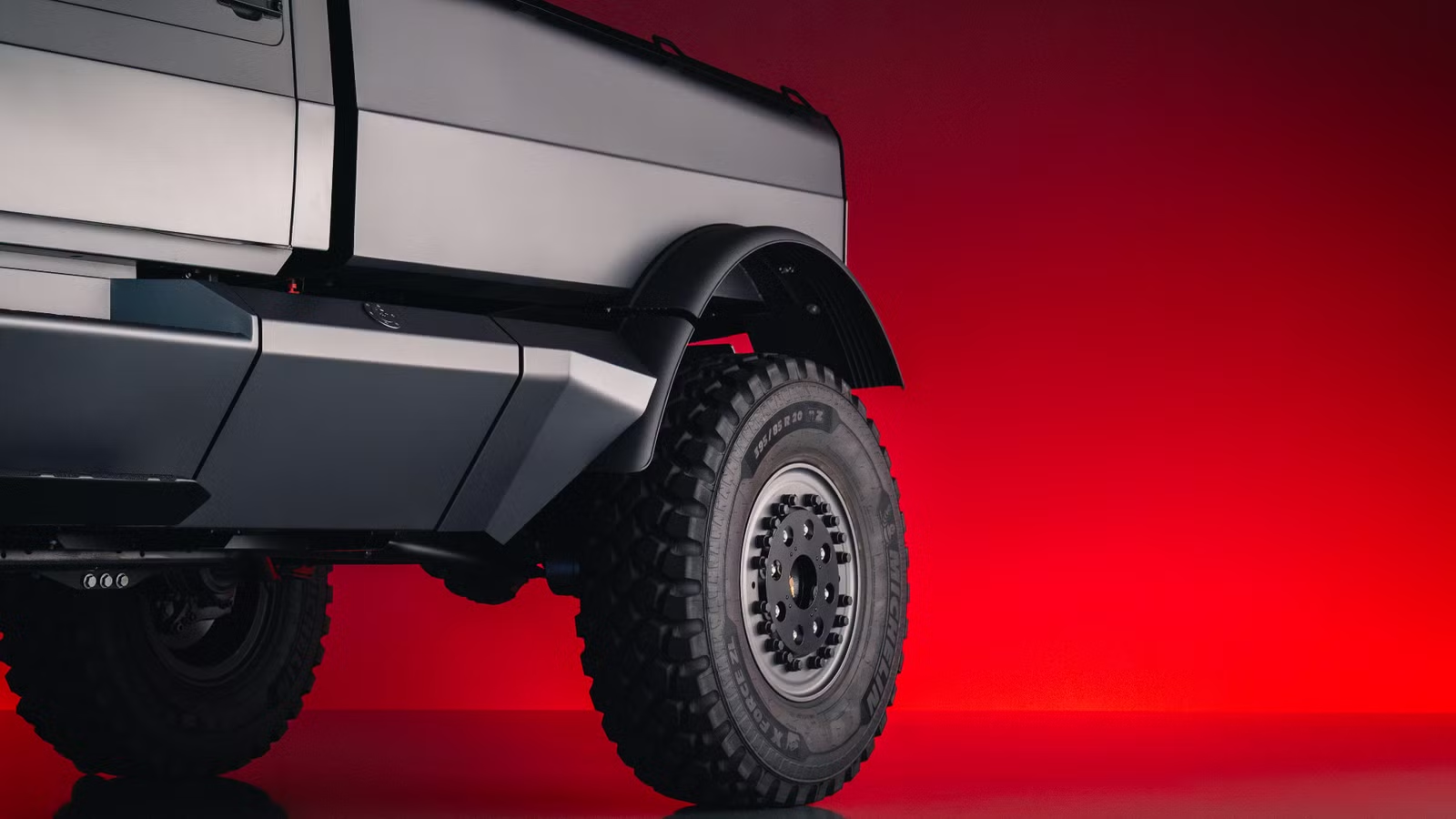
Horsepower, chassis rigidity, selectable drive modes, and enough suspension travel to land a jump at 70 mph — that is the shared vocabulary of American off-road trucks. The assumption underneath it is that capability means more of everything.

Mercedes-Benz spent eight decades reaching the same goal by inverting every one of those variables. Its engineers built flex into the chassis on purpose, geared for walking pace, and handed traction back to the driver as mechanical locks. The result climbed higher than any wheeled machine ever had, using principles Detroit deliberately walked away from.
Every American Off-Roader Is Built On The Same Three Ideas
Ford’s 2026 F-150 spec sheet lists the frame as fully boxed, high-strength steel, and the Ford F-150 Raptor uses more of it than any other version of the truck. Rigidity is the stated goal rather than a compromise. A frame that stays square under load is what keeps a desert truck predictable when it comes down from a jump.

Off-road geometry on the Raptor comes almost entirely from tire diameter. Ford quotes 13.1 inches of ground clearance on the 37-inch package, along with a 33.1-degree approach angle, 24.9 degrees of departure, and 24.4 degrees of breakover. Those bigger tires also cost wheel travel, dropping the front from 14 inches to 13.

David Alpert / HotCars / Valnet
The Jeep Wrangler Rubicon 392 follows the same logic with gearing, pairing 470 hp with a 48:1 crawl ratio. Jeep’s best-in-class 100:1 figure does exist, but it requires the manual transmission and an optional 4.88:1 axle that most buyers never order.
Traction in both trucks is managed by software. Off-Road Plus rewrites throttle mapping, shift points, and traction control for rock or sand, and Selec-Speed Control holds a fixed crawl speed in low range without the driver touching a pedal.
Stiff frame, tall gearing, electronic traction. Those three pillars define the modern American off-roader, and they are exactly what make it superb at running a desert wash flat out and landing without bending anything.
The Mercedes-Benz Unimog’s Chassis Is Engineered To Flex

The Mercedes-Benz Unimog is built to twist up to 600 mm (23 inches, or nearly 2 feet) diagonally across its frame, which works out to nearly 24 inches of intentional chassis flex. Three systems produce the figure together: a torsionally flexible frame, torque tube technology, and three-point mounting of the engine, transmission, cab, and body. Remove any one of them and the other two stop making sense.
The frame is cranked, or offset, and fully welded, which lets it absorb torsional stress permanently instead of fatiguing under it. Offsetting the rails also drops the frame low while the axles hold the body high, so the truck gets clearance and a low center of gravity at the same time.

Three-point mounting is what makes the flex survivable. Engine, gearbox, cab, and any fitted body are anchored at three points rather than bolted rigidly along the rails, so the stiff components travel with the frame instead of resisting it. Bolt them down conventionally and something cracks the first time the chassis winds up.
A rigid frame deals with cross-axle terrain by lifting a wheel clear of the ground, which is why rock crawlers run sway bar disconnects and enormous suspension travel. A torsionally flexible frame keeps all four wheels loaded because the chassis itself absorbs the diagonal.
The Unimog arrived in 1946 as a replacement for the farm tractor rather than as an off-road vehicle. Its track width was set precisely wide enough to straddle two rows of potatoes in a field. Raptor proportions were dictated by Baja; Unimog proportions were dictated by agriculture.
Mercedes Deleted The Conventional Suspension Layout Every Truck Uses

The Unimog has no trailing arms, no multi-link rear end, and no leaf springs anywhere. Each axle connects to the transmission through a torque tube and a thrust ball, with coil springs carrying the suspension load. That layout allows axle articulation of up to 30 degrees.
The torque tube encases the driveshaft along its full length, sealing it against dust, water, and everything else the terrain throws at it. It also performs the locating job that trailing arms handle on a pickup, tying each axle to the gearbox so the two move as one assembly.
Unimog Center, a US specialist in the trucks, notes that the arrangement prevents axle wind-up and axle hop under load, the failure mode leaf-sprung pickups fight with traction bars and stiffer bushings. An axle cannot rotate independently of the tube wrapped around its own driveshaft.

Ford answers the same problem with a five-link coil-sprung rear axle, extra-long trailing arms, and internal-bypass dampers under electronic control. That system produces more wheel travel and vastly better high-speed damping, but it only works because the frame beneath it never moves.
Mercedes groups all of this under safety rather than capability. The welded frame, all-steel cab, 47-inch optional fording depth, and torque tube concept appear together in the company’s own safety copy, which says a lot about what the truck was built to survive.
Portal Axles Give The Unimog Six More Inches Than A Raptor

Portal axles place the axle tube and differential above the center of the wheel, with a hub reduction gear at each corner stepping the drive back down to the hub. Mercedes labels the components on its own cutaway as hub reduction gear, axle center, and wheel center.
Ground clearance across the Unimog range reaches 490 mm, or 19.3 inches, though that maximum belongs to the older U 5000 — the current U 5023 measures 460 mm, or 18.1 inches. Neither figure required a single extra inch of tire.

The Raptor’s 13.1 inches on 37s sits roughly six inches lower, and Ford gave up an inch of front wheel travel to get there. Raising the axle centerline lifts the entire driveline instead, which is why the Unimog keeps its clearance and its low body at once.
Mercedes offsets the axle differentials asymmetrically so obstacles pass between the wheels more easily rather than catching the lowest point of the axle. Short overhangs at both ends give the truck up to a 46-degree approach angle and 50 degrees of departure straight from the factory.

Multiplying torque at the wheel end means everything upstream sees less of it. Driveshafts, differentials, and the transmission all run at lower stress, which is the only reason the gearing in the next section is survivable at all.
Three Mechanical Locks And A Climb No Pickup Has Matched

Ford’s published 2.64:1 low range and 4.10:1 axle gears, multiplied through the 10-speed automatic’s first gear, put the Raptor at roughly 50:1. Unimog Center places the Unimog’s ceiling above 3,000:1 with optional gearboxes. Jeep’s best-in-class 100:1 sits far closer to Ford than to Mercedes.
The low-range gears cover 1 to 90 km/h, or roughly 0.6 to 56 mph, and the eight-speed transmission carries an off-road group adding eight more forward and eight more reverse ratios on top of the standard set.

Three differential locks handle traction, each engaged by the driver and each delivering a full 100% lock. That is positive mechanical engagement rather than a computer pulsing a brake caliper at a spinning wheel, and it works the same whether the electronics are healthy or not.
Mercedes rates climbing ability at 100%, which sounds modest until it is converted — a 100% grade is a 45-degree slope.
A Unimog makes 231 horsepower and 664 lb-ft from a four-cylinder diesel, tops out at 55 mph, and carries a gross vehicle weight between roughly 16,500 and 33,000 pounds. That buys far less payload per pound than a conventional truck, and nobody commutes in one.

In December 2019, two Unimog U 5023s climbed the Ojos del Salado volcano in Chile to 6,694 meters — 21,962 feet — higher than any wheeled vehicle had ever been driven. They were there to install emergency radio units linking four high-altitude camps so climbers could call for help.
The Unimog is not a better Raptor. It is evidence that “truck” covers a much wider category than an American showroom will ever show you.
Sources: Mercedes-Benz, Ford

Related posts


Latest Post


No Comments