
The Only Harley-Davidson That Evel Knievel Trusted For Stunt Jumps
Evel Knievel, born Robert Craig Knievel, remains the gold standard of daredevilry — a name still synonymous with heart-stopping motorcycle jumps and death-defying spectacle decades after his heyday. Long before modern performers like Travis Pastrana were even born, Knievel was already captivating the world throughout the 1970s, launching himself over cars, buses, and canyons with nothing but nerve, skill, and the machine beneath him. What made him more than just a stunt rider was his showmanship: he was a genuine entertainer and a pioneer who redefined what was physically possible on two wheels. He experimented with several different twin-cylinder motorcycles throughout his career, but when it came to the jumps that defined his legacy, he trusted only one Harley-Davidson. The remarkable part? Harley-Davidson had originally built it as a low-production factory race bike.
The XR750 Was Evel Knievel’s Main Stunt Jump Bike

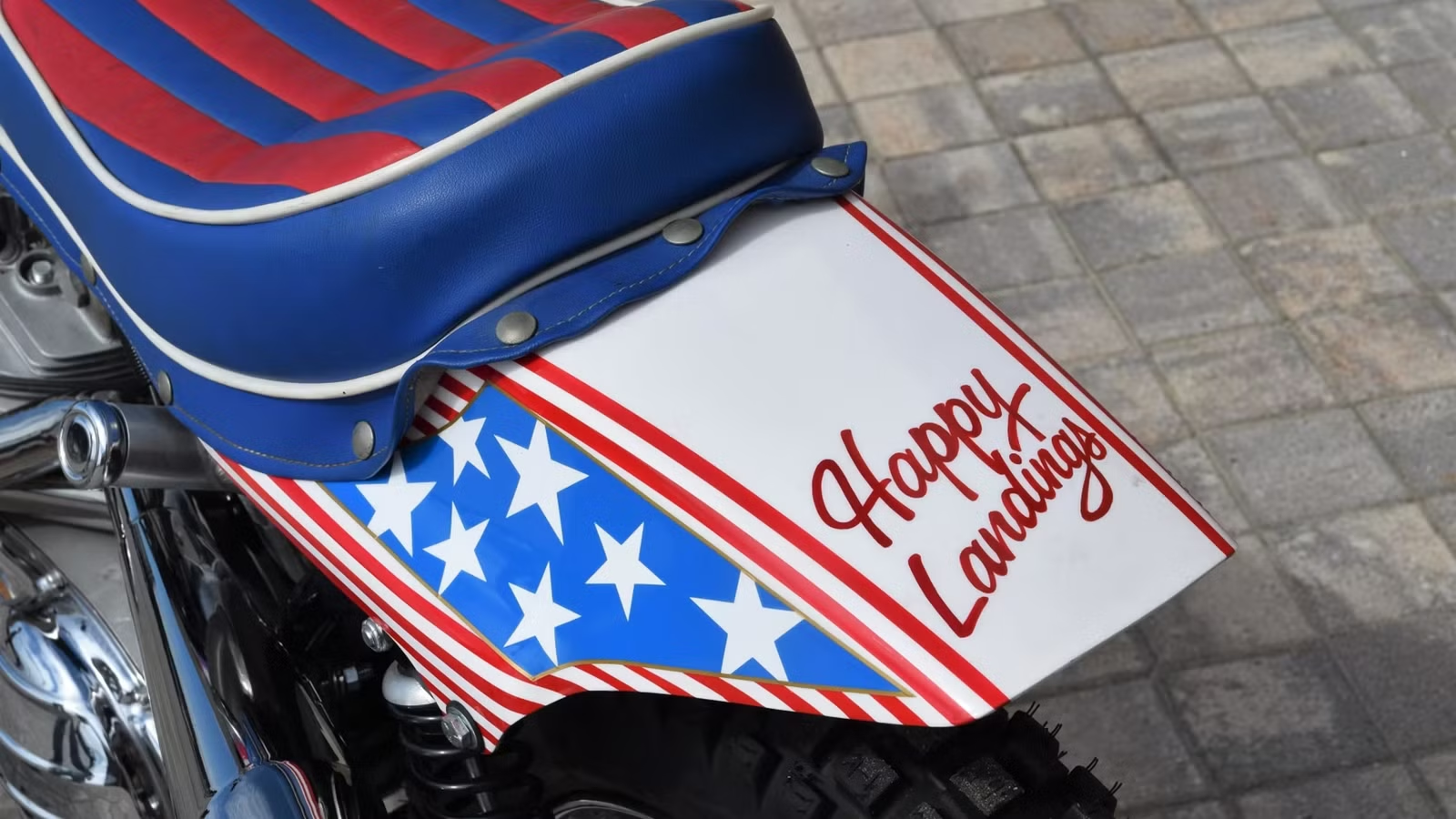
Evel Knievel rode a number of different motorcycles over the course of his career, but the bike he’s best remembered for is the Harley-Davidson XR750, like the replica pictured above. He first started jumping the XR in 1970, and it remained his bike of choice all the way through his final, infamous shark-jumping performance in 1977.

As a rider for Harley-Davidson, Evel Knievel performed some truly death-defying feats, setting records with a 129-foot jump over 19 cars in 1971, a 120-foot jump over 50 stacked cars in 1973, and a 133-foot jump over 14 buses in 1975 — each on an XR750. Of course, not every performance went according to plan. Beyond the records he set for jumps, Knievel holds the Guinness World Record for the most broken bones in a lifetime, with 433 fractures to his name.

Long before Evel Knievel was prominent enough to attract Harley-Davidson’s attention, he started out on a little Honda 350. As part of a promotional effort to generate publicity for a local dealership, he cleared a crate of rattlesnakes and two mountain lions. After that first jump, his increasingly ambitious stunts demanded bigger and more powerful motorcycles — nowhere more dramatically than the Snake River Canyon attempt, which called for the rocket-propelled Skycycle X-2.
Other Evel Knievel Jump Bikes
- Norton Commando 750 (1966)
- Triumph Bonneville 650 (1967-1968)
- Laverda/American Eagle 750 (1969-1970)
- Skycycle X-2 (Snake River Canyon Jump)
Making A Deal To Ride For Harley-Davidson


Evel made his first public jump atop a Harley-Davidson XR750 on December 12th, 1970 at the Lions Dragstrip in Los Angeles, California, successfully clearing 13 cars. From that point on, Harley-Davidson supplied the American stunt rider with a succession of XRs draped in the Stars and Stripes. As the owner of the Kewanee Harley-Davidson dealership, Roger Reiman took over as his head mechanic, while George Sedlak laid down the eye-catching paint that covered each machine.
A Stunt Bike Born From Harley’s AMA Race Efforts

Evel Knievel’s daredevil career wouldn’t have been the same without the XR750. Yet Harley-Davidson never designed it with jumping in mind. The XR was a purebred flat track racing bike, created in response to an AMA rule change that left Harley less competitive against rival British motorcycle manufacturers brands like Triumph, BSA, and Norton. It featured a newly developed overhead-valve V-twin race engine based on the Sportster XLR, and the frame was engineered to be lightweight yet responsive, using a thinner backbone construction (1″ compared to the XLR’s 1.65″) optimized for flat-track competition.
1972 Harley-Davidson XR750 Performance Specs
|
Engine |
45-Degree V-Twin |
|
Displacement |
750 cc |
|
Compression |
10.5:1 |
|
Transmission |
4-Speed |
|
Power |
80 Horsepower |
Harley-Davidson
Harley’s initial XR750 efforts used cast-iron heads and cylinders that had a tendency to overheat in warm conditions and during longer races, earning them the nickname “waffle irons.” Knievel’s first jumps on the XR750 were aboard one of these Iron Heads, though the overheating issues that plagued flat trackers didn’t affect his performances in the same way.
Harley-Davidson responded by introducing a revised, more powerful aluminum alloy XR750 engine in 1972, benefiting from a meaningful power increase as well as improved cooling. Paired with Ceriani forks, twin Girling rear shocks, aluminum rims, and a fiberglass tank and tail section, the result was a svelte package that tipped the scales at right around 300 lbs. Flat-track bikes were sold without a front brake, but Knievel’s XR750 needed every bit of stopping power available. Perhaps the most remarkable aspect of his choice to use the now classic Harley was that it offered a mere five inches of suspension travel.
XR750 Competition Accomplishments
What A Harley-Davidson XR750 Is Worth Today

Because the XR750 was intended strictly for competition, Harley-Davidson never offered it as a standard production motorcycle. After the XR debuted, Harley built small batches in 1972, 1975, 1978, and 1980. As racers increasingly opted for custom frames, Harley-Davidson eventually stopped selling the complete bike and made only the engine available. Some sources report around 500 competition XRs leaving the factory, while others put the number even lower. Either way, authentic examples from the era are genuinely scarce and can command hefty sums at auction.
Harley-Davidson XR750 Pricing (Classic.com)
|
Lowest Sale |
$8,250 |
|
Average Sale |
$41,566 |
|
Highest Sale |
$93,500 |
|
Most Recent Sale |
$93,500 |
As with any Classic.com comparison, it’s worth noting that this market data doesn’t filter by trim. In this case, that means XR750 sales figures also include results from the XRTT racer as well as tribute bikes. Even so, the averages serve as a useful benchmark. Mecum has sold a 1980 XR750 for $55,000, while Bring a Trailer has sold a 1970 XR750 for $28,000. Though XR750 flat trackers have been creeping up in value, the XRTT represents a considerably more expensive investment. Exact production counts vary — some say 15 units, others say 25 — but the low volume means original examples routinely sell for close to six figures.
Knievel Bike Sales
- Bonham’s valued the lone surviving XL1000 from ‘Viva Knievel’ at $80,000–$100,000
- Mecum sold Knievel’s Honda CBX for a record-tying $49,500
Other Stunt Riders Trust The XR750

Evel Knievel is the most famous daredevil to have launched the Harley-Davidson XR750 off a ramp, but he’s far from the only one. The old-school Harley has proven popular with stunt riders since his retirement, and several have managed to surpass some of his records.

In 1998, Bubba Blackwell broke Knievel’s car record with an impressive 20-car jump. Not content to stop there, he then broke Knievel’s bus record in 1999 with a monumental 157-foot jump over 15 buses. In 2008, Blackwell broke Knievel’s last remaining XR jump record by clearing 52 stacked cars at the Deep South Speedway. The 20-car mark stood until Doug Danger jumped 22 cars at the 2015 Sturgis Rally, breaking it once more.
Sources: Evel Knievel Brand, Harley-Davidson, National Motorcycle Museum, Silodrome.

Related posts

Latest Post


No Comments