
The Japanese V8 Sedan That Outlasts Mercedes And BMW At 300,000 Miles
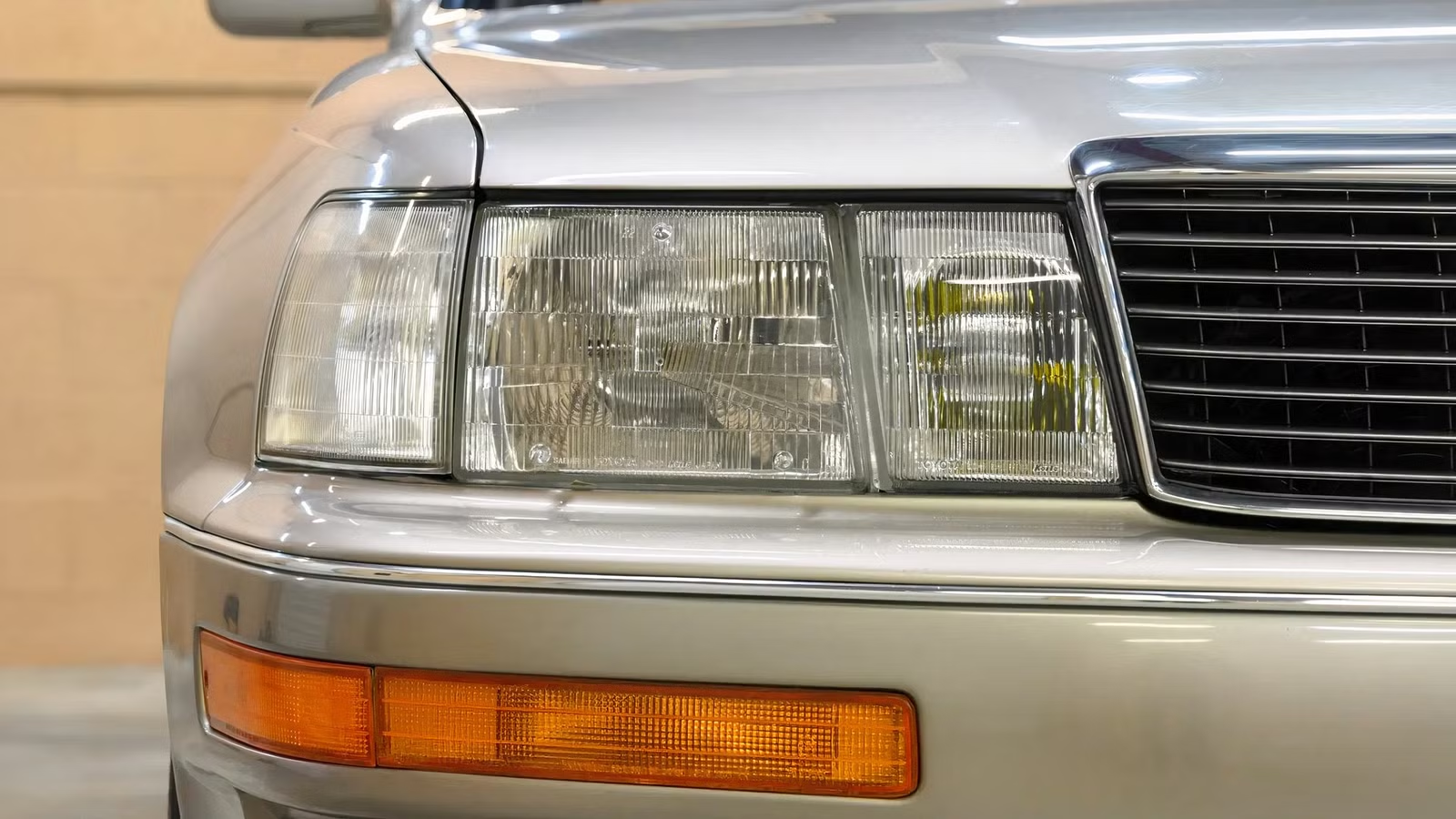
German automakers once dominated the American flagship luxury car segment. Buyers only considered models like the Mercedes-Benz S-Class and BMW 7 Series for prestige and peak engineering. These executive sedans carried immense prestige, yet their complex mechanical systems created severe long-term reliability issues.

Hydraulic suspension failures, fragile electrical harnesses, and excessive maintenance costs eventually forced weary owners to abandon these expensive vehicles. Today, thousands of once-regal German flagship sedans sit rusting in scrapyards across the country. However, there was one Japanese brand that showed the American market that this didn’t have to be the case.
How Lexus Changed Reliability In The Luxury Segment
The launch of the Lexus brand in 1989 permanently disrupted the international premium automotive landscape. Before Toyota established this standalone luxury division, the market operated under an agreement that accepted high-end prestige coming at the cost of dealing with temperamental mechanics, complex maintenance, and high repair bills. Toyota leadership recognized a massive gap in consumer expectations and set out to build a luxury brand around a founding philosophy of total quality control, extreme precision manufacturing, and unmatched customer service.

Instead of relying on traditional hand-assembly methods that introduced human error, Toyota created purpose-built manufacturing facilities utilizing advanced automation alongside highly trained experts. Engineers focused on eliminating mechanical failures through relentless component stress testing, tight panel tolerances, and rigorous quality audits. This customer-centric approach introduced true operational reliability to a luxury vehicle market previously defined by frequent breakdowns and exorbitant labor costs. Lexus effectively transformed consumer expectations for executive cars and forced the entire global industry to rethink how premium cars are engineered. The Japanese newcomer did so by prioritizing engineering durability over unnecessary mechanical complexity.
The Lexus LS 400 Coasts Past 300,000 Miles

The original Lexus LS 400 debuted as the brand’s flagship disruptor. The full-size sedan shook up Germany’s executive carmakers, thanks to a five-year development program executed by Toyota. The LS 400 was developed under the top-secret Project F1 mandate, aiming directly at the most prestigious automobiles in the world. When the production car arrived in North American showrooms, it delivered good cabin insulation, smooth ride quality, and near-perfect assembly fitment at a retail price significantly lower than equivalent European flagships.
American buyers responded immediately to the vehicle’s superior value proposition and obvious build quality. The LS 400 outsold its primary Mercedes-Benz S-Class and BMW 7 Series competitors in the U.S. market within its first full year of production. It proved that a new entrant could match or exceed the refinement of legacy luxury brands while offering superior long-term dependability, instantly establishing Lexus as a dominant player in the global luxury market.
The 1UZ Remains The Most Reliable V-8 Ever Added To A Luxury Car

Powering the original LS 400 is Toyota’s 4.0-liter 1UZ-FE V-8 engine paired with an equally durable four-speed automatic transmission. In its initial launch configuration, this powertrain produces 250 horsepower at 5,600 RPM and 260 lb-ft of torque at 4,400 RPM. The power delivery remains linear across the entire rev range, pushing the full-size luxury sedan from 0 to 60 MPH in 7.9 seconds toward an electronically governed top speed of 150 MPH.
The four-speed automatic transmission features electronically controlled shift points designed to deliver seamless gear changes without interrupting cabin serenity. Toyota engineers tuned the torque converter and gearing specifically to keep engine speeds low during highway cruising, minimizing vibration, optimizing fuel economy, and ensuring quiet cabin sound levels at elevated speeds.
Toyota’s Billion Dollar Luxury Bet

Toyota engineered the 1UZ-FE V-8 under its unrestricted Project F1 initiative, spending approximately $1 billion while employing 1,400 engineers, 2,300 technicians, and running 1.67 million real-world test miles across global climate zones. The resulting motor features a race-inspired bottom end constructed around a lightweight aluminum block, a forged steel crankshaft with eight counterweights, and robust six-bolt main bearing caps that secure the rotating assembly against high stress.
The double overhead camshaft valvetrain avoids failure-prone hydraulic lifters entirely, utilizing solid aluminum alloy valve lifters with steel outer shim adjusters that maintain exact tolerances over hundreds of thousands of miles. Pre-1995 versions feature a non-interference engine design, meaning a snapped timing belt will not cause the pistons to strike the valves, preventing catastrophic engine damage. This over-engineered construction was so mechanically sound that it later earned FAA approval for light aircraft use. This race-grade architecture gives the 1UZ-FE far greater mechanical longevity than the complex, leak-prone V-8 engines produced by contemporary European manufacturers.
How To Keep Your 1UZ-FE Running Forever

Maintaining the 1UZ-FE engine requires basic preventive care to ensure its legendary durability remains intact. Owners must replace the rubber timing belt and water pump every 50,000 to 60,000 miles to maintain precise engine timing and cooling efficiency. While the engine block routinely exceeds 300,000 miles without requiring a rebuild, high-mileage examples require attention for specific age-related wear items. Leaking electronic control unit capacitors can cause random misfires or stalling.
Failing lower ball joints require inspection to prevent front suspension collapse, and power steering pump fluid leaks can drip onto the alternator directly below, causing electrical failure. When automotive journalist Matt Farah subjected his famous 1996 LS 400 to a comprehensive mechanical inspection at 983,000 miles, the report revealed roughly $3,000 in required maintenance. Crucially, those repairs consisted almost entirely of aged suspension bushings, tired shock absorbers, and minor external oil leaks, leaving the engine internals untouched and healthy on its path to one million miles.
How The 1UZ Outlasts Its German Rivals

The 1UZ-FE, Mercedes M119, and BMW M60 defined early 1990s flagship V-8 engineering. However, distinct architectural choices created vastly different long-term outcomes for each engine. Toyota built the 1UZ-FE with a motorsport-grade bottom end. It utilizes a forged steel crankshaft with eight counterweights, an aluminum block, and robust six-bolt main bearing caps. Its DOHC valvetrain avoids failure-prone hydraulic lifters entirely. Instead, it uses solid aluminum alloy lifters with steel outer shim adjusters.
Early pre-1995 variants feature a non-interference layout, ensuring a snapped timing belt will not cause catastrophic piston-to-valve contact. This simple, over-engineered approach yields unmatched durability. Mercedes matched this displacement with the 4.2-liter and 5.0-liter M119 V-8s. The M119 features an aluminum block with high-silicon cylinder liners, four valves per cylinder, and dual-overhead camshafts with variable valve timing. While internal components like the forged crankshaft are exceptionally durable, the engine relies on complex hydraulic valve lifters for compensation.
Over time, plastic oil tubes supplying the hydraulic lifters degrade and snap, leading to top-end oil starvation and severe valvetrain noise. Early versions also utilized failure-prone biodegradable wiring harnesses, causing widespread electrical faults across the engine bay. BMW engineered the 3.0-liter and 4.0-liter M60 quad-cam V-8s with a light, high-revving architecture. However, early production engines suffered an infamous design flaw. Nikasil coatings suffered accelerated erosion when exposed to high-sulfur fuel, causing loss of compression. BMW ultimately replaced damaged blocks under warranty with Alusil units. Additionally, the M60 relies on a delicate plastic timing chain guide system. These guides crumble with age and heat, causing timing chain slippage and total engine destruction on interference heads.
The LS 400’s Ride Is Just As Smooth As Its Engine

The LS 400 utilizes an advanced double-wishbone suspension architecture at all four corners to deliver an exceptional balance of ride comfort, body control, and high-speed stability. Toyota chose traditional steel coil springs and gas-pressurized shock absorbers over fragile pneumatic air springs or active hydraulic setups for standard models. This deliberate mechanical simplicity prevents the costly suspension sag, compressor burnouts, and blown hydraulic lines that routinely plague contemporary European luxury sedans as they age.
The double-wishbone geometry keeps the tire contact patch flat relative to the road surface during cornering and vertical suspension movement. This configuration isolates cabin occupants from sharp pavement impacts and road expansion joints while maintaining stable, predictable handling characteristics when cruising at highway speeds.
The LS 400 Is Still An Affordable Used Luxury Car

Current market values for first-generation Lexus LS 400 sedans reflect a growing appreciation among car enthusiasts, mechanics, and young collectors seeking dependable daily transportation. High-mileage driver-quality examples with minor cosmetic flaws sell between $3,000 and $6,000, offering reliable luxury transportation for the price of a used economy hatchback.
Well-maintained examples showing under 150,000 miles with documented service records command between $8,000 and $14,000 in the private market. Exceptionally preserved, low-mileage collector cars occasionally fetch over $20,000 at modern online auctions. Depreciation on early LS 400 models has fully bottomed out. Market values show steady upward appreciation as buyers recognize these nineties Japanese luxury sedans as virtually indestructible vehicles that quietly outlast modern cars.
An Interior That Outclasses Modern Luxury Sedans

Inside the cabin, the LS 400 offers a luxurious sanctuary constructed with premium leather upholstery, real California walnut wood trim, and precise panel fitment. Electroluminescent gauge clusters light up vividly behind dark glass, providing sharp instrument visibility under all exterior lighting conditions while reducing night driving eye strain.

Optional features include a Nakamichi premium sound system, power-adjustable shoulder seat belts, and dual-zone climate control. The full-size cabin provides ample interior space for five adult occupants, offering 38.8 inches of front headroom, 43.5 inches of front legroom, 36.8 inches of rear headroom, and 34.1 inches of rear legroom. The rear luggage compartment holds 14.4 cubic feet of cargo space, easily accommodating multiple full-sized suitcases for extended cross-country travel.

Available Models
Lexus
- Founded
-
1989
- Founder
-
Eiji Toyoda, Toyota
- Headquarters
-
Nagoya, Japan
- Owned By
-
Toyota Motor Corporation
- Current CEO
-
Takashi Watanabe (President)
Sources: MotorReviewer, J.D. Power, and RepairPal.

Related posts



Latest Post


No Comments