
The $70K Mitsubishi Halo Car That Out-Speced The Supra And Lost Anyway
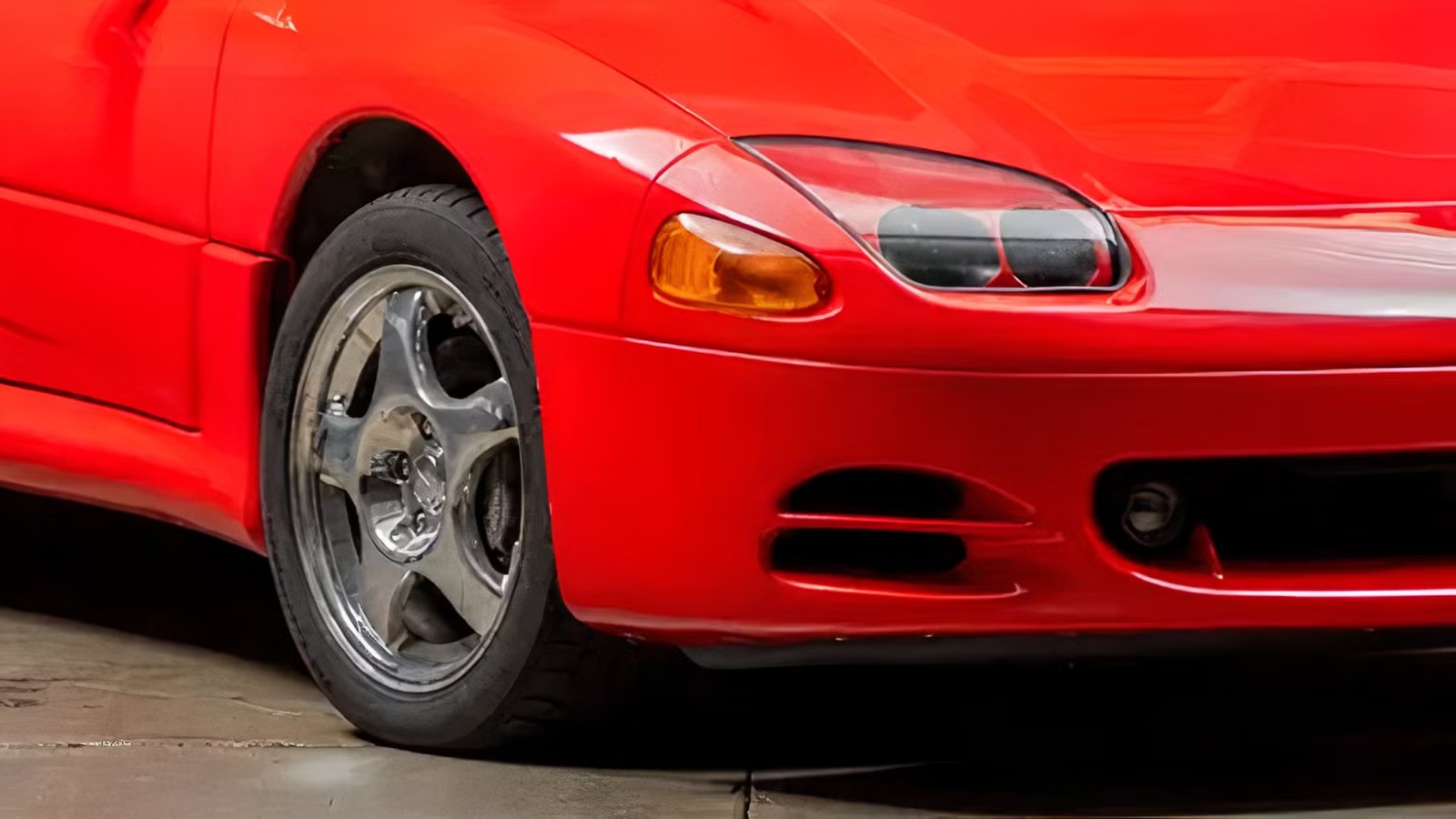
In the 1990s, Japanese automakers treated flagship sports cars like rolling engineering contests. One company took that idea almost comically far: its ultimate grand tourer packed twin turbos, all-wheel drive, a six-speed manual, four-wheel steering, and then gained a powered metal roof that folded into the trunk. The result cost close to $70,000, carried an absurd amount of hardware, and still became slower than the coupe underneath it. Three decades later, that failure makes Mitsubishi’s wildly ambitious experiment much harder to ignore.
In The ’90s, More Technology Looked Like The Winning Formula

Japan’s performance boom in the 1990s involved far more than a race for the biggest horsepower number. The major brands approached speed from different directions. Toyota built the turbocharged Supra around the 3.0-liter 2JZ-GTE inline-six, which made 320 horsepower in U.S. trim and worked with a six-speed manual and rear-wheel drive. More importantly for what happened later, the Supra gave enthusiasts a strong base for modification. The engine bay offered useful room compared with many tightly packed rivals, while the famously stout iron-block six eventually supported power levels that went far beyond anything Toyota advertised.
Mazda went hunting for speed with a much smaller stick. The third-generation RX-7 wrapped its compact twin-turbo rotary engine in a chassis that weighed around 2,800 pounds. Its 1.3-liter 13B-REW made 255 horsepower, but raw output told only half the story. The FD RX-7 stayed small, low, and light when many competitors grew heavier and more complicated. Period testers praised the Mazda for exactly that focus – it delivered performance through low mass, quick responses, and a drivetrain with a character that nothing with pistons could really copy.

Then there was Mitsubishi’s philosophy. Rather than strip a sports car down, it attacked physics with hardware. Its flagship used twin turbochargers, full-time all-wheel drive, four-wheel steering, electronically controlled chassis systems, and enough luxury equipment to make the whole thing feel closer to a Japanese grand tourer than a bare-knuckle sports car. Contemporary testers already noticed that its huge technical résumé came with weight and a less delicate feel than some rivals. Still, the approach made sense in an era when new electronics carried real showroom magic. Mitsubishi then decided that this already complicated flagship needed one more party trick. It wanted the roof to disappear.

One Engineering Decision Turned A Heavy GT Into A Technical Nightmare

For a wealthy buyer in 1996, the idea sounded brilliant. A normal soft-top convertible forced the owner to accept a fabric roof, more noise, and less security when the top went up. A retractable metal roof promised the comfort and appearance of a coupe with the open-air appeal of a convertible. Push a switch, and the car could change personality without anyone wrestling with latches or storing removable panels. Mitsubishi wanted that trick on one of the most mechanically packed performance platforms already on sale.
Mitsubishi turned to American Sunroof Corporation, or ASC, to make it happen in California. The conversion required far more work than cutting off the roof. Cars arrived prepared for ASC’s surgery, and workers removed body and interior pieces, cut away sections of the shell, strengthened the rocker areas, reinforced the windshield structure and cowl, and added substantial support around the rear of the chassis. The rocker reinforcement alone added about 110 pounds, and ASC then fitted a 98-pound folding steel roof along with the motors, hydraulic equipment, wiring, sensors, and control hardware needed to make the whole machine operate. The conversion took roughly 12.5 hours per car and added about 342 pounds in total.
Then came the mechanical ballet. One switch started a sequence that lowered the windows, opened the rear deck, released the roof, moved the rear quarter glass, folded the metal top, tucked it into the rear compartment, and closed the deck again. Four electric motors, four hydraulic actuators, and a dedicated computer were involved, managing a process that took about 35 seconds.
The Mitsubishi 3000GT VR-4 Spyder Was The $70,000 Halo Car Nobody Needed

That machine was the 1996 Mitsubishi 3000GT VR-4 Spyder. Its specification sheet still reads like someone checked every expensive box at once. A twin-turbocharged 3.0-liter 6G72 V6 produced 320 horsepower and 315 lb-ft of torque. The car came with all-wheel drive, four-wheel steering, and a six-speed manual transmission, then added ASC’s power-retractable hardtop. Production figures make the package even stranger. Mitsubishi and ASC produced 1,034 Spyders across 1995 and 1996, including both the front-wheel-drive SL and twin-turbo VR-4. Of those, only 604 were VR-4s.
The sticker could get almost as wild as the engineering. The VR-4 Spyder carried a base price of $64,449 when it arrived, and a fully loaded example could reach $68,766. For context, the regular VR-4 already lived in expensive territory – a 1994 coupe was listed at about $42,253 before options. The folding hardtop therefore added the price of a perfectly respectable new car to an already pricey Mitsubishi.
The performance numbers made the price hurt more. The 1996 VR-4 Spyder had a 5.8-second 0–60 mph time, and needed 14.4 seconds through the quarter-mile. The quickest independently tested VR-4 coupe benchmark hit 60 mph in 4.8 seconds. Test conditions differed, so those two numbers should not pretend to be a laboratory A/B test, but the pattern points in one direction: the convertible carried hundreds of extra pounds, and those pounds blunted acceleration.

The market eventually sent Mitsubishi an even clearer message. Early reports made the Spyder sound like a success because Mitsubishi had dealer commitments for large numbers of cars, but those commitments did not translate to retail customers. Mitsubishi offered dealers floorplan assistance in early 1996 as slow-selling Spyders sat in inventory. Dealers had sold 232 Spyders in 1995 and just 56 more during the first two months of 1996. One Mitsubishi dealer went further in a letter published by Automotive News at the time, claiming the company charged stores $2,500 when they refused a Spyder allocation.
The Technology That Made It Special Also Locked Tuners Out

Weight and price explain the Spyder’s showroom problems, but they do not fully explain why the 3000GT lost so much cultural ground to the Supra. Toyota gave tuners an engine that encouraged escalation – the 2JZ-GTE used a strong iron block, a conventional inline-six layout, and an engine bay that proved relatively workable as builds became more serious. The recipes multiplied – bigger turbochargers, intercoolers, fuel systems, exhausts, engine management, and complete packages became easier to buy as demand grew. That created a loop: owners built fast cars, those cars attracted more enthusiasts, and more enthusiasts attracted more aftermarket companies.
The RX-7 built its following from a different foundation. It already weighed roughly 2,800 pounds, gave drivers rear-wheel drive, and wrapped everything around the unusual rotary engine. Owners could chase straight-line power, but they could also build an FD for road courses, autocross, drifting, or simply sharper street driving. The platform had a clear identity before modification started. Mazda also brought decades of rotary racing history into the picture, giving enthusiasts a mechanical culture that extended beyond one model generation.

Against this, the Mitsubishi required a different kind of patience. Its 6G72 V6 sat sideways in an engine bay already crowded with twin turbochargers, intake plumbing, cooling hardware, and the equipment required to send power to all four wheels. Four-wheel steering added more components elsewhere in the car. The Spyder then brought structural bracing, roof motors, hydraulics, wiring, sensors, and unique body pieces into the same ownership experience. Independent specifications put curb weight at roughly 4,123 pounds, more than 1,300 pounds above a period RX-7.
That difference shaped reputation. The Supra became famous partly because owners could keep changing what it meant to be a Supra. A 320-hp stock car could become a 500-hp street car, then a drag build, then something so powerful that the rear tires started evaporating. Mitsubishi delivered the VR-4 Spyder much closer to a completed engineering statement. Twin turbos? Already there. AWD? Done. Rear steering? Included. Six-speed? Check. Folding steel roof? Somehow, yes. Its engineering impressed because Mitsubishi had already transformed the car at the factory. That left owners with a far more complicated starting point when they wanted to transform it again.
Losing The Tuner War Might Be Why The VR-4 Spyder Matters Now

Three decades later, the Spyder’s old weaknesses create a very different kind of appeal. Complexity now serves as a snapshot of an unusually ambitious period in Japanese engineering. Poor sales created rarity that no modern special-edition badge can fake. A smaller tuning footprint also gives original cars extra interest because the factory hardware remains the main event rather than something owners immediately remove on the way to a bigger power number. And then there is the strongest figure of all: 84 VR-4 Spyders for 1996. Even within the already tiny two-year Spyder run, the final twin-turbo cars occupy a very small corner.
Imagine the entire process – ASC cut apart a sophisticated AWD coupe, reinforced the shell, installed a computer-controlled folding metal roof, and sent it back into the world carrying more than two tons of Mitsubishi’s finest ideas. That sounds ridiculous because, in several ways, it was ridiculous. But rational products rarely become the ones enthusiasts stand around staring at 30 years later.

The truth is the VR-4 Spyder really did cost too much, and really did carry too much weight. Dealer reports from that era show that Mitsubishi struggled to move the cars despite the excitement surrounding their launch. Those flaws helped keep the Spyder from becoming the tuner icon that the Supra became, but they also explain why the car feels so interesting now. The Supra won the legend, but the Mitsubishi became something stranger: evidence of a moment when an automaker believed enough technology could solve almost any problem, including problems created by adding even more technology. Sometimes losing produces the better story.
Source: Mitsubishi, Toyota

Related posts

Latest Post


No Comments