
10 Audi Models You Should Buy Used
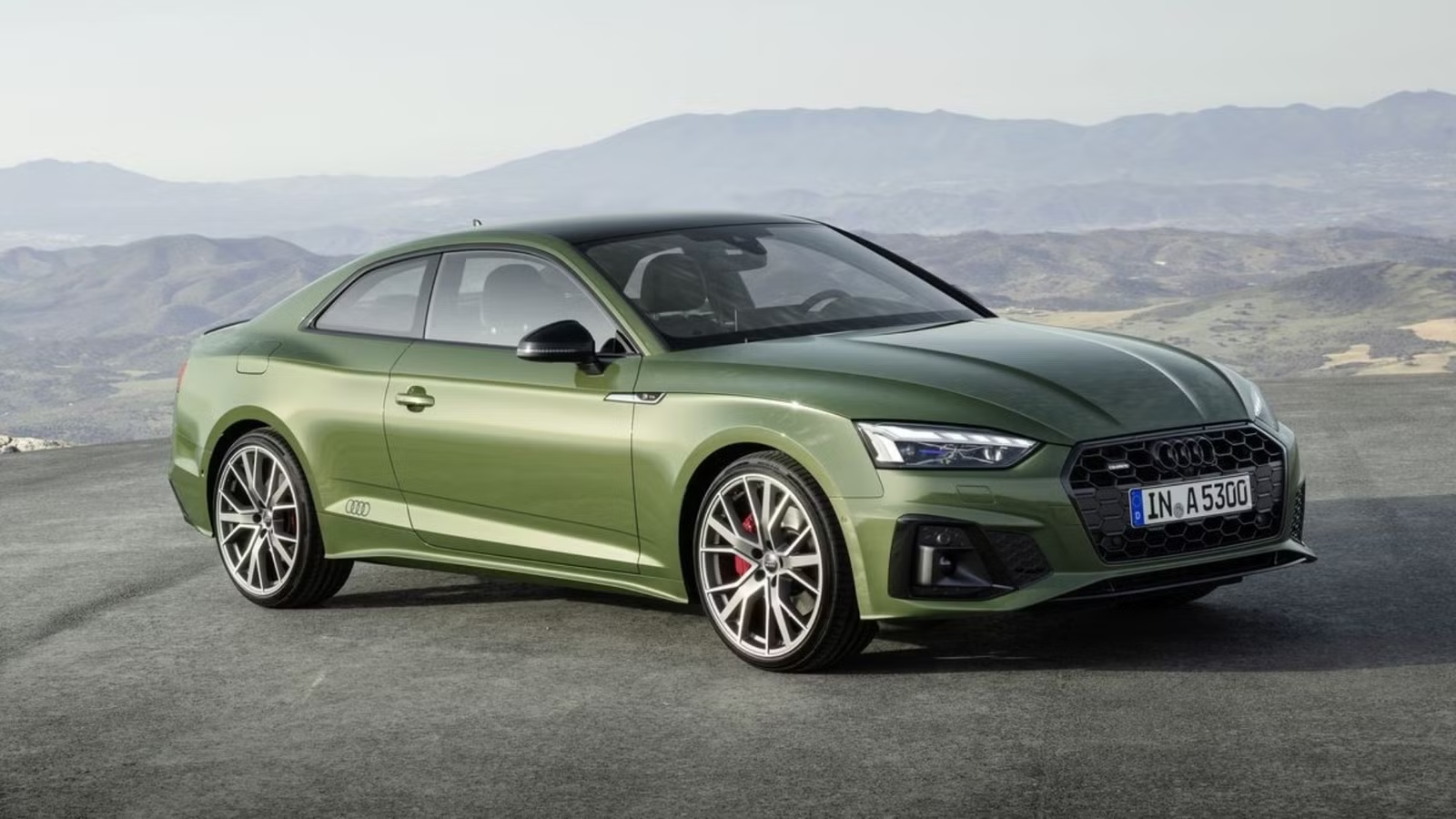
Shopping for a used Audi can feel like navigating a minefield — the brand’s reputation for cutting-edge engineering is matched only by its reputation for eye-watering repair bills. But not every model year is created equal, and some genuinely stand out as smart buys. To cut through the noise, we dug into a major Consumer Reports reliability study covering more than 150,000 vehicles to identify the specific model years worth your money. Only models with at least five years of data were factored into the brand’s overall reliability rating.

We then examined every model included in the study to pinpoint which model years delivered the strongest reliability scores. Each model’s rating is based on the volume of owner-reported problems, ranging from minor issues such as trim quality to major failures involving the engine or transmission.
In the study, Audi earned a total “Reliability Verdict” score of 39/100, placing the German luxury brand 16th out of 26 manufacturers. That put Audi behind parent company Volkswagen in 14th, Mercedes in 10th, and BMW in 7th. Lexus led all brands with a score of 75/100.
Why has Audi continued to struggle with reliability despite producing several standout models over the years? We’re going to answer that question as we dive into the major Audi platforms of the last decade and identify the exact model years worth buying. Warranties? Get a good one — you’ll want it.

2013 Audi Q5
KBB Fair Purchase Price: $6,175 – $9,175
Our first Audi on the list is the facelifted first-generation 2013 Q5 compact crossover SUV. The 2013 model year brought a significant overhaul to the first generation of Audi’s top-selling SUV — none more critical to long-term reliability than a new family of Audi engines, earning this specific model year a 4/5 Reliability Verdict.
Three engine options were offered, including the new 2.0-liter “TFSI” turbocharged inline-four, which replaced the dated but beloved 3.2-liter V-6 that had been the previous standard. The new supercharged “3.0T” V-6 remains the most desirable of the available options, while buyers who prioritize efficiency over performance will find the short-lived 2.0T hybrid model delivers impressive fuel economy (26 MPG combined).
Pros
- The supercharged V-6 model is top-class
- Efficient hybrid model (30 mpg highway)
- Quality interior
Cons
- The V-6 model’s start/stop technology is rudimentary
- Sporty all-around, but has an artificial steering feel
- Audi Drive Select is unnecessary extra $$$
2014 Audi A5
KBB Fair Purchase Price: $8,950 – $11,300

Next on the list is the facelifted first generation of Audi’s athletic yet comfortable coupe, the 2014 A5. 2013 was a pivotal year for Audi, as the 3.2-liter V-6 that had long been the brand’s staple was retired in favor of the more efficient 2.0-liter turbocharged inline-four — a unit that would go on to underpin the majority of Audi’s lineup, including the A5.
Although not an exceptional model year, the 2014 A5 scored a solid 3/5 Reliability Verdict — still the best result of any year within its lengthy generational lifespan from 2008 to 2017.
Pros
- Sleek styling in a variety of body styles
- Understated quality interior
- Comfortable ride and quick handling
Cons
- 2.0T is not the fastest in its segment
- Rear passenger space is very tight
- The FWD Cabriolet model is a downgrade
2016 Audi A3
KBB Fair Purchase Price: $9,700-$13,300

Our first and only Audi A3 entry comes from the third generation, which was available as a sedan or convertible from 2015 through the 2020 model year. The 2016 stands out as the clear outlier of its generation, scoring a 4/5 Reliability Verdict — a stark contrast to the 2018 model year’s dismal 1/5.
We cannot say with certainty why there is such a dramatic gap in reliability between these two model years. However, after 2017 all available engine variants were dropped except the larger 2.0-liter turbocharged unit, which became the sole powertrain for Audi’s most compact and affordable model.
Pros
- Entry-level, but doesn’t cheap out
- A true compact car in a sea of oversized vehicles
- Fun and flexible powertrains that make you smile
Cons
- Rear passenger space
- Trunk space
- Audi’s proprietary USB interface
2018 Audi Q3
KBB Fair Purchase Price: $14,000-$15,250

Audi made its priorities clear with the first-generation Q3 compact crossover SUV: luxury utility first, sporting pretense a distant second. The 2.0-liter turbocharged inline-four is the only engine on offer, and it is undoubtedly this otherwise impressive compact SUV’s weak point.
Another disappointing detail that cost the Q3 even more sporting credibility was the use of an outdated six-speed automatic transmission — Audi’s dual-clutch unit was available but would have raised the price. That is part of the compromise you accept with the 2018 Q3, and a factor worth weighing against its impressive 4/5 Reliability Verdict.
Pros
- Plentiful standard options compared to the competition
- Whisper quiet cabin
- Top-in-class comfort and quality
Cons
- Lacks Apple CarPlay/Android Auto
- It doesn’t drive as well as it should, given its compact size
- 22 MPG combined is disappointing
2019 Audi Q5
KBB Fair Purchase Price: $16,100-$19,100

Our second and final Audi Q5 on the list is the second generation, which ran from the 2018 to 2023 model years. The supercharged V-6 of the previous generation has been replaced by a single engine option: the 2.0-liter turbocharged inline-four that by this point forms the very backbone of Audi’s powertrain lineup. In this application it doesn’t quite match the power or torque of the previous generation’s high-strung V-6, but it gains three MPG (24 MPG combined) and earns a 4/5 Reliability Verdict.
Performance enthusiasts need not despair — the high-strung SQ5 model carries the torch, packing the successor to the previous generation’s 3.0-liter V-6. It drops the supercharger in favor of a more efficient single twin-scroll turbocharger, developed in part through joint engineering with brand partner Porsche. Fuel economy is on par with the old 3.0T at 21 MPG combined, but the new SQ5 is considerably quicker.
Pros
- Top-in-class interior design and features
- A beautiful blend of performance and luxury
- Audi’s best-selling vehicle
Cons
- Not the best in the oversaturated field of 2.0-liter turbocharged inline-four platforms
- Less cargo space than you’d hope
2019 Audi A5
KBB Fair Purchase Price: $17,00 – $22,200

2018 marked the debut of the second-generation Audi A5 Coupe, riding on an all-new platform. The 2019 model year proved to be a standout, scoring 4/5 in both the Reliability Verdict and Owner Satisfaction categories.
You may notice by this point that without the 2.0-liter turbocharged inline-four, Audi’s lineup would look very thin indeed. This 2.0-liter EA888 engine is the thread holding the brand together, and in the second-generation A5 it receives a welcome power bump that sharpens the car’s character.
Pros
- Varied body styles available (coupe, convertible, and the Sportback 4-door hatchback)
- Audi MMI infotainment is one of the best available
- No-compromise comfort levels
Cons
- Rear seats still lacking in space
- Extended warranty is a necessity
- Too many unnecessary options
2020 Audi A4
KBB Fair Purchase Price: $16,950-$23,000

Next on the list is the fifth generation of the Audi A4 Sedan, which was available from 2017 through the 2024 model year, earning a 4/5 Reliability Verdict. The 2020 facelift represents the high-water mark of this generation’s reliability run. Interestingly, that same model year also received a 1/5 Owner Satisfaction rating, meaning current owners would be unlikely to buy the same car again — despite its strong reliability score.
Despite this, the facelifted A4 Sedan clearly excels in more areas than it falls short. You’ll find yourself nitpicking to find real criticisms, and it doesn’t feel like a stretch to call it a well-balanced luxury sports sedan.
Pros
- Doesn’t cheap out in its overall performance capability
- Updated top-in-class infotainment options
- Better than advertised fuel economy
Cons
- The entry-level 40 TFSI model is underpowered
- Virtual Cockpit only available with Premium Plus trim
- Deserves more responsive steering feel
2020 Audi A4 Allroad
KBB Fair Purchase Price: $20,100-$22,800

So you want a Subaru Outback but are tired of the same vanilla flavor over and over again? The 2020 Audi A4 Allroad is a well-rounded, rugged luxury wagon with no real competition in its segment, and it backs that up with a 4/5 Reliability Verdict.
If the Subaru wagon is plain vanilla, this Audi wagon is hazelnut — richer, more refined, and more interesting. The facelifted 2020 model year stands out among all available options from this third generation, which ran from 2017 to 2023.
Pros
- Why have an SUV when you can have this?
- The last of a dying breed
- Ultimate utility champion
Cons
- Automatic transmission tuning is a bit slow despite the capable unit
- Not quite a “sport” wagon
- Cannot tow
2022 Audi A5
KBB Fair Purchase Price: $25,700-$33,000

The 2022 model year marks a genuinely significant moment in Audi’s recent history. The 2021 model year had introduced Audi’s 12-volt mild-hybrid system across models including the A5, and for 2022 Volkswagen Group rolled out the “Evo4” — the fourth generation of the proven 2.0-liter EA888 turbocharged inline-four engine.
The Evo4 2.0-liter is the latest and greatest iteration of the Volkswagen Group’s pioneering turbocharged platform, raising the bar for performance, efficiency, and reliability across Audi’s lineup. These updates give the 2022 A5 Coupe the rare distinction of a 5/5 Reliability Verdict, paired with a 4/5 Owner Satisfaction rating.
Pros
- The peak of the brand’s staple 2.0-liter turbocharged engine
- The perfect blend of all of Audi’s positive qualities
- An interior that exudes thoughtful design
Cons
- Certain Premium Plus trim options should be standard
- The S5 model isn’t as fun as its rivals
2023 Audi A5
KBB Fair Purchase Price: $28,600 – $35,000

The 2023 A5 Coupe builds on the previous year’s success, adding several new standard features including Matrix LED headlights and standard S-line exterior upgrades. There are no significant issues with the 2023 model, and with the Evo4 variant of the 2.0-liter EA888 at its heart, it delivers the most robust engine platform Audi has offered in the past decade.
The S5 performance variant remains the one genuine gripe of the generation — its restrained styling simply doesn’t reflect the character of its turbocharged V-6 engine. From the outside, an S5 is nearly indistinguishable from a standard A5, which is a hard pill to swallow when you’re paying a significant premium for a more elevated experience. Even so, the A5 cements itself as the lifeblood of the Audi brand, embodying everything that makes a well-crafted German sports coupe worth owning.
Pros
- On average, the most reliable Audi model and generation
- Versatile body styles (coupe, convertible, four-door hatchback)
- Matrix LED headlights now standard
Cons
- Storage space
- Too many premium options
- Long-term reliability of mild hybrid system
Sources: Audi, KBB

Related posts






Latest Post


No Comments