The Most Well-Rounded Hybrid SUV Under $40,000 That’s Criminally Underrated
10 minutes reading
Monday, 24 Aug 2026 13:00 0 56 autotech
For those who consider vehicles simply tools to help a family navigate the day, the modern SUV has to be regarded as the equivalent of a Swiss Army knife—it has to move people and provisions efficiently on weekdays, the family and its equipment comfortably on weekends, and it has to do it reliably and economically every day. The former is part of the SUV character; the latter has been addressed through new powertrain technology.
And to top it all off, the modern family SUV also has to fit into the household budget, which means a starting price below the federal new-vehicle MSRP average of about $50,000. There are a few choices that offer the well-roundedness to tick most of the boxes, and one in particular that has taken a huge leap in offering such a complete package.
Lo-angle front 3/4 shot of 2000 Toyota 4Runner in black parked on hill off-roadToyota
Before the turn of the century, many SUVs were essentially pickups wearing different wardrobes. They were bigger and more rugged than passenger cars, offered robust powertrains and drivetrains, and more interior room with genuine versatility. But fuel economy, ride comfort, and maneuverability were compromises that buyers had to make.
Then Honda and Toyota came along, and the SUV landscape began a seismic shift. Today’s compact SUV is closer in size and scope to a passenger car, with a hatchback’s cargo access and versatility. The transformation has widened the SUV’s appeal dramatically, leading to SUVs becoming the vehicle of choice for many families.
How The SUV Became The Well-Rounded Family Vehicle Of Choice
2007-2014 Chevrolet SuburbanGM
Today’s buyer wants an SUV that can handle the school run without guzzling fuel, park downtown without requiring a three-point turn, remain comfortable for hours on extended road trips, and provide year-round sure-footedness. Quietness, connectivity, driver assistance and usable rear seating matter just as much, and perhaps more, than the ability to tow a trailer and navigate trails.
The family SUV adds peace of mind for random circumstances—a massive snowstorm, a bulky snap purchase, a last-minute road trip, or an unexpected passenger. The one large compromise to SUV ownership remains costs like fuel consumption, though that has been well addressed by hybrid powertrains and purchase price. As an in-demand vehicle, the base prices of SUVs have steadily climbed to approach the new-vehicle average of 2020, when it rose over $40,000 for the first time.
Why The $40,000 Ceiling Matters
A 2026 Subaru Crosstrek parked by a lakeSubaru
The $40,000 line crossed in 2020 has risen to nearly $50,000 in just six years, but it’s still regarded as a valuable gauge for value, particularly in the notion that you have to spend more to get more (which is genuinely true, but still annoying). Well-rounded doesn’t mean the best of everything. It means balancing price, power, fuel-efficiency, driveline, safety and interior space, comfort and versatility.
And if family buyers can create the ideal balance of all those SUV traits and still pay less than $40,000, then they have a well-rounded package. Those vehicles aren’t readily available, since many of today’s inexpensive SUVs (and especially hybrid SUVs, which trend higher in base pricing) start in FWD before making a leap into AWD territory. One, however, started in AWD before making the leap to hybrid efficiency.
The 2026 Subaru Forester Hybrid Is Probably The Most Well-Rounded SUV
Standard AWD Plus Fuel-Efficiency With Most Trims Starting Under $40,000
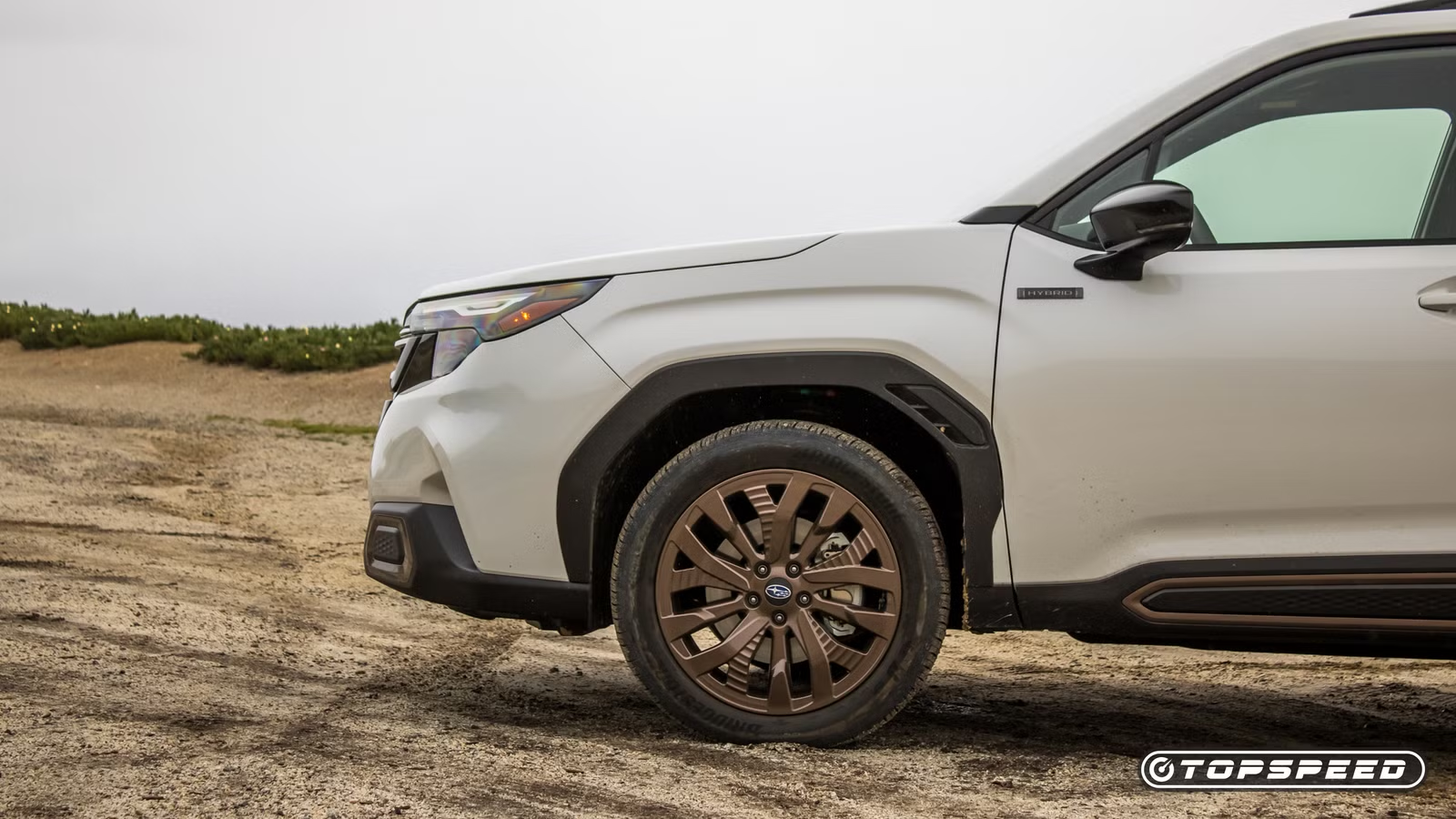
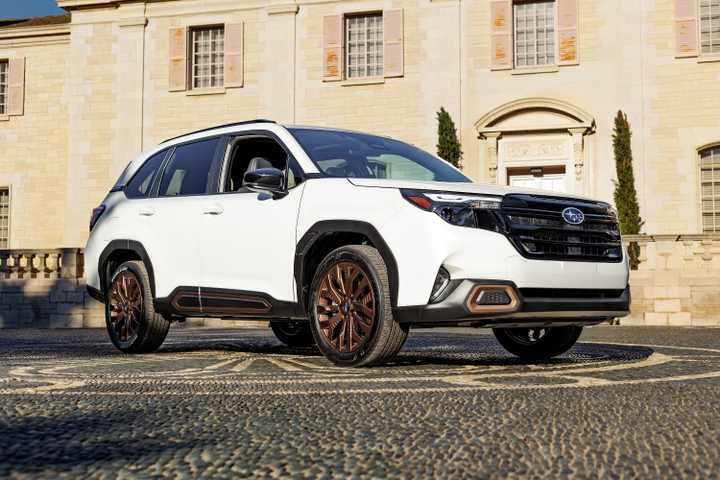
2025 Subaru Forester Hybrid front 3/4 shotChase Bierenkoven | TopSpeed
Introduced for the 1998 model year, the Subaru Forester has long understood its place as a compact SUV: an easy-to-use cabin with useful space for people and their stuff, and the one main thing that made people consider an SUV—all-wheel drive. The 2026 Forester continues that basic approach and adds a hybrid powertrain for the first time.
But perhaps its best-selling point is that all models, save one—the 2026 Subaru Forester Touring Hybrid—start under $40,000. And there’s no magic formula for making the Forester Hybrid work in the real world and on the family budget. All Forester Hybrids are good for moving people and things around year-round, and save you gas money doing it. Even the Touring Hybrid does not demand exorbitant money, at $41,546.
Hybrid Efficiency Without Abandoning Subaru’s Identity
The 2026 Subaru Forester Hybrid is not the most fuel-efficient hybrid SUV in the market, nor even in its segment or in the Subaru family. Its 2.5-liter boxer four-cylinder engine is notoriously less efficient than like-sized longitudinal ICEs used in some of its rivals, and Forester’s hybrid system preserves the boxer engine character and improves fuel efficiency dramatically, though it still trails the 2.5-liter hybrid systems used by its rivals.
The point was not in making the Forester Hybrid a fuel-economy leader, but in rewarding Subaru loyalists and buyers leaning toward Subaru’s vehicle strategy with an SUV that was considerably more efficient than its non-hybrid counterpart. Some competitors reward buyers looking for the most-efficient vehicle with outstanding fuel-economy figures, but they deliver smaller engines, special tuning and/or front-wheel drivetrains.
How The 2026 Subaru Forester Hybrid Fits The “Well-Rounded” Definition
2025 Subaru Forester Hybrid front seatsAmee Reehal | TopSpeed
Introduced shortly after the segment-pioneering Honda CR-V and Toyota RAV4, the Subaru Forester provided the added confidence of Subaru’s symmetrical all-wheel drive system from its introduction, immediately jumping ahead of the compact SUV mantra of “good-enough” front-wheel drivetrains. Its boxier dimensions also provided better cabin space utilization while preserving the traditional SUV look.
With the addition of a fuel-efficient powertrain, the 2026 Subaru Forester Hybrid added an obvious missing piece, though it took far longer to attain it than many of its rivals. It becomes efficient enough for daily commuting (not that it was horrible without a hybrid powertrain), remains powerful enough in everyday traffic, confident in snowy and trail conditions, and roomy enough for the nuclear family.
The 2026 Subaru Forester Hybrid isn’t all things to all customers. Rather, it competes by providing more of what family buyers are looking for, from affordability to value, from power to efficiency, from adequate traction to year-round confidence, and from comfortable space to effective versatility.
On that level, it surpasses the long-ago-held advantage of the family sedan, but so do its chief rivals today. The 2026 Subaru Forester Hybrid surpasses all of them on some level, though it doesn’t beat some of them on all levels. It breaks down as follows.
The 2026 Subaru Forester Offers AWD Confidence At An Affordable Price
2025 Subaru Forester HybridSubaru
The strongest argument begins with price. The 2026 Subaru Forester Premium Hybrid starts at $34,730, leaving meaningful room below the $40,000 ceiling for added equipment and options. That puts it within strikingdistance of the segment-leading 2026 Toyota RAV4’s LE AWD model at $33,300 (though the front-drive LE starts $2,000 lower). But its combined horsepower output of 194 falls short of all its rivals, including 1.6-liter turbocharged powertrains in the 2026 Hyundai Tucson Hybrid and 2026 Kia Sportage Hybrid (231 horsepower and 232 horsepower, respectively).
As for efficiency, the Forester Hybrid is rated by the EPA at a well-balanced 35/34/35 mpg (city/highway/combined), which is on par with the smaller-engined Sportage Hybrid AWD (35/36/35) but trailing the segment-leading RAV4 (47/40/43), which uses a 2.5-liter inline four-cylinder hybrid powertrain.
The 2026 Subaru Forester Outdoes Rivals In Cabin Space And Versatility
The 2026 Subaru Forester outdoes all its rivals in passenger volume, providing 106.6 cubic feet, which exceeds the slightly smaller 2026 Toyota RAV4’s 98.9 cubic feet. In terms of cargo space, the Forester’s 27.5 cubic feet behind the rear seat expands to 69.1 cubic feet when the rear seat is folded. That nearly matches the smaller RAV4’s 70.1 cubic feet (37.8 behind the rear seat) and the 2026 Honda CR-V Hybrid’s 71.8 and 36.3 cubic feet, respectively. The takeaway is that Forester’s seating positions are roomier, though passengers can take less stuff when it’s loaded up.
The 2026 Subaru Forester Hybrid Is Ready To Handle Real Life
The 2026 Subaru Forester Hybrid features a more upright cabin, which helps load in people and load up cargo. On the road, its compact size and well-balanced efficiency reward the driver with predictable maneuverability and efficiency, regardless of whether it’s negotiating city streets, suburban mall parking lots or open ribbons of highway.
The rivals each have compelling attributes. The Toyota RAV4 combines relaxed cabin ambience with unequaled hybrid efficiency. The Kia Sportage Hybrid wrings 232 horsepower and 35 mpg combined from a 1.6-liter powertrain. Both require stepping up to get AWD, but the Forester does not ask buyers to choose between efficiency, sure-footedness, interior comfort and price. That matters.
The 2026 Subaru Forester Hybrid Is An SUV That Doesn’t Ask Buyers To Be Specific
2025 Subaru Forester Hybrid make badgeChase Bierenkoven | TopSpeed
Befitting the definition of “well-rounded,” the 2026 Subaru Forester Hybrid can be an efficient commuter or family shuttle during the week, an adventurous hauler on weekends, and a snow-belt traveler whenever the need arises, without requiring a different setup for each job. Starting at $34,730, it also saves its owner up to $2,250 in fueling costs over five years, according to the EPA.
It does not make buyers choose between low purchase price and AWD. It does not ask drivers to choose between power and efficiency. It does not ask cabin occupants to choose between seating room and cargo carrying versatility. The 2026 Subaru Forester Hybrid is ready to hit the road running, and keeps working long after the new-car smell wears off. As with all things, though, there are alternatives.
The 2026 Honda CR-V Hybrid Is A More Costly Alternative
Side profile shot of a grey 2026 Honda CR-V Sport Touring Hybrid driving in the rainHonda
The 2026 Honda CR-V Hybrid is the closest alternative to the Forester, besting it in efficiency and interior versatility, but only slightly. The CR-V’s biggest compromise is purchase price, where it starts about $2,500 higher for an AWD model, and likely won’t make that up in ownership costs over five years. Still, it has a more efficient 2.0-liter four-cylinder dual-motor powertrain that is 10-horsepower stronger and $100 less costly to run per year.
The 2026 Mazda CX-50 Hybrid Leans More Into Enthusiast Driving
2025 Mazda CX-50 Hybrid front 3/4 shotWilliam Clavey | TopSpeed
The 2026 Mazda CX-50 Hybrid attacks the all-around usefulness from a different angle. Starting at $34,750, it is on par with the 2026 Forester Hybrid, but its 2.5-liter four-cylinder hybrid powertrain is more powerful (219 horsepower) and more efficient (38 mpg combined). Also, its ride and handling characteristics lean toward driving dynamics. However, its interior is more constrictive (just 97 cubic feet of passenger volume and 29.2 cubic feet of cargo space behind the rear seats) and less versatile.










No Comments