
The Lexus LC 500 Trim Enthusiasts Buy For The V8, Not The Badge
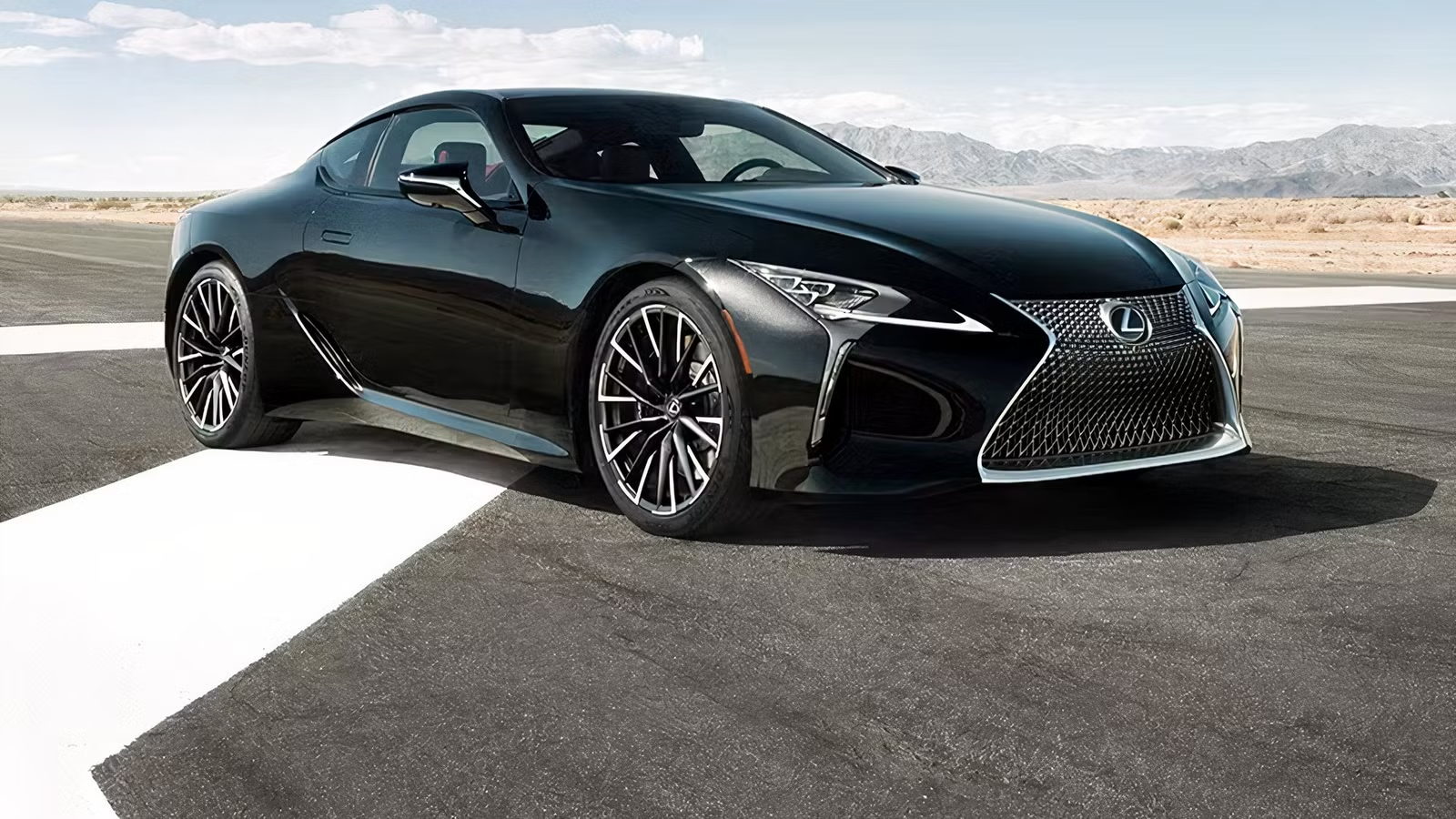
A quicker luxury coupe is easy to find. Finding one that delivers the sound, response, and high-rpm character of a naturally aspirated V8 is becoming considerably harder. That leaves the Lexus LC 500 in an interesting position: its strongest selling point has little to do with the luxury badge on its grille. For the 2026 model year, the LC 500 coupe retains its 471-horsepower 5.0-liter V8. You can chase faster acceleration elsewhere, but the Lexus makes a different argument every time its engine climbs toward redline. Choosing the right example means understanding which options enhance that experience, which change its handling, and which model-year updates deserve your money.
The V8 Is The Reason To Consider An LC 500
Naturally Aspirated Power Has Become A Rare Choice

Turbocharging gives manufacturers a practical way to produce substantial power from smaller engines. For a buyer, the result is often effortless acceleration without needing to explore the upper reaches of the tachometer. The trade-off is that the engine’s strongest performance can arrive before the experience has had much time to build.
The LC 500 takes a different approach. Its appeal comes from extending an acceleration run, hearing the exhaust change character, and feeling the engine respond as revs rise. Calling the entire car analog would overlook its automatic transmission and electronic chassis controls, but the naturally aspirated engine gives you a direct connection that increasingly distinguishes it from other luxury GTs.
The 2UR-GSE Rewards You For Using The Rev Range

Lexus’s 2026 materials specify 471 horsepower and 398 pound-feet, rather than the 472-horsepower figure associated with other applications of this engine family. The 2UR-GSE shares its lineage with the V8 used in the RC F and GS F, and its 7,300-rpm redline helps explain why its personality matters beyond the headline output.

The engine encourages you to keep using the available rev range instead of treating every acceleration request as a brief surge of torque. A 10-speed automatic and paddle shifters provide the connection to the rear wheels. You do not get a manual transmission, but you still get an engine whose delivery makes selecting and holding a gear worthwhile.
Lexus Kept The LC 500 True To Its Grand Touring Role
The Engine’s Character Fits The Car

Lexus actually explained its engine choice when introducing the LC: the naturally aspirated V8 was selected for its smooth, linear throttle response and emotional sound. That is a more useful answer than assuming the company rejected turbocharging solely because of reliability concerns. The documented decision centered on how the car should feel.
The established engine family also fits the thoughtful ownership case associated with Lexus, although familiarity cannot guarantee trouble-free service. You still have a sophisticated luxury coupe with expensive components. Its market position makes sense because it combines that engine experience with the comfort expected of a grand tourer, rather than trying to win every performance comparison.
The Standard Coupe Already Makes The Essential Case

The standard LC 500 gives you the same V8 and transmission as a Sport Package car. Adding handling equipment does not unlock extra horsepower, a higher redline, or a fundamentally different engine. That matters when an optioned example carries a meaningful premium.
There is also no LC 500 F Sport trim in the U.S. lineup. The actual decision concerns a standard coupe and its available packages, with equipment varying across model years. If the engine is your main reason for shopping, a well-chosen standard car already delivers the central attraction without requiring every available chassis option.
The Sport Package Is The Enthusiast’s Choice With A Qualification
Its Hardware Adds More Than A Sportier Look

For 2026, Lexus identifies a Torsen limited-slip rear differential, rear performance damper, performance brake pads, and Alcantara-trimmed seats among the Sport Package’s equipment. Those additions give the package a stronger mechanical argument than an appearance upgrade. The differential is particularly relevant when you want to put power down while exiting a corner.
The seats deserve attention during a test drive, too. Extra support is useful only if the seat shape works for your body on a longer journey. Shopping used requires checking the original window sticker because Sport, Performance, and Dynamic Handling package descriptions should not be treated as interchangeable across the LC’s production run.
A Sharper LC Is Still A Grand Tourer

More chassis technology does not automatically produce a more satisfying car. In its instrumented 2018 LC 500 review, Car and Driver found the Performance Package car’s rear steering less natural near the handling limit and described the standard setup as having a calmer balance. Its subsequent 2019 test also favored the comfort of an example without the earlier car’s 21-inch wheel and rear-steering combination.
Those observations concern early cars, not a controlled comparison of today’s configurations. They nevertheless provide a specific reason to qualify the recommendation: seek the Sport Package for its useful hardware, but test rear steering separately rather than assuming it improves feel. Wheel diameter, tire construction, and tire condition also deserve attention because the way an LC handles imperfect pavement matters more often than its behavior at a racetrack’s limit.
The 911 Carrera Tests What Kind Of Driver You Are
The Porsche Makes A Stronger Sports-Car Argument

The 2026 Porsche 911 Carrera produces 388 horsepower and 331 pound-feet from its twin-turbocharged 3.0-liter flat-six. Despite having less horsepower than the Lexus, Porsche quotes 0–60 mph in 3.9 seconds, or 3.7 seconds with Sport Chrono. Lexus quotes 4.4 seconds for the LC 500 coupe, making the Porsche quicker by either manufacturer comparison.
That should help clarify your priorities rather than disqualify the Lexus. If rapid acceleration and a sports-car driving experience sit at the top of your list, the Carrera deserves serious consideration. If you want the engine itself to be the occasion, the LC offers a different reason to take the longer route. The BMW 840i and used Aston Martin DB11 broaden the GT conversation, but neither duplicates the Lexus’s naturally aspirated V8 formula.
The Lexus Makes A Different Daily-Driving Argument

Cabin usability depends heavily on which LC you buy. A 2024-or-newer example has a 12.3-inch touchscreen, replacing the earlier touchpad-centered interface. The Porsche’s steering-wheel mode switch keeps driving settings close at hand, while the Lexus places its drive-mode control beside the instrument binnacle; spending time with both layouts is more useful than judging them from photographs.
The Lexus is not automatically more practical because it is a GT. Edmunds lists just 5.4 cubic feet of coupe cargo space, while Porsche specifies a 4.8-cubic-foot front luggage compartment plus storage behind the front seats. Ownership costs also require more than a brand assumption: CarEdge projects $2,609 in LC maintenance and repairs over five years, but tires, insurance, fuel, and the condition of a used example can materially change your bill. Get actual service and insurance quotes for both cars before declaring a winner.
The Used Market Makes The Buying Decision More Specific
Test The Resale Claim Against Comparable Cars
CarEdge estimates that an LC 500 loses approximately 29 percent of its value over five years, retaining $74,628 from an assumed $105,600 purchase price. Its calculation assumes good condition and 13,500 miles annually. Under the same stated condition and mileage assumptions, CarEdge projects approximately 48 percent depreciation for a BMW M850i, giving the Lexus a favorable comparison with another V8 luxury GT.
That is a forecast, not proof that every LC retains value equally well. Other valuation services produce substantially different estimates, and mileage, specification, and transaction price matter. The figure also cannot establish why owners keep their cars. For a used buyer, its practical message is narrower: depreciation can reduce your entry cost without necessarily turning a desirable LC into a bargain-basement purchase.
Shop The Year And Equipment You Actually Want

The buying guide covers 2018–2026 LC 500 coupes, beginning with the launch model. For 2021, Lexus reduced the weight by approximately 22 pounds, revised suspension behavior, added Active Cornering Assist, and updated transmission logic. Android Auto also arrived, but the major touchscreen change came for 2024. A 2021–2023 car therefore offers driving refinements while retaining the earlier control interface.
Check recall completion before buying, particularly on early examples. NHTSA campaign 20V-012 included certain 2018–2019 LC 500s for a low-pressure fuel pump that could fail and cause stalling. Beyond that documented concern, an inspection should cover service history, leaks, brake wear, tire age, damaged wheels, underbody scrapes, and operation of the electronics. Choose the Sport Package if its hardware serves your driving, choose 2024 onward if cabin usability matters enough to justify the premium, and let condition outrank either preference. The right LC is the one that gives you a reason to enjoy its V8 without making you regret the example you bought.
Sources: Lexus, Car and Driver, Porsche, NHTSA, Edmunds, Kelley Blue Book

Related posts





Latest Post



No Comments