
The Japanese Motorcycle Worth Every Penny
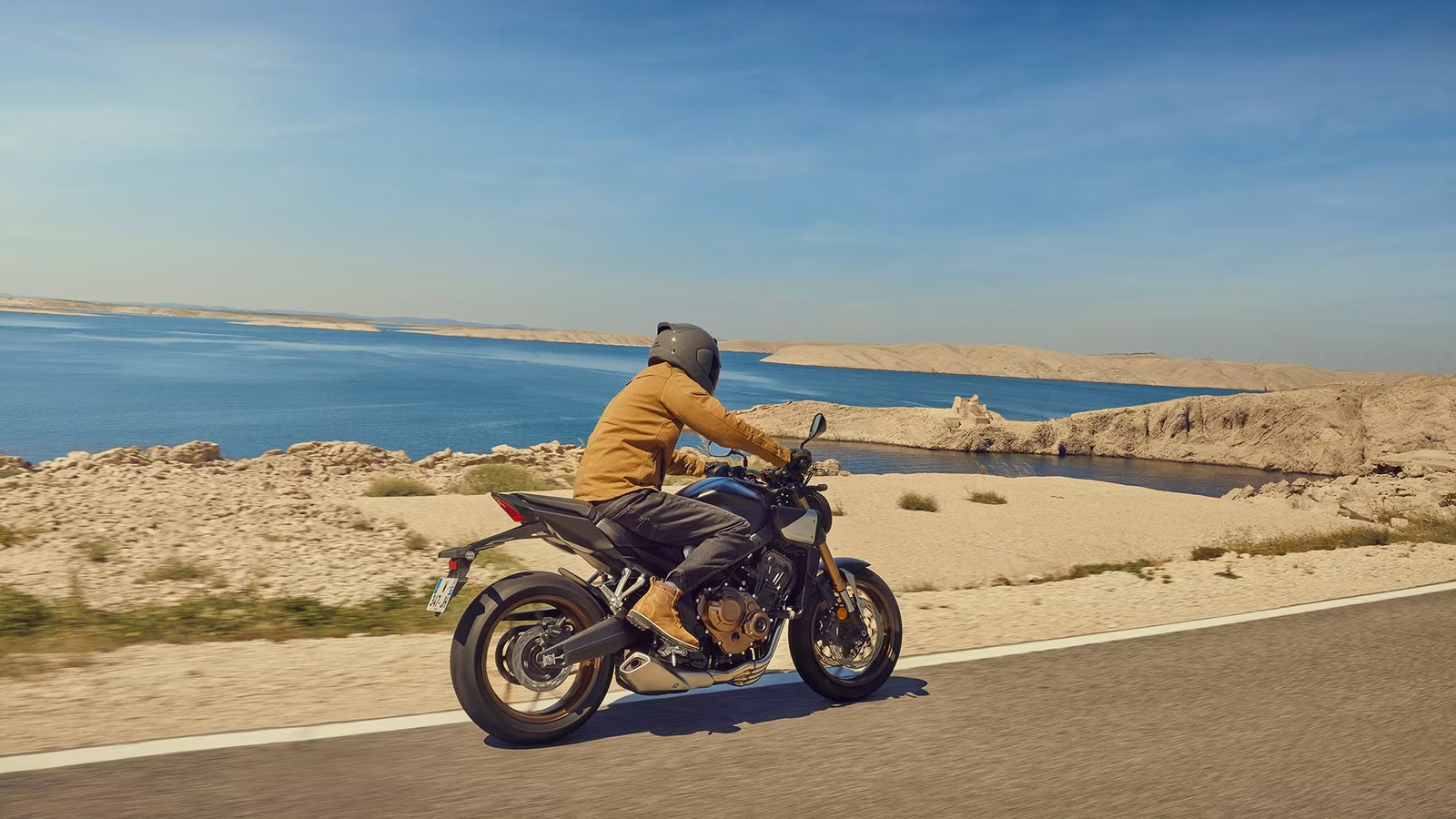
Once a category for incredible performance in small packages, the current crop of middleweight naked bikes have become ruthlessly sensible. Two cylinders spinning the quintessential 270-degree crank, packaged with tech and priced somewhere below five figures, now form the default template of the genre. And it works. Which, of course, is precisely why manufacturers keep using it.

The only downside being that another $1,000 often gets you a slightly different interpretation of essentially the same idea. That makes value harder to measure. Sometimes the better purchase is the motorcycle offering something genuinely different without charging exotic money for it. And Honda has just the right mix packed into a motorcycle that not only screams value for money but also for uniqueness.
Four-Cylinder Middleweights Are Becoming The Expensive Exception
There was a time when a Japanese four-cylinder middleweight hardly raised an eyebrow. Honda, Kawasaki, Suzuki, and Yamaha all built variations of the theme, irrespective of whether the result wore a fairing or a flatbar. Today, the economics of the class, along with the bid to save the polar bears, favors fewer cylinders to lower costs and emissions.

Parallel-twins simply package more tightly into a chassis, contain fewer major moving parts, and can deliver plenty of torque without chasing a high redline. That is why the current Honda CB750 Hornet, Suzuki GSX-8S, Yamaha MT-07, and Kawasaki Z650 all use two-cylinder engines. Triumph’s triples provide another route packing some character and unique aural experience, but four-cylinder options below liter-bike territory have become distinctly thin on the ground.

That change isn’t necessarily bad. Modern twins are lighter, punchier in the midrange, and better suited to the demands of real-world riding. What they don’t reproduce is the way a small-displacement inline-four gathers pace. Instead of giving you its strongest shove early on, it rewards the progression of revs, gear changes, and active participation from the rider’s will to twist the throttle harder.
The problem is that buying that experience usually involves accepting either supersport ergonomics, considerably more power than you need, or a higher price. A middleweight roadster that still uses four cylinders therefore occupies a much more interesting position now than it would have a decade ago. And of the less than handful sold globally, in the U.S., Honda sells the cheapest middleweight naked inline-four that you can buy brand-new.
The 2026 Honda CB650R Has Become More Interesting As The Market Moved Away From It

The 2026 Honda CB650R E-Clutch is essentially the latest refinement of an idea that Honda has kept alive while much of the class moved elsewhere. The CB650R replaced the CB650F for 2019, gained a Showa Separate Function Big Piston Fork (SFF-BP) for 2021, then received its most significant recent update for 2024 with revised styling, a 5-inch TFT display, and Honda’s E-Clutch system. The current motorcycle is a combination of an old-school engine layout and very current tech that now gives it a clearer identity than ever before.
The High-Revving Engine Is Happiest Where Parallel-Twins Tap Out

Honda’s 649cc DOHC inline-four produces 94 horsepower at 12,000 rpm and 46.5 pound-feet of torque at 9,500 rpm. Those figures tell you immediately what this engine isn’t trying to do. There is no huge slab of low-rpm torque waiting the moment you crack the throttle, and riders accustomed to modern 650-800cc engines may initially mistake it for a dud of a performer. But this is, after all, a Honda CB.
Keep revving and your perspective changes thick and fast.

The short-stroke inline-four gets stronger as the tachometer climbs, with peak output appearing on the tacho where most street twins would be screaming for mercy. Honda also uses specific valve timing, piston design, twin intake ducts, and a four-into-one exhaust to shape the engine’s power delivery more precisely rather than turning it into a peaky relic. But the inherent trait of a lower-capacity multi-cylinder engine remains, and is what makes the CB650R all the more exciting.

That behavior, however, isn’t a fixed state. Its progressiveness asks more of the rider, but it also gives ordinary road speeds some texture. You can leave it in a taller gear and ride casually, or downshift to access the upper reaches of the rev range when the road permits. With so many current middleweights designed around accessible midrange punch, having to work an engine a little is simply a unique way of riding that barely exists anymore.
Features Aren’t The CB650R’s Forte

The engine sits in a steel diamond frame rather than aluminum. The 41mm Showa SFF-BP fork is devoid of adjustment, while the rear shock provides preload adjustment only. Twin 310mm discs use radial-mounted four-piston Nissin calipers, and, thankfully, ABS is standard. Honda Selectable Torque Control (HSTC) is standard too, reducing engine power when rear-wheel slip is detected, although this traction control system is only limited to on or off rather than offering adjustable intervention levels.

At 456 pounds ready to ride, the CB650R isn’t particularly light for this class either. The extra mass is partly the weight of four cylinders and the E-Clutch hardware. All in all, basic is the underlying theme in the tech department, but being a Honda, it all comes together to simply work as intended. Its 31.9-inch seat, upright bar, and 4.1-gallon tank, instead, reinforce the fact that Honda has built a performance-oriented road bike that happens to rev like a much more serious machine.
E-Clutch Solves The Boring Part Without Automating The Fun

The E-Clutch is such a well-thought-through, versatile system. In practice, its appeal lies in that it leaves the six-speed gearbox and conventional shift lever alone. The rider still chooses every gear, but electric actuators operate the clutch when pulling away, stopping, upshifting, or downshifting. The physical clutch lever remains, and using it immediately overrides the system.

That means city traffic no longer requires repeated clutch-lever work, yet a quick series of shifts through the upper half of the rev range can happen without touching the lever either. The system is particularly smooth at lower engine speeds, an area where conventional quickshifters can feel clumsy. And it even prevents stalling when stopping. The E-Clutch therefore doesn’t turn the CB650R into an automatic motorcycle, it simply removes one repetitive control input.
At $8,699 The Math Finally Matches The Motorcycle

The 2025 CB650R E-Clutch carried a base MSRP of $9,399. Honda lowered the 2026 price to $8,699 while leaving the motorcycle mechanically unchanged. That $700 reduction matters because it moves the CB650R from being an interesting but relatively expensive alternative into a much tighter part of the middleweight market. This isn’t a stripped version created to hit a lower number. The E-Clutch remains standard, as do ABS, traction control, radial front calipers, the inverted Showa fork, full LED lighting, and the TFT display.

More significantly, so does the 649cc inline-four. And it’s the engine where its value becomes easier to defend. The individual components aren’t unprecedented, and several rivals offer deeper electronics or lower weight. What is difficult to find for $8,699 is this particular combination. Honda has effectively reduced the price at the same time that the market around the CB650R has made its engine layout more unusual, with it currently being the only sub-700cc inline-four streetfighter in the segment that you can buy as new.
Source: Honda

Related posts

Latest Post


No Comments