
The Only Gas-Powered American Cars That Can Reach 60 MPH In Under 3 Seconds
Horsepower bragging rights and top-speed claims are fun to debate, but nothing cuts through the noise quite like a 0–60 mph time. It’s the one performance benchmark that actually maps to real life: a hard launch from a stoplight, a highway on-ramp merge, or simply the satisfaction of knowing exactly how hard your car can hit. Most of us will never see a closed road long enough to safely explore V-max, and chasing lap times at a track adds up fast. The sprint to 60, though, is something every driver can feel — and appreciate. It’s not a flawless measure of a car’s full character (some machines are barely in their power band by that point), but it delivers an honest, gut-level snapshot of acceleration.

With that in mind, we scoured the data for the only gas-powered American cars capable of reaching 60 mph in under three seconds. From iconic sports cars and modern muscle to state-of-the-art hypercars, they represent the pinnacle of American performance engineering. Designed in the relentless pursuit of speed, these vehicles have redefined what’s possible in the world of high-performance cars and put American ingenuity on the map in a way few others have.
2015-2019 Chevrolet Corvette C7 Z06
0-60 mph: 2.95 Seconds
Chevrolet Corvette C7 Z06 Performance Specs
|
Engine |
 58 autotech LT4 6.2-L Supercharged V8 |
|
Transmission |
7-Speed Manual, 8-Speed Auto |
|
Max Power |
650 Horsepower |
|
Max Torque |
650 LB-FT |
|
Top Speed |
205 MPH |
Chevrolet
Chevrolet’s mid-engine C8 makes for the fastest Corvette yet, but even the prior C7 generation could hit sub-three-second 0–60 mph times in the case of performance variants like the Z06. As the last front-engine Corvette in the line, the C7 represents the pinnacle of the sports car’s development up to that point, and it still holds genuine appeal for enthusiasts — even accounting for used C8 depreciation on the market.
If you’re after the quickest Z06 money can buy, seek out an example equipped with the Z07 package. Carbon-ceramic brakes, upgraded suspension, and a carbon fiber aero kit collectively allowed the C7 to compete with some of the world’s finest supercars while staying true to its American roots.
2005-2009 Saleen S7 Twin Turbo
0-60 mph: 2.9 Seconds
Saleen S7 Twin Turbo Performance Specs
|
Engine |
Windsor 7.0-L Twin-Turbo V8 |
|
Transmission |
6-Speed Manual |
|
Power |
750 Horsepower |
|
Torque |
700 LB-FT |
|
Top Speed |
248 MPH |
Saleen
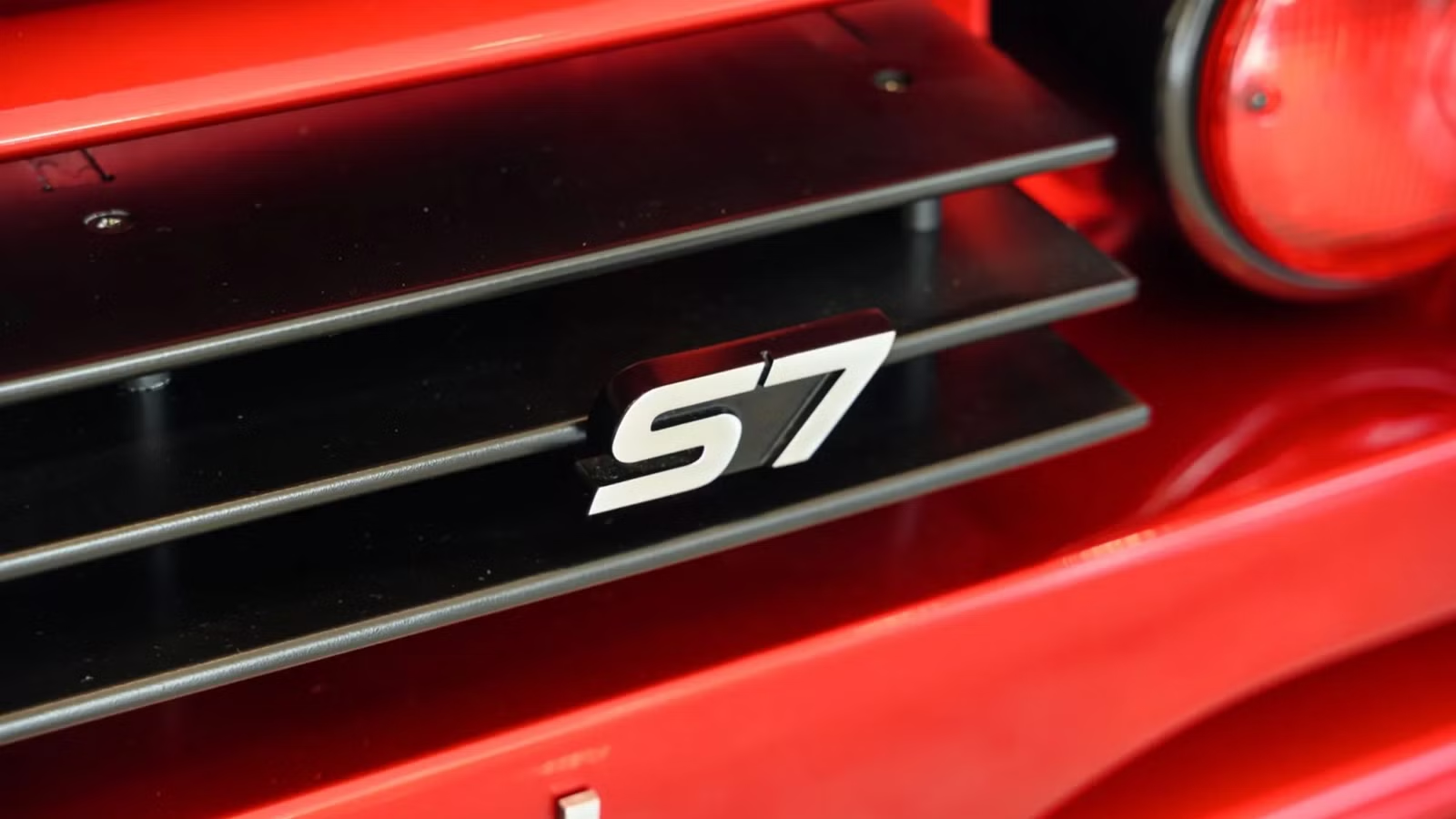
Like Roush and Shelby, Saleen is best known for its specialty Ford-based performance vehicles. However, Saleen stands apart from its fellow American tuning outfits because it built a car of its own design — and an incredibly quick one at that. To this day, the S7 ranks among the boldest American supercars ever produced, combining a refined aerodynamic design, a lightweight aluminum and carbon fiber chassis, and a mammoth 427-cubic-inch Windsor-based V8. While the standard S7 couldn’t quite crack the three-second mark in its sprint to 60 mph, the addition of the subsequent S7 Twin-Turbo and Competition packages was enough to do the trick.
2020+ Chevrolet Corvette C8 Stingray
0-60 mph: 2.9 Seconds

Chevrolet Corvette C8 Stingray Performance Specs
|
Engine |
LT2 6.2-L V8 |
|
Transmission |
8-Speed Auto |
|
Power |
490 Horsepower |
|
Torque |
465 LB-FT |
|
Top Speed |
194 MPH |
Chevrolet
Since its debut, the C8 Corvette has pulled off any number of exotic supercar upsets, so the move to a mid-engine layout clearly seems to be working in Chevrolet’s favor. The improved weight distribution and chassis balance have made the C8 remarkably capable in the corners, but it’s the LT2 engine paired with an 8-speed dual-clutch automatic that give the car its straight-line legs. You might be giving up the manual transmission of the previous C7 generation, but you gain a host of other refinements: a rigid aluminum frame, coilover suspension, and aerodynamic provisions throughout.
2017-2022 Ford GT
0-60 mph: 2.9 Seconds

Ford GT Performance Specs
|
Engine |
EcoBoost 3.5-L Twin-Turbo V6 |
|
Transmission |
7-Speed DCT |
|
Power |
660 Horsepower |
|
Torque |
550 LB-FT |
|
Top Speed |
216 MPH |
Ford
As much as we would have liked to include Ford’s track-bred GT MKII or MKIV, we didn’t feel that those cars fit with the rest of the ensemble — they’re not street-legal. Of course, even the ‘standard’ Ford GT produced from 2017–2022 has the ability to break three seconds on its way to 60 mph.
Between the carbon fiber monocoque chassis, the Le Mans-inspired aerodynamics, and the responsive steering, it was a bona fide weapon in its own right. While the Blue Oval’s halo car commands a significant premium even compared to faster Lamborghinis and McLarens, the GT is of a far more exclusive breed — Ford built just 250 cars a year over the course of the production run.
2019 Chevrolet Corvette C7 ZR1
0-60 mph: 2.85 Seconds

Chevrolet Corvette C7 ZR1 Performance Specs
|
Engine |
LT5 6.2-L Supercharged V8 |
|
Transmission |
7-Speed Manual, 8-Speed Auto |
|
Power |
755 Horsepower |
|
Torque |
715 LB-FT |
|
Top Speed |
212 MPH |
Chevrolet
Even with the launch of the C8 ZR1, Chevrolet’s 2019 Corvette C7 ZR1 remains a desirable item on the used market. And it’s for good reason — unlike ZR1s from other generations, the C7 was produced for just one model year. What’s more, it represents the last manual-transmission ZR1 to leave the Chevrolet factory, as the C8 ZR1 comes exclusively with an 8-speed dual-clutch automatic.
Beneath the aerodynamic bodywork — including a prominent front splitter and adjustable rear wing — sits Chevrolet’s supercharged LT5 engine. With 755 horsepower on tap, it boasted twice the grunt of the C4 ZR1 and 116 horsepower more than the C6 that preceded it.
2007-2009 SSC Ultimate Aero TT
0-60 mph: 2.78 Seconds

SSC Ultimate Aero TT Performance Specs
|
Engine |
LS6 6.3-L Twin Turbo V8 |
|
Transmission |
6-Speed Manual |
|
Power |
1,180 Horsepower |
|
Torque |
961 LB-FT |
|
Top Speed |
273 MPH (EST) |
SSC via Supercars
After founding SSC back in 1998, CEO and owner Jerod Shelby made waves with the release of his first hypercar — the Ultimate Aero — in 2004. At the time of its debut, the Ultimate Aero was the fastest production car on the planet, posting a 256.15-mph top speed measured over a two-way average. Not content to settle, SSC gave the Ultimate Aero even more firepower with the TT package.
Putting down 1,180 horsepower and 961 lb-ft of torque, it could hit 60 mph in just 2.78 seconds and claimed to be capable of 273-mph top speeds. Add lightweight carbon fiber bodywork, cutting-edge aerodynamics, and — of course — butterfly doors, and you’re left with one hell of an American supercar.
2012-2017 Falcon F7 Twin-Turbo
0-60 mph: 2.7 Seconds

Falcon F7 Performance Specs
|
Engine |
LS7 7.0-L Twin Turbo V8 |
|
Transmission |
6-Speed Manual |
|
Power |
1,100 Horsepower |
|
Torque |
600 LB-FT |
|
Top Speed |
200 MPH |
Falcon
Even if you’re familiar with niche names like Saleen and SSC, chances are you haven’t heard of the Falcon F7. That’s a shame, because Falcon Motorsports owner Jeff Lemke proved to the world that you don’t need a ludicrous budget to build a capable supercar. Beneath the carbon fiber and Kevlar composite bodywork, the F7 featured a bespoke aluminum and Kevlar monocoque chassis, a 7.0-liter LS7 engine sourced from a C6 Corvette Z06, and a six-speed gated manual transmission. Thanks to the tuning efforts of Lingenfelter Performance, the Falcon boasted a base output of 620 hp and 585 lb-ft of torque. As with many of these home-brewed American supercars, adding a pair of turbos pushed power well past 1,000 ponies.
2011-2017 Hennessey Venom GT
0-60 mph: 2.7 Seconds

Hennessey Venom GT Performance Specs
|
Engine |
LS7 7.0-L Twin Turbo V8 |
|
Transmission |
6-Speed Manual |
|
Power |
1,244 Horsepower |
|
Torque |
1,155 LB-FT |
|
Top Speed |
270.49 MPH |
Hennessey
Okay, so even though the Venom GT technically started its life as a Lotus Elise, we’re going to give the spot to Hennessey. After all, the Venom GT still ranks among the fastest cars in the world thanks to a blistering 13-second 0–186 mph time and a 270.49-mph top speed. To accomplish such feats, Hennessey gave the British lightweight a healthy dose of American grunt, ditching the 1.8-liter inline-four in favor of a 7.0-liter twin-turbocharged LS7 V8.
Weighing just 2,743 lbs dry, it produced 1,244 horsepower and 1,155 lb-ft of torque in coupe form. As if that wasn’t enough, the Hennessey Venom GT got even more power with the Spyder variant, pushing the total to some 1,451 ponies in 2016.
2022+ Chevrolet Corvette C8 Z06
0-60 mph: 2.6 Seconds

Chevrolet Corvette C8 Z06 Performance Specs
|
Engine |
LT6 5.5-L V8 |
|
Transmission |
8-Speed Auto |
|
Power |
670 Horsepower |
|
Torque |
460 LB-FT |
|
Top Speed |
195 MPH |
Chevrolet
Out of the gate, the C8 Corvette was so impressive that it singlehandedly redefined the price to performance ratio amongst the supercar segment. With the Z06, Chevrolet raised the stakes even further, producing a Corvette with the potential to make its European rivals genuinely uncomfortable. Rather than the 6.2-liter LT2 used in the Stingray and the E-Ray, it incorporates a 5.5-liter flat-plane-crank V8. On the road, that translates to 670 horsepower and 460 lb-ft of torque, with a redline that stretches all the way to 8,500 rpm. Spec the Z07 package — which unlocks additional aero, upgraded brakes, and stickier tires — and you have a genuine missile.
2021+ Hennessey Venom F5
0-60 mph: 2.5 Seconds

Hennessey Venom F5 Performance Specs
|
Engine |
Fury 6.6-L Twin Turbo V8 |
|
Transmission |
7-Speed Automatic |
|
Power |
1,817 Horsepower |
|
Torque |
1,193 LB-FT |
|
Top Speed |
300+ MPH (EST) |
Hennessey
Like Saleen, Hennessey pays the bills by transforming standard production cars into completely unhinged horsepower monsters. When Hennessey isn’t building cars like the Camaro Exorcist, though, the Special Vehicles team turns its talents to in-house creations like the Venom. As the second bespoke Hennessey supercar and a follow-up to the GT, the Venom F5 was designed with one purpose in mind: top speed. Thanks to a twin-turbo 6.6-liter V8, a lightweight carbon fiber construction, and a low-slung profile, it’s projected to surpass 300 mph. While that has yet to be officially verified, there’s no denying that the car is quick — just 2.5 seconds to 60 mph.
2020+ SSC Tuatara
0-60 mph: 2.5 Seconds

SSC Tuatara Performance Specs
|
Engine |
5.9-L Twin Turbo V8 |
|
Transmission |
7-Speed Auto |
|
Power |
1,750 Horsepower |
|
Torque |
1,322 LB-FT |
|
Top Speed |
295 MPH |
SSC
After taking the world by storm with the Ultimate Aero, SSC set its sights even higher with the Tuatara. When the car debuted in 2020, it was built with the express goal of breaking speed records. Power comes from a twin-turbo 5.9-liter V8 producing over 1,700 horsepower, and SSC kept the dry weight to a scant 2,750 lbs through an aerospace-grade carbon fiber construction. While the Tuatara’s 2020 record attempt faced some controversy, it has since completed subsequent attempts that have taken it as fast as 295 mph. Guinness World Record potential aside, a 2.5-second 0–60 mph time makes the SSC Tuatara plenty quick enough for the purposes of our roundup.
2025 Chevrolet Corvette C8 ZR1
0-60 mph: 2.3 Seconds

Chevrolet Corvette C8 ZR1 Performance Specs
|
Engine |
LT7 5.5-L Twin Turbo V8 |
|
Transmission |
8-Speed Auto |
|
Power |
1,064 Horsepower |
|
Torque |
828 LB-FT |
|
Top Speed |
233 MPH |
Chevrolet
The C8 Corvette generation has been defined by relentless innovation, and the ZR1 is its most dramatic expression yet. In addition to being the first factory-turbocharged Corvette ever built, Chevrolet claims it produces both the most powerful Corvette and the most powerful American production V8 in history. On the road, that means 1,064 horsepower and 828 lb-ft of torque — enough to reach 60 mph in a scant 2.3 seconds and cover the quarter-mile in 9.6 seconds when equipped with the ZTK performance package. In its quest for supercar dominance, the C8 ZR1 shattered no fewer than five lap records around the United States at the hands of GM’s development team.
2018 Dodge Challenger SRT Demon
0-60 mph: 2.3 Seconds

2018 Dodge Challenger SRT Demon Performance Specs
|
Engine |
Hemi 6.2-L Supercharged V8 |
|
Transmission |
8-Speed Auto |
|
Power |
840 Horsepower |
|
Torque |
717 LB-FT |
|
Top Speed |
168 MPH (Limited) |
Dodge
In 2018, Dodge revived the Demon nameplate for the first time since the Dart of the 1970s. It made for a fitting reintroduction: the Challenger boasted 840 horsepower, a host of specialty performance aids, and even a crate filled with upgrades designed to ready the car for gut-punching 9.65-second quarter-mile runs at 140 mph.
You’ll likely need to perfect your launch technique and pick a day with ideal conditions to match Dodge’s authoritative claims, but those numbers still add up to a seriously quick Challenger. It’s all the more impressive when you consider the car tips the scales at over 4,000 lbs.
2023 Dodge Challenger Demon 170
0-60 mph: 1.66 Seconds

2023 Dodge Demon 170 Performance Specs
|
Engine |
Hemi 6.2-L Supercharged V8 |
|
Transmission |
8-Speed Auto |
|
Power |
1,025 Horsepower |
|
Torque |
945 LB-FT |
|
Top Speed |
152 MPH |
Dodge
Taking the top spot on our list of the only gas-powered American cars to hit 60 mph in less than three seconds is the Dodge Challenger SRT Demon 170. As the last high-performance expression of the Challenger line, Dodge threw everything it had at the car to create a 1,025-horsepower strip-destroying speed machine.
On a prepped drag strip with a professional driver, Dodge claimed an 8.91-second quarter-mile at 151.2 mph. When it comes to 0–60 mph performance, that translates to times as low as 1.66 seconds. Under real-world conditions, the number is more likely around 2.2 seconds by MotorTrend’s estimation. Either way, a Dodge that can keep pace with a Bugatti is nothing to sniff at.
Sources: Dodge, Falcon, Ford, GM, Hennessey, Saleen, SSC, Supercars.

Related posts


Latest Post


No Comments