
The Inline-Triple Engine That Could Change What Riders Expect From Middleweights
Middleweight motorcycles, in the last few years, have been getting considerably better at doing more with less. After all, that’s what this segment was aiming to pursue. Middle-of-the-road didn’t have to mean a compromise, and the recent swarm of parallel-twins out there has proven this. Compact, inexpensive-to-manufacture motorcycles that also boast capable performance which riders can actually use on the street. The only tradeoff thus far has been that it’s all looking way too similar now.

Move upward and things become considerably more interesting, but also more expensive. Yamaha’s 890cc CP3 models show how much character and performance an inline-triple can bring, while Triumph’s Street Triple naked takes the concept closer toward serious sport-bike territory. There is now room between those two ends of the market for something with middleweight pricing, but one that offers considerably more middleweight performance.
The Middleweight Class Has Outgrown Its Old Definition
A decade ago, calling something a middleweight generally gave you a decent idea of what to expect. Engine capacities sat somewhere around 600cc to 750cc, with manageable power and relatively straightforward equipment. This also made for pricing that created a clear step between beginner-friendly motorcycles and genuinely fast machines.


That line is much harder to draw in 2026. Consider the naked bike middleweight genre, where Kawasaki’s Z650 S ABS produces 67 horsepower from its 649cc parallel-twin and costs $7,699. Honda’s 755cc CB750 Hornet E-Clutch starts at $7,999 and ups the power output and tech, while Suzuki asks $9,249 for the 776cc GSX-8S with a whole host of modern tech.
So the middleweight buyer is already getting considerably more motorcycle than what the displacement alone would suggest. What remains fairly consistent, however, is the engine architecture. Parallel-twins have become the segment’s default solution because they’re cost-effective and package neatly into a chassis, and that makes things a bit boring.

The next logical step doesn’t necessarily require moving straight into the $15,000 bracket. Adding a cylinder, another dose of horsepower, and upmarket tech that’s more accessible and cost-effective now is a solution that Triumph has figured out without even reinventing a product that they already had. All the while, packaging it at under $10K to signal the competition that the game has moved to a higher level.
The Triumph Trident 800 Finds The Gap That Everyone Else Left Open

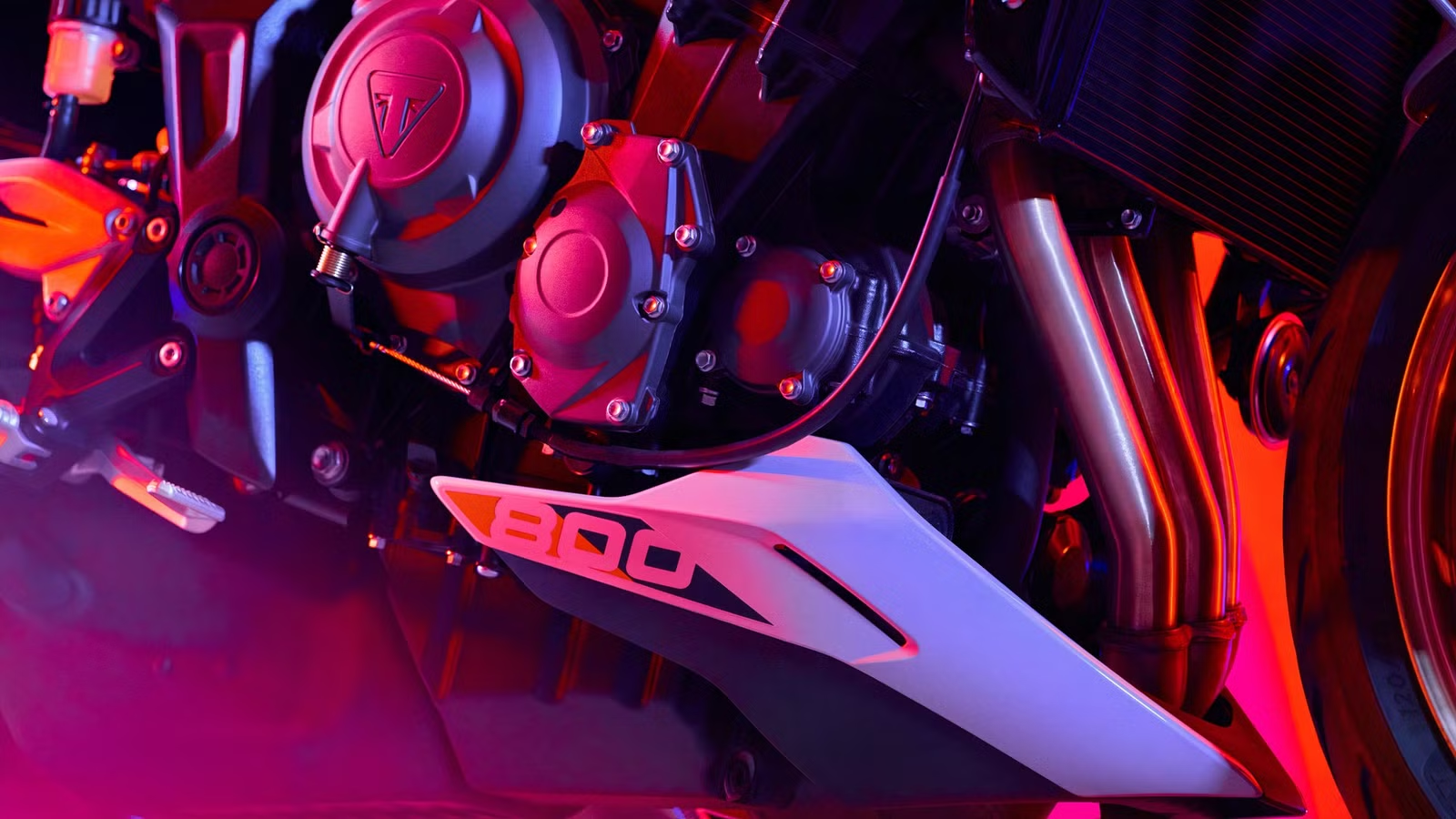
The name that Triumph chose to reinvent the middleweight category with is the Trident, not the 660, but the new for 2026, Trident 800. Priced from $9,995, Triumph calls it “Made to Upstage,” and for once, the advertising department has been handed plenty of mechanical evidence to justify the tagline. It gets a new 798cc inline-triple, with adjustable Showa suspension, and a comprehensive electronics package as standard. It weighs less than 441 pounds fully fueled, placing all that extra performance into a package that still belongs firmly in middleweight naked bike territory.
The 798cc Triple Brings A Different Kind Of Performance To The Class

Triumph’s liquid-cooled DOHC triple uses three individual throttle bodies and revs to 11,500 rpm. Just about 1,000 revs below, it peaks at 113 horsepower, and develops 62 pound-feet of torque at 8,500 rpm. That puts it roughly 46 horsepower clear of the Z650 S, a bike that is properly middle-of-the-road of this segment and costs about $2,300 less. But keep this amount in mind as you read further and see just how deftly Triumph adds value to the Trident 800, which is worth much more money.

A twin can make excellent midrange torque, while an inline-four generally rewards higher revs. Triumph’s triple spreads its 62 pound-feet of torque through a broad working range yet still has enough breathing room to build toward a properly energetic top end. Triple throttle bodies also contribute to the distinct intake whistle of the triple, before the engine develops the familiar Triumph howl as the revs climb. Character isn’t being simulated through the typical 270-degree firing intervals here.
Triumph Has Given The Chassis Hardware Enough Adjustability To Keep Up

Trident 800’s front end uses 41mm Showa SFF-BP inverted forks with separate compression and rebound adjustments while the rear shock provides preload and rebound adjustments. Mind you, adjustable damping remains one of the first things manufacturers tend to remove when building motorcycles to a price point, and an upgrade takes a sizable chunk away from the $2,300 on the Z 650 while power remains substantially lower.

Triumph has been similarly generous with the brakes. Twin 310mm front discs work with four-piston radial calipers and braided lines, while the standard Michelin Road 6 tires are unusually serious original equipment for a sub-$10,000 roadster. There’s also the Triumph Shift Assist bundled in the price, a bidirectional quickshifter which further separates the Trident from cheaper motorcycles where a quickshifter can still sit on the accessory list. Together with a fueled weight below 441 pounds, and relatively compact proportions, the hardware alone suggests that Triumph wanted something considerably sharper than a bigger-engined commuter wearing a sporty jacket.
The Electronics Package Moves The Goalposts Even Further

Horsepower gets the obvious attention, but the Trident 800 becomes harder to dismiss once its standard electronics are considered. An IMU-based system supports cornering ABS and lean-sensitive traction control, while Sport, Road, and Rain riding modes alter throttle response and intervention. Cruise control is standard as well, along with self-canceling indicators, LED lighting, smartphone connectivity, turn-by-turn navigation, and an LCD instrument cluster incorporating a color TFT screen.

This is where the “Made to Upstage” tagline starts making more sense. Triumph hasn’t tried to undercut basic middleweights given the seemingly unfair comparison to the Z650 S here. Instead, it has priced the Trident close enough to a GSX-8S, yet adds an entire cylinder, considerably more power, adjustable suspension, IMU-based electronics, cruise control, and that distinct triple soundtrack for just another $746. That comparison says more about the motorcycle and what it’s trying to do than simply calling it affordable.
The Yamaha XSR900 Shows How Much Motorcycle Triumph Is Offering For Under $10,000

The Yamaha XSR900 makes a particularly interesting comparison because it represents where the triple-cylinder roadster formula goes once the price climbs beyond the traditional middleweight bracket. Its 890cc CP3 engine sits in an aluminum frame, while fully adjustable KYB suspension, a six-axis IMU, lean-sensitive rider aids, cruise control, a third-generation quickshifter, and a five-inch TFT reinforce its more premium positioning. At $10,599, however, it also costs $604 more than the Trident 800.
Triumph isn’t matching the Yamaha component for component. The XSR900 has the more sophisticated aluminum chassis and offers finer damping adjustment at the rear, while Yamaha’s electronics allow considerably deeper intervention tuning, adding adjustable slide control, lift control, back-slip regulation, and customizable rider modes beyond the Triumph’s three preset modes.

What the Trident does is narrow the price-to-performance gap far more aggressively with the spread of value across all the features and components. That is ultimately what makes the 798cc triple interesting. The Trident 800 isn’t trying to become a cheaper XSR900. Instead, it brings much of the performance, hardware, electronic sophistication, and three-cylinder theater associated with motorcycles above $10,000 effectively into the middleweight price bracket.
Source: Triumph Motorcycles

Related posts





Latest Post


No Comments