
Kawasaki’s Corleo Hydrogen-Powered Robot Horse Is Headed For Production
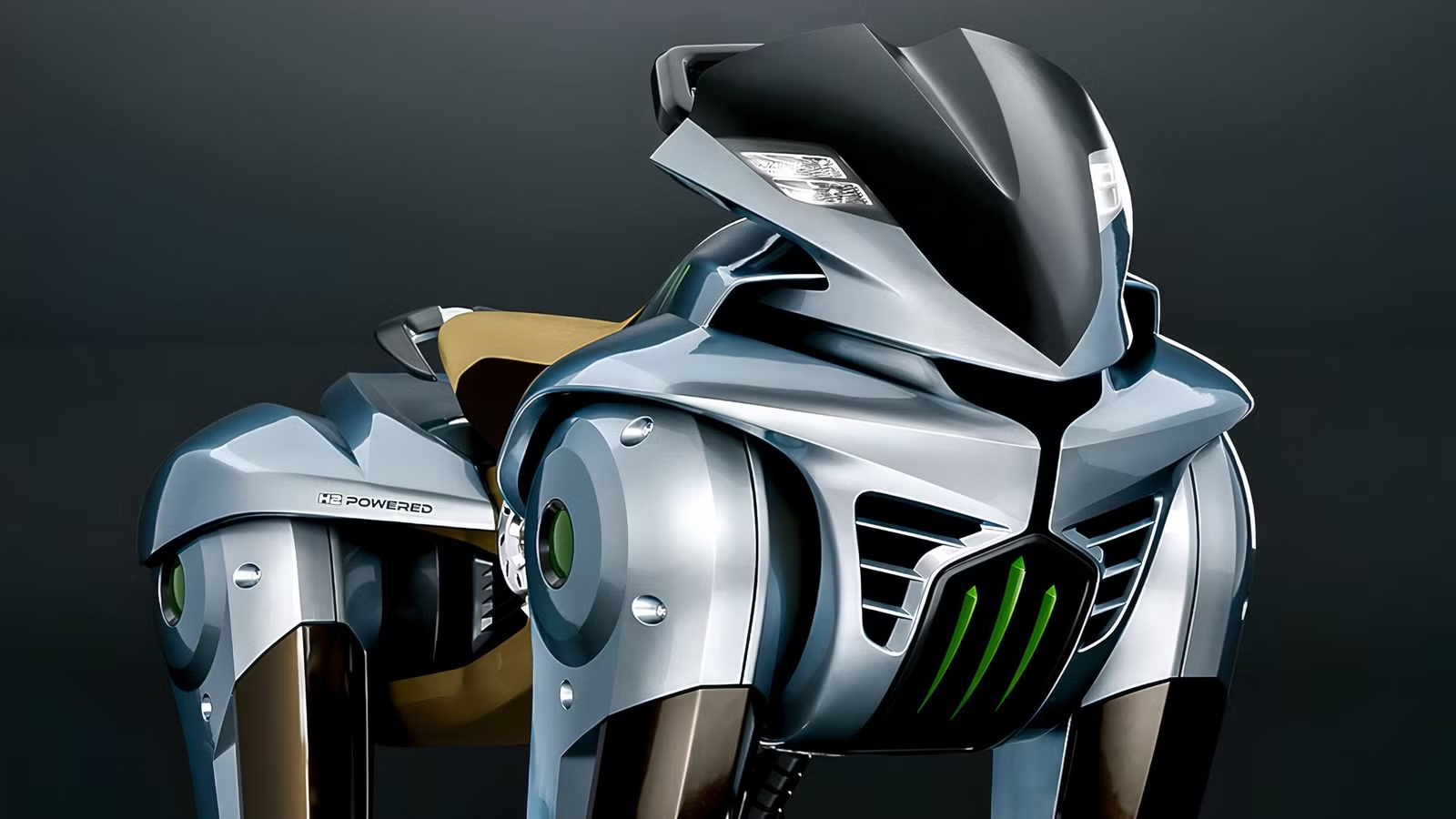
Kawasaki has spent decades building motorcycles, ATVs, and other vehicles designed to tackle challenging terrain. But its latest off-road creation takes an entirely different approach to mobility. Instead of two or four wheels, the Kawasaki CORLEO uses four robotic legs, a hydrogen-powered engine, and an unconventional riding system that borrows more from horseback riding than traditional motorcycling. While the CORLEO is certainly unusual, we’d remind readers that Kawasaki Heavy Industries, the parent company of Kawasaki Motorcycles Ltd., has its hands on nearly every conceivable mechanical pie imaginable. From bullet trains to container ships, turbine engines for power plants and military aircraft, and, of course, robotics, Kawasaki has the capability to do just about anything, which apparently includes building a hydrogen-powered robot horse.

Originally unveiled at Expo 2025 Osaka, the CORLEO returned to the spotlight at EICMA 2026 in Milan, where Kawasaki displayed a full-scale mock-up of the futuristic machine. More importantly, this isn’t simply another wild concept destined to spend eternity in a design studio. Kawasaki has officially launched a development program targeting commercialization in 2035, with plans to demonstrate a rideable version several years earlier.
Four Legs Instead Of Two Wheels
Kawasaki describes the CORLEO as a Robotic Multi-legged Vehicle, or RMV, representing an entirely new category of personal transportation. It’s designed to combine the terrain-crossing abilities of four-legged robotics with the handling characteristics and rider engagement associated with motorcycles.
The concept features four independently articulating legs capable of adapting to uneven surfaces. Unlike a conventional motorcycle or ATV, which relies on its wheels maintaining contact with the ground, the Corleo is envisioned to step over obstacles and negotiate rocky terrain using individually controlled limbs. Kawasaki ultimately wants the machine to walk, run, and even jump, although those capabilities have yet to be demonstrated on a fully functional vehicle.
The riding position also takes inspiration from motorcycles, with a saddle-style seat and a forward-leaning posture. However, riders won’t operate the machine using conventional handlebars and throttle controls. Instead, the Corleo is designed to respond to changes in body weight, similar to how a rider communicates with a horse. Electronic systems would translate these movements into coordinated actions across all four legs.
A Hydrogen Engine With An Unusual Job
Perhaps the most interesting part of the CORLEO’s proposed powertrain is its 150cc hydrogen-burning internal combustion engine. Rather than mechanically driving the vehicle’s legs, the engine generates electricity to power its electric drive systems. Hydrogen is stored in canisters positioned toward the rear of the machine.
This arrangement separates the combustion engine from the propulsion mechanism, allowing Kawasaki to explore electrically controlled leg movements without relying exclusively on a conventional battery-powered drivetrain. It’s an unusual application of hydrogen technology, particularly considering that Kawasaki is also developing hydrogen combustion technology for motorcycles.
However, Kawasaki hasn’t disclosed the Corleo’s horsepower, torque, hydrogen storage capacity, operating range, or top speed. The company also hasn’t published a production-ready specification sheet, making direct performance comparisons with motorcycles and other off-road vehicles impossible for now.
A Rideable Machine Is Targeted For 2030

Kawasaki established its dedicated Safe Adventure Business Development Team in December 2025, placing the project directly under the company’s president. That organizational commitment gives the Corleo a clearer development path than most futuristic vehicle concepts.
The first major milestone is scheduled for 2027, when Kawasaki aims to complete a riding simulator designed to refine the CORLEO’s handling and operating characteristics. The company also intends to explore applications for the simulation technology in gaming and esports, potentially allowing people to experience the concept virtually before a physical version becomes available.
By 2030, Kawasaki plans to unveil a new version of the CORLEO at Expo Riyadh in Saudi Arabia, marking a stage when people could actually ride the vehicle. The company is also considering its use as an official mobility solution for security personnel at the event. The ultimate target is 2035, when Kawasaki hopes to commercialize a CORLEO capable of walking, running, jumping, and handling off-road terrain. Initial applications are expected to focus on tourism and recreational activities rather than replacing conventional motorcycles or ATVs.
An Ambitious Concept With Plenty Left To Prove

The CORLEO represents an intriguing combination of Kawasaki’s motorcycle engineering, robotics expertise, and hydrogen research. However, the machine displayed at EICMA 2026 was a full-scale mock-up rather than a working prototype, and several fundamental questions remain unanswered.
Weight, durability, energy consumption, maintenance requirements, and operating costs will all play major roles in determining whether a four-legged vehicle can become commercially viable. The complex mechanical and electronic systems required to coordinate its legs also present challenges that conventional wheeled vehicles don’t face. We assume our readers have all seen Star Wars: Episode V – The Empire Strikes Back (1980), and saw how well things went for the AT-AT (All Terrain Armored Transport), so, maybe Kawasaki will do well to avoid snowy battlefields for the time being.
Still, Kawasaki’s decision to pursue commercialization makes the Corleo more than an attention-grabbing design study. It remains a long way from production, but if the company succeeds, the next generation of off-road adventures might involve considerably more legs than wheels.
Kawasaki Corleo Photo Gallery:
Source: Kawasaki

Related posts



Latest Post



No Comments