
Nissan Gave Its Cheapest SUV AWD And Sent It After The Subaru Crosstrek
Subaru has spent years turning the small, lifted AWD crossover into something close to its own private business. The Crosstrek mixes hatchback dimensions, useful ground clearance, standard all-wheel drive, and just enough trail ability to make a muddy campsite feel like an expedition. Now Nissan wants some of that action, and its latest answer takes the brand’s cheapest SUV, adds real traction hardware and outdoor gear, then points it squarely at Subaru’s formula.
Affordable AWD Crossovers Aren’t As Cheap As They Used To Be

Shopping for an inexpensive crossover sounds easy until all-wheel drive enters the conversation. A buyer may want something short enough for a tight parking space, tall enough to clear a snowy driveway, useful enough to swallow camping gear, and cheap enough that the monthly payment does not start impersonating a mortgage. Add AWD to that list and the field quickly gets thinner. Some small SUVs offer plenty of space but sit low, others start cheap with front-wheel drive, then make buyers climb the trim ladder before AWD becomes available. Finding compact dimensions, decent clearance, AWD, cargo room, and a genuinely low price in one vehicle takes more work than it should.
That explains why the Subaru Crosstrek has become such an obvious measuring stick. For Subaru, AWD is not an expensive winter-weather add-on – every 2027 Crosstrek gets Symmetrical All-Wheel Drive, and even the ordinary versions provide 8.7 inches of ground clearance. Pricing starts at $26,995 before Subaru’s $1,475 destination charge, putting the delivered entry price at $28,470. It also gets a 180-horsepower 2.5-liter flat-four for 2027. None of those numbers sound outrageous on their own, but their value comes from getting them together in one small vehicle without needing an expensive off-road trim.
Competitors often manage only part of that trick. A cheap urban crossover might offer AWD, but only after options push it toward the price of a larger compact SUV. Another may wear enough black plastic to frighten a recycling bin while leaving its ride height and traction hardware largely unchanged. Then there are models that deliver decent ground clearance but remain front-drive at the bottom of the range.

AWD Alone Wouldn’t Be Enough To Challenge A Subaru

Four driven wheels alone would not make a convincing Crosstrek rival, though. Subaru has spent decades attaching a broader identity to its AWD system. The Crosstrek combines useful clearance, X-MODE traction management, hill-descent control, roof-carrying ability, compact dimensions, and styling that suggests the owner may occasionally leave pavement on purpose. None of that turns a normal Crosstrek into a rock crawler, but that misses the point. It offers believable everyday adventure capability without the weight, fuel use, price, or parking headaches of a traditional body-on-frame off-roader. Subaru essentially sells hiking boots that remain comfortable in the grocery store.
Any serious challenger therefore needs more than an AWD badge glued to the hatch. It needs enough clearance to avoid scraping its belly on rutted tracks, software that understands loose surfaces, and some way to control speed on steep descents. Outdoor buyers also notice mundane details that spec-sheet racing can overlook. Roof hardware matters when bicycles, skis, kayaks, or a cargo box need somewhere to live. Heated seats and a heated steering wheel become much more persuasive after someone has spent a freezing morning pretending that camping is relaxing. A useful camera can matter more than another inch of touchscreen when a stump disappears below the hood.
Nissan’s new adventure vehicle checks nearly every one of those boxes. AWD comes standard, a dedicated off-road setting changes how the vehicle handles slippery surfaces, and hill-descent control manages low-speed downhill work. There is more than eight inches of clearance, tough-looking 17-inch wheels, a proper roof rack, heated equipment, and an around-view camera that can help drivers place the vehicle around rocks, curbs, holes, or badly positioned campsite fire rings. But which is this new model?
The 2027 Nissan Kicks Rock Creek Has All The Ingredients To Conquer The Crosstrek

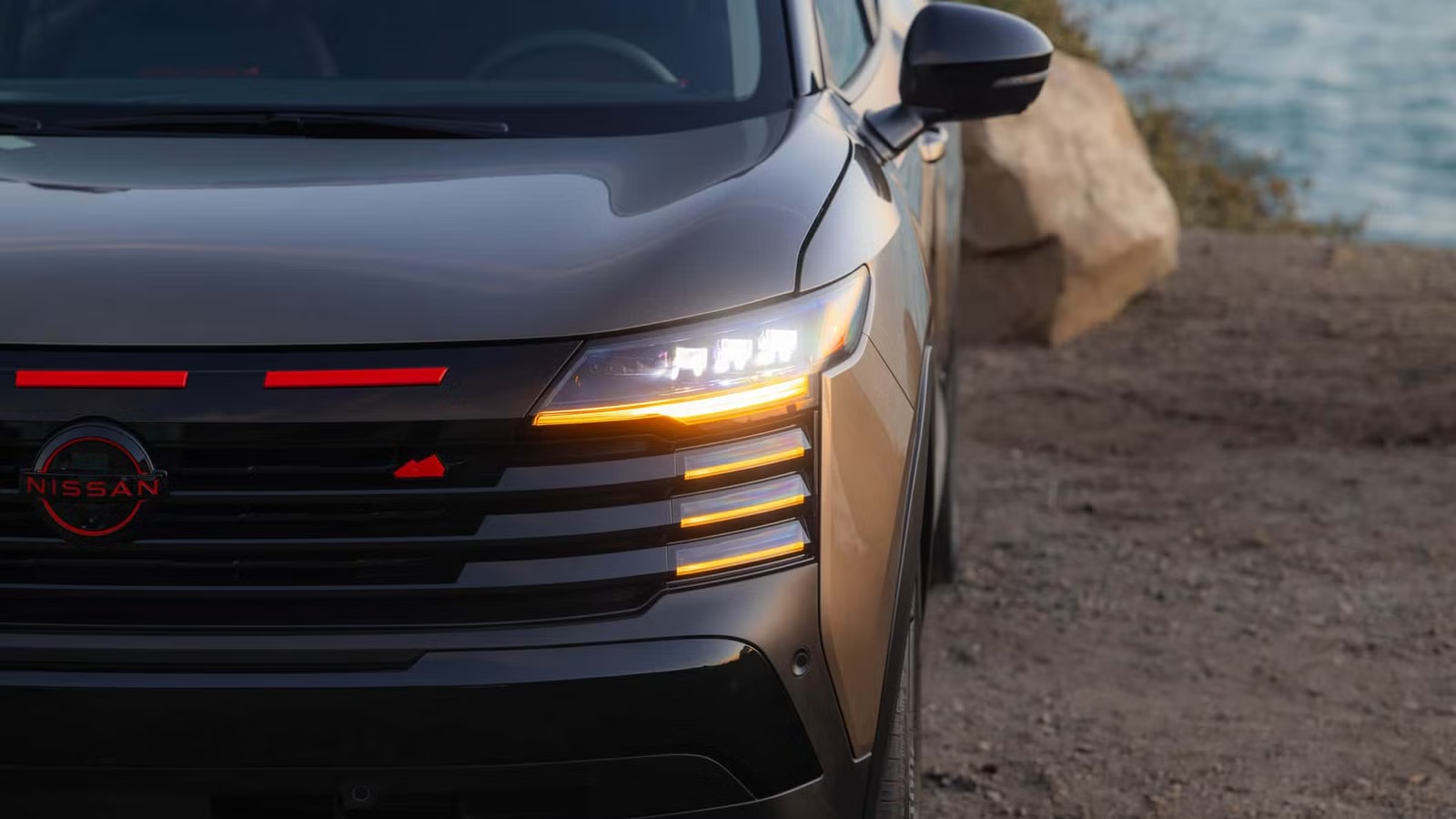
The surprise is the vehicle Nissan chose for the job: the 2027 Kicks Rock Creek. The Kicks sits at the bottom of Nissan’s SUV range, and the normal 2027 lineup starts at just $22,790 before destination, making it the most affordable AWD SUV in America. That claim applies to the Kicks family rather than this loaded Rock Creek version, but it explains why the platform makes sense. Nissan already had a small, cheap crossover with available AWD and 8.4 inches of clearance. Instead of inventing a new trail toy, it simply taught its urban runabout a few dirt-road tricks.
Rock Creek makes those tricks standard. Nissan gives it Intelligent AWD, an exclusive Off-Road mode, and hill-descent control. The special drive setting allows more wheel slip on loose ground, which can help the Kicks carry momentum instead of cutting power just when a driver needs it. Ground clearance measures 8.4 inches, only 0.3 inch below a normal Crosstrek. More tellingly, regular Kicks models already sit that high. The Rock Creek keeps the same basic suspension height and the same 141-horsepower, 140-lb-ft 2.0-liter four-cylinder with a CVT.
The outside gets much harder to confuse with a rental-spec Kicks. Exclusive 17-inch wheels sit beneath the chunky bodywork, while a Rock Creek grille, gloss-black mirrors and trim, more aggressive lower fascias, and amber daytime-running and accent lights give it the familiar modern-adventure look. Nissan adds roof rails and crossbars rated for 165 pounds while the vehicle is moving, enough for the kinds of bicycles, skis, kayaks, or cargo boxes likely to accompany a Kicks into the woods.

Inside, Rock Creek-specific upholstery and orange accents continue the theme. Heated front seats, a heated steering wheel, heated mirrors, Rock Creek floor mats, rear heater ducts, ambient lighting, and Nissan’s HD Intelligent Around View Monitor add real daily value. The camera system may sound like luxury-car fluff until a driver needs to see the rock hiding below the front bumper. Then it becomes money well spent.
Price creates a catch, though. Nissan sets Rock Creek MSRP at $28,840, and its $1,545 destination charge brings the total to about $30,385. A base 2027 Crosstrek costs $26,995 before destination, or $28,470 with Subaru’s listed $1,475 delivery fee. In other words, the Rock Creek lands roughly $1,915 above the cheapest Crosstrek once both destination charges enter the math. It also costs $2,350 more than a Kicks SV AWD.
Nissan Copied The Crosstrek Formula, But Not All Of Its Capability

On paper, Nissan gets remarkably close to the basic Crosstrek brief. Both vehicles deliver standard AWD in the versions under discussion, more than eight inches of ground clearance, hill-descent assistance, terrain-focused drive software, compact bodies, roof-carrying ability, and enough rugged styling to look at home beside a trailhead. The 0.3-inch clearance gap means little for someone whose idea of off-roading involves snow-covered streets, maintained fire roads, grassy festival parking, or a gravel track to a cabin. The truth is tires, surface conditions, driver judgment, and traction programming can matter much more than three-tenths of an inch.
Subaru still starts from a stronger mechanical position. The whole Crosstrek range comes with AWD rather than treating it as an option or an adventure-trim feature. Its standard 2.5-liter flat-four produces 180 hp, giving it 39 hp more than the Kicks’ 141-hp four-cylinder. The Subaru also starts with 8.7 inches of clearance. Neither vehicle aims to pin occupants against their seats, especially with a CVT behind the engine, but the extra Subaru power should matter when the vehicle carries passengers and gear up a grade. The Nissan’s strength sits elsewhere: its small footprint and low-cost roots.

Then there is the Crosstrek Wilderness, which shows how far Subaru can stretch the concept when the trail gets serious. The 2027 Wilderness stands 9.3 inches off the ground and adds taller suspension pieces, Yokohama Geolandar all-terrain tires, underbody protection, revised gearing, a stronger rear differential, improved approach and departure angles, and a 3,500-pound towing rating. Nissan gives the Kicks Rock Creek no comparable lift or all-terrain tires, and no major mechanical overhaul beyond the AWD-related programming and hill-descent feature. That makes the Nissan a soft-roader in the classic sense.

That distinction may actually reveal Nissan’s smarter play. The Rock Creek will never chase a Crosstrek Wilderness through deep ruts to succeed. Most buyers will spend far more time commuting, driving through rain and snow, visiting campsites, carrying bicycles, tackling gravel roads, or reaching trailheads than crawling over rocks. For that life, 8.4 inches of clearance, AWD, an off-road mode, hill-descent control, and a surround-view camera cover a lot of ground.
The Kicks Rock Creek Shows How Valuable Subaru’s Formula Has Become

The strongest compliment to Subaru may come from what other automakers now build. The Crosstrek helped prove that buyers do not necessarily want a hardcore off-roader. Many want a normal small car with AWD, clearance, useful cargo space, roof gear, and enough traction technology to make a rough road feel less risky. Nissan has now taken that recipe to an especially unlikely place: the cheapest SUV in its American lineup.
The Rock Creek cannot dethrone the Crosstrek with pure trail hardware. It sits slightly lower, makes substantially less power, lacks the Wilderness model’s dedicated suspension and all-terrain equipment, and costs more than an entry Crosstrek once destination fees join the party.

Its real strength is familiarity. The Rock Creek takes a crossover that once lived mostly in an urban, value-focused niche and gives it much of the Crosstrek experience: small dimensions, AWD confidence, useful clearance, outdoor styling, roof-carrying hardware, and technology for light trail work. Subaru still has the stronger off-road résumé, Nissan only needs enough of it to make commuters, snow-belt drivers, campers, cyclists, and weekend explorers stop before automatically choosing the Subaru. For the Kicks, getting onto that shopping list may count as conquering plenty of new ground.
Source: Nissan, Subaru

Related posts




Latest Post


No Comments