
Pontiac Once Built A Sports Car So Advanced, It Was Too Expensive To Sell
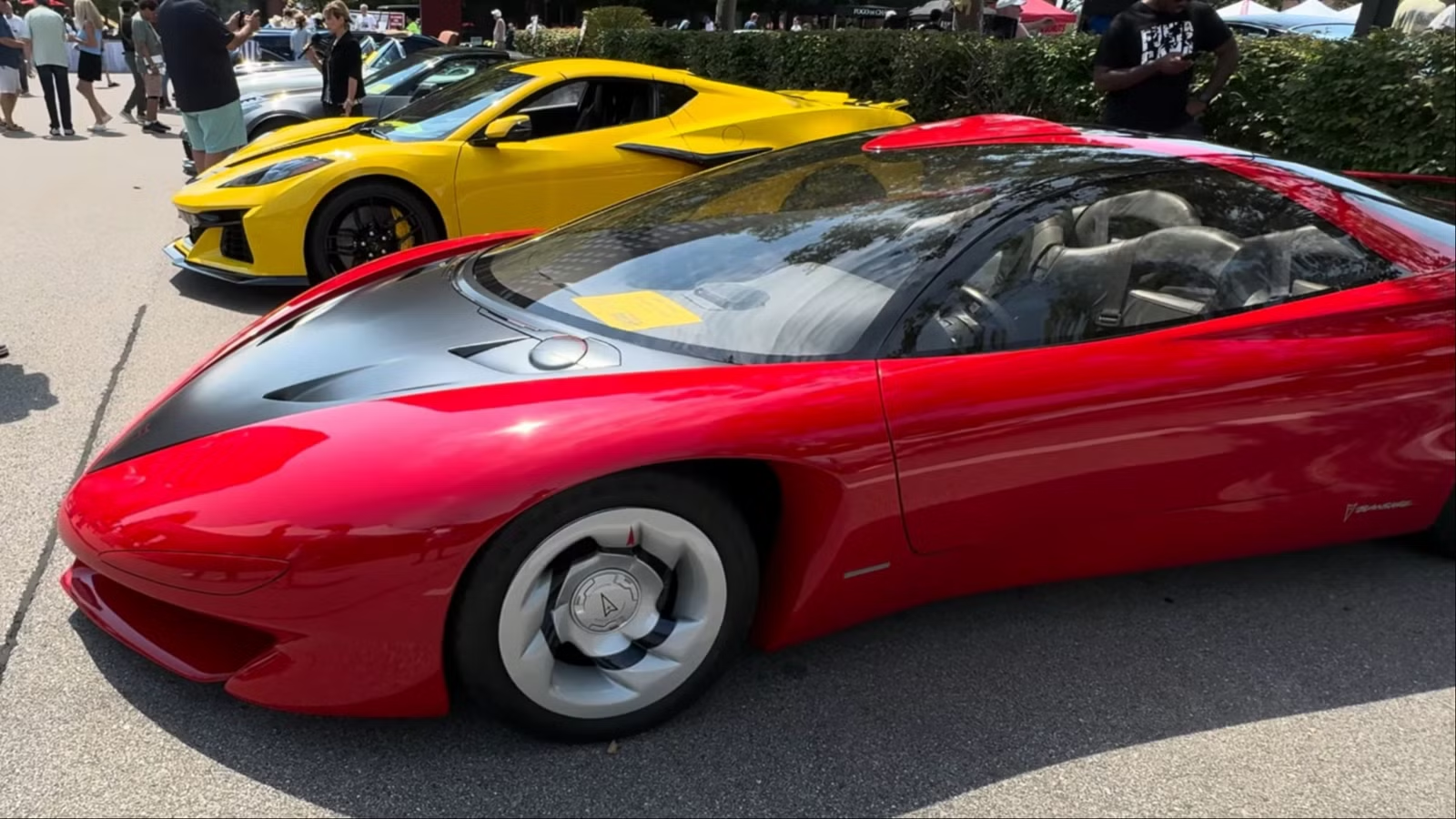
Few automakers have left a void quite like Pontiac. For decades the brand stood apart from its GM siblings as the go-to choice for drivers who wanted genuine excitement — bold styling, real performance, and an identity that felt miles away from the mainstream. Even after the showroom lights went dark for good, Pontiac’s legacy keeps drawing enthusiasts back, and nowhere is that legacy more fascinating than in the concepts the brand built but never sold. For every GTO or Trans Am that became a legend on the street, there was a wilder, forgotten concept car more enthusiasts should know about.

One ’80s Pontiac concept, in particular, was so remarkable that there’s little doubt people would have wanted it the moment it hit the market. Despite that, it never made it out of Pontiac’s factory. Had it been built as close to the concept as possible, it would simply have been too expensive to produce and sell. Everything from the engine to the chassis and the bodywork is utterly weird, unique, and unapologetically Pontiac.
The Pontiac Banshee IV Was Too Advanced For The Roads
Specs
|
Engine |
 76 autotech 4.0-liter V8 |
|
Transmission |
5-speed manual |
|
Power |
230 hp |
|
Torque |
N/A (not readily available) |
|
Drivetrain |
Rear-wheel drive |
Source: Pontiac
The Pontiac Banshee IV is easily one of the wildest concept cars any General Motors brand has ever produced. It’s so striking that there’s no way you can ignore it. It was a chance for Pontiac to push the boundaries of sports car design, and push them it did — in almost every respect imaginable for a car from the late ’80s.
Detailed information on the Pontiac Banshee IV can be hard to come by. Thankfully, a forum commenter compiled a post gathering all the publicly available information they could find about it.
A Design You Simply Can’t Miss

The thing you notice before anything else about the Pontiac Banshee IV is how striking it looks. It’s a classic example of ’80s retro-futuristic design, combining sharp angles with rounded wheelarches and a smoothly shaped cabin. It definitely wouldn’t feel out of place in the world of Blade Runner, Judge Dredd, or Cyberpunk 2077.
As with all concept cars, the design wasn’t supposed to be realistic — it was supposed to be as daring as Pontiac could make it, while still appealing to the general public. The Banshee IV absolutely delivered on that front. Much like the Peugeot Oxia and the Oldsmobile Aerotech, it captured the era’s appetite for futuristic-looking cars perfectly.
The Banshee’s Tech Blew Most Other American Cars Out Of The Water
One of the Pontiac Banshee IV’s biggest talking points was how much technology was packed into it. That became obvious the moment people saw the interior. The driver’s side of the car featured a fighter jet-style heads-up display showing all the most important information — speed, fuel level, and turn indicators — without requiring the driver to glance down at the dashboard. A large visual display also sat in the traditional instrument cluster position, presenting an enlarged rendering of the car’s analog gauges.
The Banshee’s seats, steering column, and pedals were all electrically adjustable, and it even offered memory seats — a feature that many luxury cars of the era hadn’t yet adopted. It also carried a very early navigation system developed by Etak. Rather than relying on satellites, the Etak system used pre-loaded maps stored on magnetic tapes and determined the car’s position by cross-referencing data from an internal compass and sensors on the non-driven wheels against those maps.
The incredibly advanced technology in the Banshee IV meant that if it had ever been produced, it would have commanded a very high price. It incorporated features found only in the most expensive luxury cars of the time — and some that wouldn’t become standard factory equipment for years or even decades to come.
It Had An Odd Engine
One of the quirkiest things about the Pontiac Banshee IV was its engine. It used an all-new dual overhead cam 4.0-liter V8 with an integrated engine block and cylinder head design that eliminated the need for head gaskets entirely.
Because of how unusual this engine was — and the fact that the concept car was electronically limited to 55 mph — it’s difficult to know the Banshee IV’s full performance potential. The quoted output was 230 hp, but torque, 0–60 mph time, quarter-mile performance, and top speed all remain unknown.
The Pontiac Banshee IV’s experimental engine is a major reason it was never put into production. It would have been extremely difficult and costly to manufacture at scale, and it had actually been carried over from a previous abandoned project. Given all of that, it’s easy to understand why neither the Banshee IV nor its unique powerplant ever reached a dealership.
It’s Not The First Banshee Pontiac Tried Making

The Pontiac Banshee IV was the final model in a line of Pontiac concepts sharing the Banshee name. The first Banshee, codenamed the XP-798, appeared all the way back in 1966. It was inspired by the classic European grand touring cars of the day and was powered by the 6.9-liter Pontiac 421 engine. The ultra-sleek Banshee II appeared in 1968, and the Banshee III followed in 1974. The Banshee III had a more conventional design than its predecessors, and its front end closely resembled the versions of the Pontiac Trans Am that came after it.
The Surprising Story Of Its Name
Even the Banshee’s name has an interesting backstory. It was suggested by none other than John DeLorean, muscle car pioneer and creator of the DeLorean DMC-12. The name was drawn from the McDonnell F2H Banshee fighter jet, one of the earliest jet fighters ever developed — which was itself named after the Banshee of Irish mythology.
The Banshee IV In Popular Culture
No doubt thanks to its strikingly futuristic appearance, the Pontiac Banshee IV’s design ended up appearing in quite a few movies and TV shows. Perhaps the most famous example is its use as the basis for the Knight Industries Four Thousand (K.I.F.T.) in the movie Knight Rider 2000. While that wasn’t the actual Pontiac Banshee IV — it was a Dodge Stealth fitted with a custom body by Star Cars Inc. — the design was close enough to the original concept that it’s often treated as the real thing. That Banshee IV replica later appeared in Demolition Man and the TV series Power Rangers: Time Force. The Banshee IV also makes a brief cameo in Back to the Future Part II.
How Did The Banshee IV Influence GM’s Future?
While the Pontiac Banshee IV was never mass-produced, it left a clear mark on the direction General Motors took with its sports cars. The styling of the fourth and final generation of the Pontiac Firebird was heavily influenced by the Banshee IV’s design language, and that influence carried over to the Chevrolet Camaro of the same era as well — not surprising, given that the two cars shared the same platform.
The technology showcased in the Banshee IV also helped steer GM’s product direction. It wasn’t long before top-of-the-line General Motors vehicles began offering features like memory seats and satellite navigation as standard equipment. Several GM models today even carry heads-up displays reminiscent of what the Banshee IV previewed decades earlier.
Sources: Pontiac, pontiactransamforum.com

Related posts





Latest Post


No Comments