
The Diesel That Changed American Pickups Forever
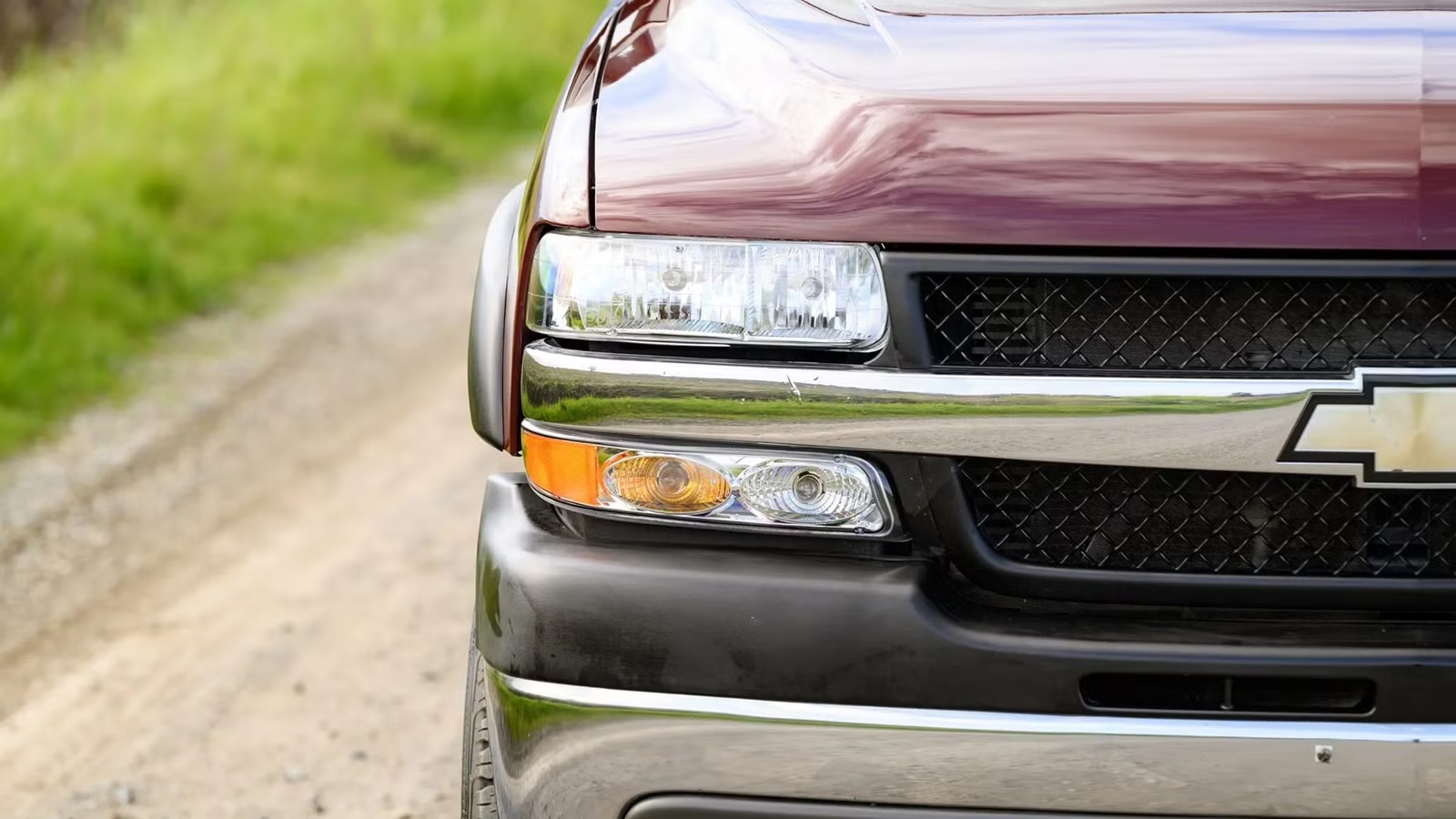
For decades, the American heavy-duty pickup market was defined by a clattering diesel engine. If you needed to tow heavy machinery, pull massive trailers, or haul huge payloads across the country, the choice of an oil-burner came down to its mechanical layout and, most importantly, the manufacturer who produced it.

But at the turn of the 21st century, a quiet crisis was brewing at one of Detroit’s most historic manufacturers. Their existing diesel technology was already outdated and underperforming; as a result, they simply couldn’t keep pace with rivals. The manufacturer had two options: innovate immediately, or prepare to be left out of one of America’s largest segments.
The Blue-Collar Horsepower War That Left An Industry Giant Behind
By the late 1990s, heavy-duty pickups were transitioning from basic agricultural-style vehicles into premium, daily-driven towing machines. No longer did consumers have to deal with slow, agricultural performance. The expectation was of commercial-grade capability combined with passenger-car-like drivability. But in this race, a manufacturer found itself caught under-equipped and underpowered to meet consumer demand.

Their primary heavy-duty diesel offering at the time was already dated, an indirect-injection-style design with roots in a bygone era. This particular engine was outmatched by its competition: Dodge had enthusiasts captivated by the 5.9-liter inline-six Cummins diesel, while Ford was dominating sales volume with the mighty 7.3-liter Power Stroke V8.
The manufacturer’s market share in the heavy-duty diesel segment had fallen to a low of three percent. The financial stakes were massive. Losing the heavy-duty segment meant giving up millions in fleet vehicles and private consumer sales. They had to come up with a solution and come up with it quickly. And an unlikely alliance across the Pacific was the answer to their problem.
A High-Stakes Gamble Across the Pacific Ocean

Fixing this ongoing problem meant that a completely new architectural philosophy was needed. However, starting from scratch was an incredibly expensive, multi-year process. And the clock was running against them. General Motors had a next-gen truck platform scheduled for debut for the 2001 model year, but it required an absolutely class-leading powertrain to claim its position at the top.
General Motors executives made a high-stakes move and reached across the Pacific to establish a 60:40 joint venture with Japanese diesel specialists Isuzu Motors, forming an entity called DMAX Ltd in Moraine, Ohio. The mission was straightforward; it was anything but simple. Leapfrog its competitors in refinement and power, and deliver an engine in just thirty-seven months.
Every existing piece of tooling was discarded to build a new clean-sheet design, with lightweight materials and high-pressure systems that the domestic truck market had never seen before. A lot was riding on this new engine philosophy, and if it didn’t succeed, the truck division at GM could easily have gone under. What happened next was anything but that.
The 6.6-Liter Duramax V8: A 300 HP Diesel Workhorse

In 2001, General Motors revealed the fruits of the global alliance. The 6.6-liter Duramax V8 was code-named LB7. It debuted under the hood of the Chevrolet Silverado HD and GMC Sierra HD. The LBZ Duramax didn’t just bridge the gap to its rivals. It completely redefined the standards of American diesel performance.
Right out of the box, the 6.6-liter V8 produced a class-leading 300 hp at 3,100 RPM and a massive 520 lb-ft of torque at a low 1,800 RPM. It was the fastest engine development program in GM’s history. This engine sent shockwaves through Dearborn and Auburn Hills.
Almost overnight, GM’s heavy-duty diesel market share skyrocketed from a tiny three percent to over thirty percent. Enthusiasts realized this was not another slow, smoky utility engine. Rather, it was a smooth performance engine that happened to be a workhorse. The Duramax secured a spot on Ward’s “10 Best Engines” list for both 2001 and 2002.
2001 Diesel Truck Comparison
|
Engine Metric |
General Motors 6.6L Duramax V8 (LB7) |
Ford 7.3L Power Stroke V8 |
Dodge 5.9L Cummins inline-6 (HO) |
|---|---|---|---|
|
Configuration |
90-degree V8 |
90-degree V8 |
Inline-6 |
|
Block/Head |
Cast Iron/Cast Aluminum |
Cast Iron/Cast Iron |
Cast Iron/Cast Iron |
|
Valve Train |
32-Valve OVH (4 per cylinder) |
16-Valve OVH (2 per cylinder) |
24-Valve OVH (4 per cylinder) |
|
Fuel Injection System |
Bosch High-Pressure Common Rail |
HEUI (Hydraulic Electronic Unit Injection) |
Bosch VP 44 Rotary Injection Pump |
|
Peak Injection Pressure |
23,000 psi |
21,000 psi |
16,000 psi |
|
Aspiration |
Turbocharged |
Turbocharged |
Turbocharged |
|
Horsepower |
300 HP @3,100 RPM |
275 HP @2,800 RPM (-25 HP) |
245 HP @2,700 RPM (-55HP) |
|
Torque |
520 LB-FT @1800 RPM |
525 LB-FT @1,600 RPM |
505 LB-FT @1,600 RPM |
Inside the Engine: Common-Rail Injection Meets Aluminum Engineering

What made the LBZ Duramax special was its cutting-edge technology that its domestic rivals had not yet adopted. Among these advancements was its high-pressure common-rail direct fuel injection system, developed in partnership with Bosch. Competitors were still relying on loud, clattering hydraulic unit injectors.
The Duramax had a gear-driven Bosch CP3 injection pump to feed fuel into a shared rail at 23,000 psi. This allowed for incredibly precise fueling. The result was an engine that started instantly in sub-zero temperatures, eliminated the black smoke at idle, and ran with a quietly refined hum. Furthermore, GM equipped the Duramax with lightweight, high-flowing cast-aluminum cylinder heads atop a rugged cast-iron block. It also featured a 32-valve overhead design with excellent heat dissipation properties.
This newfound power was paired with a commercial-grade Allison 1000 five-speed automatic transmission. Featuring an advanced overdrive system and smart electronic grade braking that downshifted automatically to assist the truck’s brakes on steep descents, this engine-transmission combination offered a modern towing experience that changed how America would haul cargo forever.
Why the Pre-Emissions Icons Remain Unbeatable Today

Today, the early Duramax generations, particularly the LB7 and its highly evolved 2006 descendant, have an iconic status in the truck market. These engines represent a unique sweet spot in automotive history: an era when engines had modern technology and refinement yet were mechanically simple. As these early engines were produced before the implementation of stringent emissions mandates, they lack complex emissions systems such as Diesel Particulate Filters (DPFs) and Selective Catalytic Reduction (SCR) systems that use Diesel Exhaust Fluid (DEF).
Without all these complex modern systems, the early Duramax ran cooler, breathed easier, and had excellent long-term durability. The platform remains famous for its aftermarket support, allowing owners to extract massive torque figures from the engine thanks to its relatively simple nature.
By breaking away from outdated engineering and embracing an advanced, clean-sheet design, the Duramax didn’t just save General Motors’ truck division. It redefined what refinement, capability, and performance meant and raised expectations for how an American engine should feel.
Source: BD Diesel Performance, Track Tech Fasteners, Bring a Trailer, Ford Super Duty

Related posts




Latest Post


No Comments